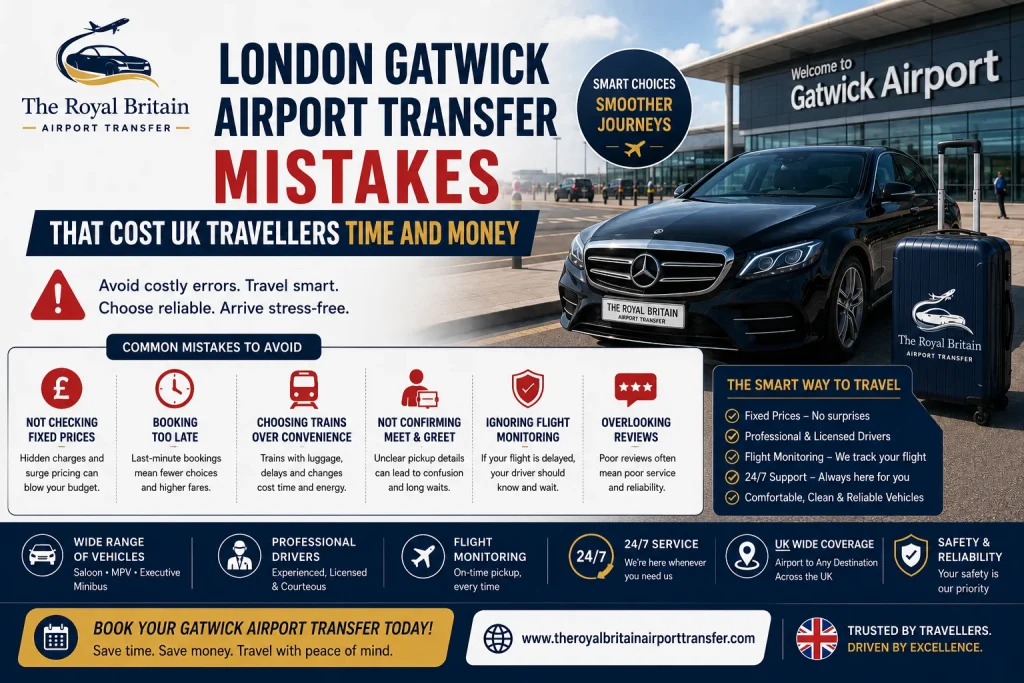
Most London Gatwick Airport Transfer journeys go wrong in small ways rather than dramatic ones. Nobody plans to arrive at the wrong terminal or discover that the vehicle booked three days earlier cannot actually accommodate four suitcases. These problems happen because airport transport often seems simpler than it really is, and the details that matter most are rarely the ones travellers think to check in advance.
Booking a London Gatwick Airport Transfer can be more complicated than many people expect. Gatwick has two terminals separated by a live runway, a railway station serving only one terminal, and a forecourt charging structure that changed significantly at the start of 2026. These factors can easily lead to unnecessary delays, confusion, and extra costs if you are unprepared. Below are the ten most common mistakes that cost UK travellers both time and money, along with practical tips to help you avoid them and enjoy a smoother journey.
Why Small Airport Transfer Mistakes Become Expensive
Airport journeys have almost no slack in them. Most trips absorb a twenty minute setback without consequence. A flight does not. Check in closes, security queues build, and gates shut on a fixed schedule regardless of what happened on the M23.
That is why minor errors compound. A booking made for the wrong terminal is not a five minute inconvenience at Gatwick, because you cannot walk between the two buildings. The cost is rarely the mistake itself. It is what the mistake does to the rest of your timeline.
Mistake One: Booking At The Last Minute
The assumption is that booking late costs more. At Gatwick, the more common outcome is that it costs you the vehicle you actually needed.
Larger vehicles are finite, as are drivers starting at half past three in the morning, which is precisely when many Gatwick departures require a pickup. During school holidays, bank holiday weekends and the summer peak, eight seat vehicles and early slots book out well before saloons do.
What to do instead: arrange your London Gatwick Airport Transfer as soon as your flight is confirmed rather than the week you travel. Availability, not price, is the constraint that bites.
Mistake Two: Ignoring Flight Monitoring
Travellers think of flight monitoring as protection against delays. It matters just as much when a flight lands early, which happens more often than most people expect.
Without it, your booking is tied to the time you typed into a form. Land ninety minutes late and the driver may already have gone. Land forty minutes early and you wait in arrivals for a car that was never told you were coming.
What to do instead: give your flight number at booking, not just a time, and confirm the operator tracks it. Ask specifically how much complimentary waiting time is included after landing, and whether delay waiting is chargeable. Reputable operators will answer both questions plainly.
Mistake Three: Choosing The Wrong Pickup Location
This is the mistake that has become measurably more expensive. Since 6 January 2026, Gatwick charges £10 for up to ten minutes in the forecourt drop off zones at both terminals, then £1 for every additional minute to a thirty minute maximum. That was a rise from £7, and it makes Gatwick the most expensive London airport to drop off at.
The zones are barrierless. Cameras read your number plate, and payment is made online by midnight the day after. Miss the deadline and a £100 penalty charge notice follows, reduced to £60 if settled within fourteen days.
Two things catch people out. The forecourt is a set down area rather than a waiting area, so using it to collect an arriving passenger is an expensive way to wait for a baggage carousel. And the free alternative is rarely mentioned: the Long Stay car parks allow up to two hours at no charge, with a shuttle bus to the terminals.
What to do instead: decide the meeting point before travel day and get it in writing. For arrivals, an arrivals hall meeting is almost always calmer and cheaper than a forecourt one.
Mistake Four: Focusing Only On The Cheapest Price
A quote is only meaningful alongside what it excludes. Two fares twelve pounds apart are frequently not the same product at all.
The exclusions worth asking about are consistent: waiting time after landing, the terminal access charge, additional luggage, child seats, card fees, and what happens if your flight diverts or is cancelled. A low headline price that later adds the forecourt charge, thirty minutes of waiting and a card fee is not a low price.
What to do instead: ask one question of every provider you are comparing. What is not included? The answer, and how quickly it comes, tells you most of what you need to know.
Mistake Five: Forgetting About Luggage Requirements
Vehicle capacity is described in seats, and seats are the wrong unit. Four adults fit comfortably in a saloon. Four adults with four large suitcases and hand luggage do not, and the discovery happens at the kerb with a flight to catch.
Golf clubs, skis, pushchairs and cabin bags that have quietly become checked bags all change the calculation. So does a return leg carrying more than the outbound one, which is what usually happens after a fortnight away.
What to do instead: count large cases first, then people, and declare both accurately. Booking one class larger than you think you need costs a little. Discovering the boot will not close costs considerably more.
Mistake Six: Not Checking The Airport Terminal
Gatwick’s North and South Terminals are roughly a mile apart, separated by the active runway. You cannot walk between them. A free automated shuttle links the two in about two minutes, running around the clock, but allows ten to fifteen minutes door to door once you account for walking and waiting.
The detail that surprises rail travellers most: Gatwick Airport railway station sits beneath the South Terminal only. Gatwick Express, Southern and Thameslink all arrive there. If you are flying from the North Terminal, the shuttle is part of your journey whether you planned for it or not.
Airlines also move between terminals from time to time, so the terminal shown when you booked months ago is not authoritative.
What to do instead: check your boarding pass roughly twenty four hours before departure and pass the terminal to your driver. It takes ten seconds and removes the single most disruptive Gatwick error.
Mistake Seven: Assuming Public Transport Is Always The Best Choice
Gatwick has genuinely good rail links, and pretending otherwise would be dishonest.
The Gatwick Express runs non stop to London Victoria in around thirty minutes, twice an hour, at roughly twenty pounds for a single. Southern and Thameslink cover similar journey times on the same tracks for meaningfully less, with Thameslink serving London Bridge, Blackfriars, Farringdon and St Pancras International directly. Coaches are cheaper again and slower again.
For a solo traveller with hand luggage in daylight, the train is quick, cheap and hard to beat. The arithmetic changes with the company. Rail fares are charged per person while a transfer is charged per vehicle, so four Gatwick Express singles come to close to ninety pounds before anyone has lifted a suitcase onto a train. Timing matters too: Gatwick’s early departures and late arrivals often fall outside the hours when rail and coach services run frequently.
What to do instead: compare per group rather than per person, and factor in the time of day. Take the train when it wins. It often does.
Mistake Eight: Forgetting Child Seat Requirements
Child seat requirements are a legal matter, not a comfort preference, and they cannot be improvised in a car park at five in the morning.
Nor can seats be conjured at short notice. A request made on the day may mean a vehicle substitution, a delay, or a journey that cannot go ahead as booked. Different ages and weights need different seat types, and a note saying “child travelling” is not enough for an operator to fit the right one.
What to do instead: specify the age and weight of each child at the point of booking, and confirm the seat type in your confirmation. Many operators supply seats at no additional charge, but only when told in advance.
Mistake Nine: Not Reading The Booking Confirmation Carefully
Confirmations are skimmed rather than read, and three fields cause almost all the problems. The date is the first: overnight flights land the morning after they departed, and a booking made for the departure date rather than the arrival date is among the most common errors operators see. The direction of travel is the second, since a pickup from the airport and a drop off to it are different bookings entirely. The terminal is the third.
A fourth detail matters for international visitors. The contact number on the booking must work in the United Kingdom on the day. A foreign mobile that cannot receive UK calls is the most frequent reason a driver and passenger fail to find one another in arrivals. A WhatsApp number is a practical alternative.
What to do instead: read the confirmation once, properly, on the day it arrives, while there is still time to correct it without a fee.
Mistake Ten: Choosing An Unlicensed Provider
Private hire vehicles must be booked in advance through a licensed operator. That is a legal requirement rather than an industry convention, and it is the reason a private hire car cannot be flagged down or hired on the spot at a terminal.
Licensing sits with local authorities. Crawley Borough Council licenses operators, drivers and vehicles in the Gatwick area, while other authorities including Transport for London license elsewhere. A licensed vehicle carries a licence plate issued by the authority, and a licensed driver carries a badge. Both should be visible.
This matters practically as well as legally. Licensing brings enhanced background checks, vehicle testing and insurance written for hire and reward. Anyone approaching you inside an arrivals hall offering an immediate ride is, by definition, not operating a booked journey.
What to do instead: book through an operator that publishes its licensing details and confirms the driver and vehicle to you before travel. Companies such as The Royal Britain Airport Transfer make licensing, fixed pricing and flight monitoring visible before you commit, which is the standard worth applying to any provider you consider. Never accept an unsolicited offer of a ride at the terminal.
Expert Tips For A Smooth Airport Journey
- Work backwards from your flight. Decide your terminal arrival time first, then add a realistic buffer for the M23 and M25, then set your pickup.
- Screenshot your booking confirmation. The airport signal is unreliable and your confirmation email is useless if you cannot open it.
- Give the operator a second contact number where possible, particularly for group bookings.
- Treat the return leg as a separate piece of planning. It usually involves more luggage and more fatigue than the outbound one.
- Confirm the meeting point in words, not assumptions. “Arrivals hall, name board” and “outside the terminal” are very different arrangements.
Conclusion
None of these mistakes is complicated, which is exactly why they keep happening. Airport transport gets planned last, in the gaps between booking flights and packing, and the details that matter are easy to skim past.
The travellers who arrive calm are rarely the ones who spent the most. They are the ones who booked early enough to get the right vehicle, gave a flight number rather than a guess at a time, counted their suitcases honestly, checked the terminal the day before, and read the confirmation properly.
For travellers who want the whole journey handled with fixed pricing, licensed drivers, flight monitoring and a meeting point agreed in advance, a professional London Gatwick Airport Transfer removes most of the failure points described above. The Royal Britain Airport Transfer is one option among several worth comparing on those criteria. Whichever you choose, choose it before travel day rather than on it.
Frequently Asked Questions
How much is the Gatwick drop off charge in 2026?
Gatwick charges £10 for up to ten minutes in the forecourt drop off zones at both the North and South Terminals, then £1 for each additional minute up to a thirty minute maximum. The increase from £7 took effect on 6 January 2026. The zones use number plate cameras rather than barriers, so payment is made online by midnight the day after your visit. Missing that deadline results in a £100 penalty charge notice, reduced to £60 if paid within fourteen days. The Long Stay car parks offer up to two hours free with a shuttle bus if you would rather not pay at all.
Which Gatwick terminal is the railway station at?
Gatwick Airport railway station sits beneath the South Terminal only. Gatwick Express, Southern and Thameslink services all arrive and depart from there. If you are flying from or arriving at the North Terminal, you will need the free inter terminal shuttle, which takes about two minutes and runs around the clock. Allow ten to fifteen minutes door to door in practice, since walking and waiting add to the journey. The terminals are separated by the active runway, so walking between them is not possible.
What happens to my transfer if my flight is delayed?
With a properly configured booking, nothing changes for you. The operator monitors your flight number rather than your original booking time, so the driver’s arrival adjusts automatically whether you land early or late. Reputable providers include a waiting time allowance after landing and do not charge for delays outside your control. This is worth confirming explicitly at booking, because it is one of the clearest practical differences between operators quoting similar prices.
How far in advance should I book a Gatwick airport transfer?
Book as soon as your flight is confirmed. The limiting factor is availability rather than price. Larger vehicles are finite in number, and the very early morning slots that Gatwick’s departure schedule demands are the first to go during school holidays, bank holidays and the summer peak. For a saloon on a weekday afternoon, a few days is usually sufficient. For an eight seat vehicle at four in the morning in August, several weeks is more realistic.
How can I check that a Gatwick transfer company is properly licensed?
Ask for the operator’s private hire operator licence number and the licensing authority that issued it. Operators working in the Gatwick area are typically licensed by Crawley Borough Council, though operators licensed by other authorities including Transport for London also serve the airport lawfully on pre booked journeys. Licensed vehicles display a licence plate issued by the authority and licensed drivers carry a badge. A legitimate operator will confirm driver and vehicle details to you before travel. Anyone offering an immediate ride inside the terminal is not operating a booked journey.
Do I need to arrange a child seat in advance?
Yes. Child seat requirements are a legal matter, and the correct seat type depends on the child’s age and weight. Seats cannot reliably be added on the day, since fitting the right one may require a different vehicle. Specify each child’s age and weight when booking and check the confirmation reflects it. Many operators provide seats without an additional charge, but only where the request was made in advance.
Is the Gatwick Express better value than a private transfer?
It depends almost entirely on how many of you are travelling. The Gatwick Express reaches London Victoria in around thirty minutes and is an excellent value for one person with light luggage. Because rail fares are charged per person and a private transfer is charged per vehicle, the comparison shifts as the group grows. Four singles on the Express approach ninety pounds, at which point a fixed price car that collects you from your door becomes competitive on cost as well as convenience.
What should I do if I arrive at the wrong Gatwick terminal?
Take the free inter terminal shuttle immediately and tell your driver or operator where you actually are. The shuttle journey itself is around two minutes, but allows ten to fifteen minutes overall. If you are departing rather than arriving, remember that you will need to clear security at your correct terminal, so the time cost is considerably higher than the shuttle ride suggests. Checking your boarding pass the day before is the simplest way to avoid the situation entirely.
