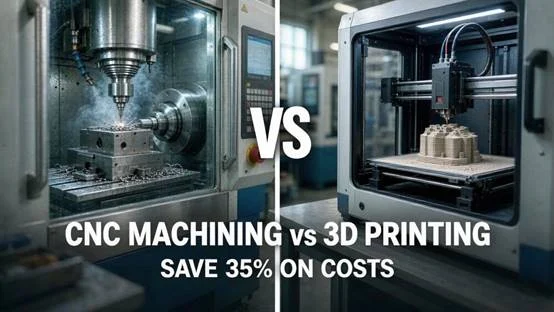
Figure 1: A side-by-side visual comparison of CNC Machining and 3D Printing highlights the fundamental differences between subtractive and additive manufacturing technologies used in modern production.
Introduction
There are several factors to consider when deciding whether to use CNC machining or 3D printing, like part geometric complexity, tolerances (e.g. 0.005 mm), material properties, production volume. Right decision on the method not only saves material by reducing material waste and saving on time by avoiding costly delays but also saves up to 35% on the costs of prototypes and production.
H2: What Is the Fundamental Difference Between Additive and Subtractive Manufacturing?
With additive manufacturing, parts are built up one layer at a time from powder or filament, in subtractive manufacturing, material is taken away from a solid block. The contrast between these two methods not only determines the strength of structures, the finish of surfaces, but also the production cost.
H3: Strength and Surface Quality Contrast
CNC milling creates parts with uniform mechanical properties in all directions since the base material’s original grain structure is preserved. Surface roughness with machine Ra ≤ 0.8 μm can be achieved, which in many cases eliminates the need for secondary finishing. 3D printed parts tend to have a weak spot in the direction of the layers and have a surface roughness (Ra) of 5–15 μm. Functional surfaces need to be further processed after printing.
H3: The Irreplaceable Role of CNC Milling
High precision CNC milling manufacturing are essential for making load-bearing structural components. The knowledge of what is CNC milling enables engineers to grasp that rotating cutting tools not only produce tight tolerances but also ensure the workpiece remains materially solid. The choice between CNC machining vs 3D printing is essentially the one between isotropic strength and precision versus the one between geometric freedom and the absence of directional properties.
Key differences include:
- Resource consumption: CNC cutting produces waste material (which can be recycled). 3D printing consumes just the required amount but often also needs the use of supports.
- Turnaround time: The delivery of simple CNC parts can be in one working day, complex 3D printing pieces may be delivered in several days.
- Part cost: CNC machines have better cost advantages for producing large numbers while 3D printing is most efficient for single or small quantity parts.
Learn how CNC milling manufacturing gives repeatable quality for the most critical specifications.
H2: Which Process Delivers Superior Dimensional Tolerances and Surface Quality?
Dimensionally accurate manufacturing may determine success for vital parts. Usually, CNC machining guarantees the part to meet ±0.005mm tolerance, whereas a best 3D printing can only achieve ±0.1mm at least.
H3: Tolerance Capabilities Compared
By precision tolerance control in CNC milling, a stable rigid structure of the machining unit, thermally controlled operations, and on-the-fly measurement with probing device are combined. Typical achievable tolerances:
| Feature | CNC Milling | 3D Printing (FDM/SLA) |
| Linear dimensions | ±0.005 mm | ±0.1–0.3 mm |
| Hole positions | ±0.01 mm | ±0.2 mm |
| Surface finish (Ra) | 0.4–0.8 μm | 3–15 μm |
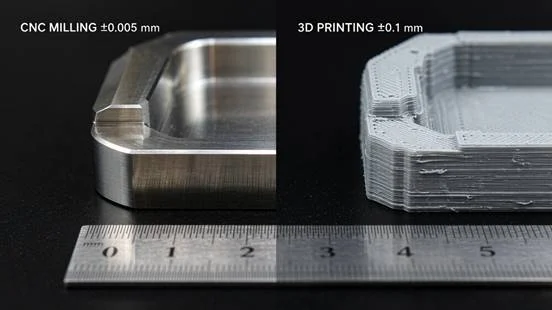
Figure 2: A microscopic view of the edge and surface finish of both manufacturing methods demonstrates the superior dimensional tolerances and smoother surface quality achievable through precision CNC milling compared to standard 3D printing.
H3: Avoiding Confusing Terminology
Engineers often use the terms face milling and end milling to specify the processes they want done. Types of CNC milling cover peripheral milling for slots and face milling for flat surfaces, each having a different cost effect. Knowing the difference allows to implement machining cost optimization by pairing a process capability with a requirement and avoid overkill.
H2: How Do Material Properties and Structural Integrity Compare Across Technologies?
In terms of material properties, there is a fundamental difference between wrought (CNC) and additively manufactured parts. Parts manufactured by CNC machining preserve the mechanical characteristics of the initial blank, while the 3D printed parts show layer-dependent anisotropy.
H3: Mechanical Anisotropy in Printed Metals
6061-T6 aluminum alloy reaches ultimate tensile strength of 310 MPa when it is machined by CNC, while selective laser melted (SLM) variants usually do not exceed 240-280 MPa with lowered elongation. As for stainless steel 316L, the CNC components retain the 580 MPa UTS while the printed ones show the range of 480-530 MPa. The CNC milling process keeps the material’s grain structure which makes it have better fatigue resistance.
H3: Verified Data from LS Manufacturing
Production data from LS Manufacturing show that fine-tuning parameters in the precision CNC milling process can cut the percentage of scrap, 30%, versus the usual machining. Through fine-tuning of various aspects like feed rate, coolant, and tool path strategy, they are able to produce first-pass yields above the 98% level for complex shapes.
H2: When Does 3D Printing Outperform CNC Machining in Rapid Prototyping?
Despite the precision and strength delivered by CNC processes, 3D printing is a better option in certain cases, most of all when it comes to highly unconventional part geometries and very limited quantities.
H3: Cost-Effective Scenarios for Additive Manufacturing
3D printing becomes the preferred choice when:
- Internal conformal cooling channels are required (impossible with standard CNC tooling).
- Batch size is 1–5 pieces and geometry is highly complex.
- Iterative design changes are expected weekly.
Using two methods together in a clever way can save around 35% of the total development cost. CNC milling applications are used to make brackets, housings and precision mounts, CNC milling operations, like drilling and tapping create threaded parts which a 3D printer cannot make accurately.
H3: Hybrid Workflow Example
A complete enclosure: 3D print the starting concept in 24 hours at 50, then produce the final model by CNC machining from 7075 aluminum with a tolerance of 0.01 mm and price per piece at 120 at 500 units. The combination method reduces time-to-market and keeps unit cost in check.
H2: Why Opt for Custom Milling Services for Mid-to-Large Batch Production?
As the volume of parts produced goes up past 50-100, CNC machining turns out to be extremely cheap because of a smaller cost of each additional part and the production rate which is much faster.
Principles of CNC milling reveal that once the machine is set up, producing extra parts only needs the time for cutting, usually just minutes instead of hours on 3D printers. ISO 9001, IATF 16949, ISO 14001, and AS9100D certified facilities guarantee identical quality for thousands of parts without any variance. These quality standards require full material traceability, inspection during production, and final CMM verification.
Getting custom milling services can really reduce total quality risk. At the same time, LS Manufacturing ensures their quality control is top-notch and catches any issues early on. They are able to maintain extremely tight tolerances (±0.005 mm) while machining with 5-7 axes and doing automated probing in their custom milling services even in mass production runs.
Conclusion
Choosing wisely between additive and subtractive manufacturing is not only a matter of cost but more importantly of part geometry assessment and specification of tolerances, volume delivery, from single prototypes to mass production up to 10,000+ units. The integration of 3D printing flexibility at design stage together with the robust strength of CNC machining guarantees product cost-efficiency at every stage of the life cycle.
Engineer teams and purchasing personnel wanting to increase parts quality, reduce lead time and cut supply chain risk should examine supplier certifications for quality management systems such as ISO 9001, IATF 16949, ISO 14001, AS9100D. A product’s manufacturing ability check (DFM) carried out during the early phase, helps in preventing potential production issues thereby making it a guarantee to precision specifications of ±0.005 mm.
FAQs
Is CNC machining always more expensive than 3D printing for prototypes?
Not necessarily. CNC machining can be more cost-effective and time-efficient than 3D printing for small batch production of simple parts and when the surface finish is so stringent that there is no scope for post-processing.
How do cutting parameters directly impact overall machining scrap rates?
Wrong setting of feed rate and cutting speed leads to the tool fastidious wearing and generates heat above 200°C causing dimensional accuracy loss. If cutting conditions are chosen carefully, the tool can be used longer and the parts produced meet the requirements for accuracy.
What role do international management certifications play in component quality?
Certifications including ISO 9001, IATF 16949, ISO 14001, and AS9100D lead to overall quality control, strong environmental compliance, and material traceability, reducing the risk during purchasing.
Which metals are most commonly processed using multi-axis milling?
Aluminium alloys are a frequent choice. Other metals include stainless steel, brass, and titanium. Aluminium is easy to machine where stainless steel and titanium will be more durable under extreme conditions.
Can a part originally designed for 3D printing be transitioned to CNC milling?
If the transition is feasible, it should follow the design for manufacturability (DFM) rules, e.g. Increase tool corner radii, provide adequate cutter clearance, and make it possible for multi-axis tools to reach fully enclosed internal cavities.
About the Author
Written by Gloria Wu, a director of technical support at LS Manufacturing, with over 15 years of deep experience in precision mechanical engineering, multi-axis CNC machining, mold manufacturing, and global supply chain quality management.
