Running a business in Dubai has never been more financially demanding. Between VAT filings, the introduction of Corporate Tax, mandatory digital recordkeeping, and an increasingly watchful regulatory environment, the bookkeeping function has quietly become one of the most critical operational decisions a business owner makes. A few years ago, keeping your books on a spreadsheet or handing a folder of receipts to your accountant once a quarter was acceptable. Today, that approach carries real risk.
Many business owners who invest in bookkeeping advisory services early discover that the way they manage financial records shapes everything else from how quickly they can get a bank loan to how prepared they are when regulators come calling. Yet, a surprising number of Dubai SMEs are still debating a very basic question: should they stick with what they know, or make the move to cloud-based bookkeeping?
That question has a longer answer than most people expect.
Understanding Traditional Bookkeeping
Traditional bookkeeping means recording financial transactions manually through spreadsheets, desktop accounting software, or even physical ledgers. The process typically involves someone entering data by hand, filing paper documents, storing records locally on a computer or hard drive, and generating reports periodically, usually at month-end or year-end.
For years, this worked. Small businesses with low transaction volumes could manage perfectly well with a part-time bookkeeper, a copy of accounting software installed on one machine, and a filing cabinet full of invoices.
The appeal is obvious. It feels familiar. Staff already know the system. There’s no subscription fee. And for business owners who are skeptical of technology, keeping financial data “in-house” on a local machine feels safer than sending it into the cloud.
But familiarity is not the same as efficiency and for growing Dubai SMEs, the gap between the two is getting harder to ignore.
Understanding Cloud Bookkeeping
Cloud professional bookkeeping services store financial data on remote, encrypted servers accessible through any internet-connected device. Platforms like Xero, QuickBooks Online, and Zoho Books are the most widely used examples. Instead of manually entering every transaction, these systems pull data automatically from bank feeds, payment processors, and point-of-sale systems.
The result is a real-time view of your finances without the daily data entry.
Multi-user access means your bookkeeper, accountant, and you can all see the same numbers simultaneously without emailing files back and forth or worrying about who has the latest version. Everything is backed up automatically, access is controlled through permissions, and audit trails are built in from day one.
For a business that is growing, handling multiple revenue streams, or operating across more than one location, this kind of setup stops being a luxury and starts being a necessity.
Cloud Bookkeeping vs Traditional Methods: A Real Comparison
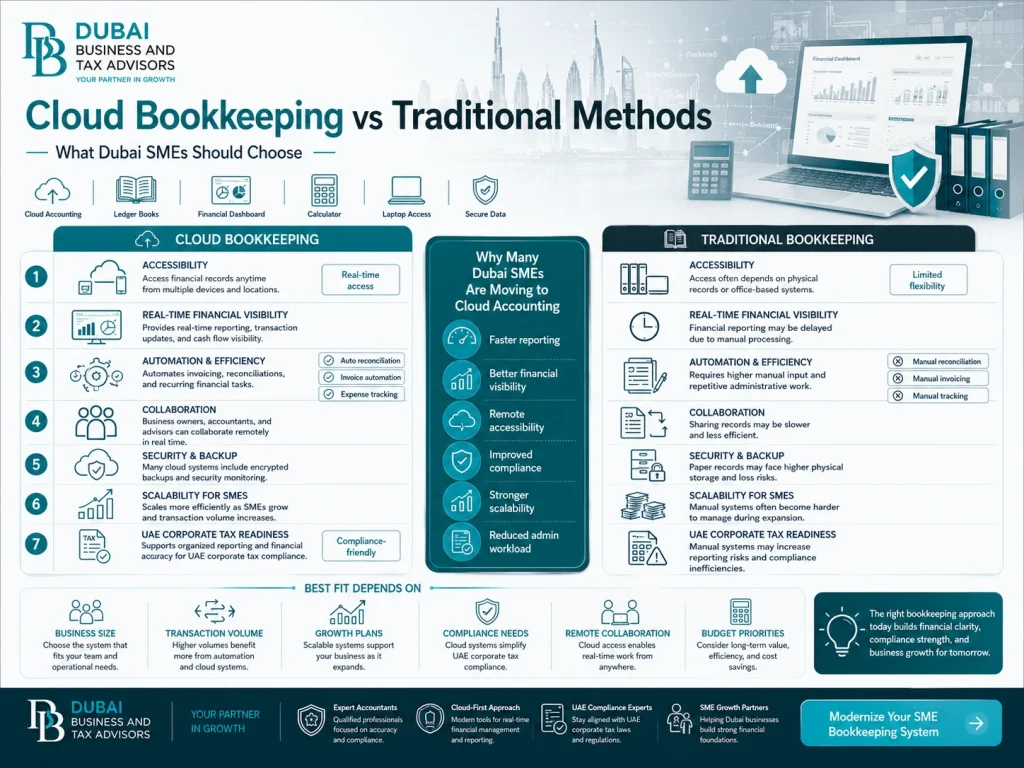
Accessibility
With traditional bookkeeping, financial records live on one computer, in one office. If your bookkeeper is sick, or you are traveling, or you need a figure for an urgent meeting, you are stuck. Cloud systems eliminate that entirely. You can pull up your profit-and-loss statement from your phone while sitting in a client meeting, and so can your advisor.
Data Accuracy
Manual data entry produces manual errors. A misplaced decimal, a duplicate invoice, a categorization mistake these are not hypothetical scenarios. They happen constantly in spreadsheet-based systems, and they compound over time. Automated bank feeds in cloud platforms remove the human from the data entry process entirely. Reconciliation that used to take days can take minutes.
Financial Visibility
Traditional systems produce reports when someone sits down and generates them, which usually happens once a month if you are lucky. Cloud bookkeeping gives you a live dashboard. You can see outstanding invoices, current cash position, upcoming liabilities, and profit margins at any time. That is not just convenient it changes how you make decisions.
Security
Counterintuitively, cloud systems are typically more secure than local storage. A laptop gets stolen. A hard drive fails. A USB stick gets lost. Cloud platforms use enterprise-grade encryption, role-based access controls, and automated backups across multiple servers. Your data is far less likely to disappear or fall into the wrong hands.
Scalability
A business with ten transactions a month and a business with ten thousand monthly transactions need very different systems. Cloud platforms scale with you add users, integrate new tools, manage multiple entities without replacing your entire setup. Traditional systems hit a ceiling quickly once complexity increases.
The Hidden Problems That Show Up Too Late
Many business owners do not realize their bookkeeping system is failing them until something goes wrong: a delayed VAT filing, a failed audit, a cash flow crisis that nobody saw coming.
Spreadsheets look organized. They rarely are. Formula errors propagate silently. Multiple versions of the same file circulate over email. Version control becomes a guessing game. There is no audit trail showing who changed what and when, which is a serious problem when a regulator asks questions.
The real cost of outdated financial processes is not just the time lost on manual work. It is the decisions that get made with incomplete information. When a business owner does not know their actual cash position until three weeks after month-end, they cannot negotiate supplier terms effectively, plan for growth, or spot a problem before it becomes a crisis.
Time loss, opportunity loss, and compliance exposure are the three consequences that tend to arrive together and they all trace back to the same root cause.
Why Are Dubai SMEs Leaving Excel Behind?
Excel is a powerful tool. It is not a bookkeeping system.
Spreadsheets have no automation. Every number is entered manually. There is no connection to your bank, no automatic categorization, no built-in VAT calculation. As transaction volume grows, the risk of error grows proportionally. Managing VAT returns from a spreadsheet when you are processing hundreds of monthly transactions is not just tedious.It is genuinely dangerous from a compliance perspective.
Ask yourself these questions honestly. Are multiple people editing the same file? Are you spending hours reconciling figures that should take minutes? Do you have Corporate Tax obligations you are not entirely sure how to document properly? Is your business expanding into new locations or product lines?
If the answer to any of those is yes, you have outgrown Excel. The question is not whether to change it is when.
The Compliance Reality for Dubai SMEs
When the UAE introduced VAT in 2018 and Corporate Tax in 2023, bookkeeping stopped being a back-office function and became a compliance obligation. The Federal Tax Authority expects accurate, complete, and accessible records. Penalties for non-compliance are not theoretical, they are real and they have been applied.
Recordkeeping under UAE tax law requires businesses to retain financial documents for a minimum of five years. Those documents must be organized, traceable, and available on request. An “I’ll find it eventually” approach to filing does not meet that standard.
Digital recordkeeping directly supports compliance. Cloud platforms maintain searchable, timestamped records. Every transaction links back to a supporting document. VAT reports generate automatically with the correct figures. When a tax period closes, the data is already structured the way an auditor would expect to see it.
What Happens During an Audit?
Auditors look for consistency, completeness, and accuracy. They trace individual transactions back to their source documents. They check that VAT has been applied correctly. They look for gaps, periods with no activity, invoices that do not match, payments that appear without documentation.
Traditional systems often fail this test not because the business did anything wrong, but because the records are disorganized. Missing invoices, manually typed figures that do not match bank statements, reports generated weeks after the fact create questions that take time and money to answer.
Cloud systems maintain a continuous, unbroken log of every transaction, every user action, and every document. When an auditor asks for records from eighteen months ago, you produce them in seconds rather than spending three days digging through folders.
Audit readiness is not something you build in a panic when you receive a notice. It is something that exists naturally when your bookkeeping system is doing its job properly.
Understanding the Real Cost Comparison
The sticker price of a cloud platform subscription is visible. The cost of traditional bookkeeping is not, which is why most business owners underestimate it significantly.
Consider what traditional bookkeeping actually costs. Staff time spent on manual data entry. Software license fees and hardware maintenance. Error correction: finding the mistake, understanding its source, fixing the downstream effects. And then there is the cost of decisions made with delayed information.
Cloud platforms save money through automation. Tasks that previously required hours of manual work happen automatically. Reconciliation, transaction categorization, VAT calculations, report generation these run without human intervention. The productivity gains compounds over time. And better financial visibility means fewer expensive surprises.
For most Dubai SMEs, the honest comparison does not favour traditional methods even on pure cost terms.
Addressing the Common Fears About Switching
What happens to my historical data?Most cloud platforms have well-established migration tools. Historical data can be imported, and good implementation partners will handle the process without data loss. You do not start from zero.
Will the transition disrupt my business?Only if it is managed poorly. A phased implementation, proper staff training, and a clear cutover date minimizes disruption. Businesses switch accounting systems regularly. It is a solved problem.
The software looks complicated.Modern cloud platforms are built for business owners, not accountants. The interfaces are clean, the onboarding is structured, and most platforms offer substantial training resources. The learning curve is shorter than most people expect.
I don’t trust putting my data in the cloud.Bank-grade encryption, multi-factor authentication, role-based access controls, and automated backups across geographically distributed servers. Your data is safer on a reputable cloud platform than it is on a local hard drive.
How Better Financial Data Changes Decision-Making?
There is a difference between having financial data and understanding what it means.
Recording transactions is the starting point. Making decisions based on those records managing cash flow, controlling costs, planning expansion requires insight, not just information. Business owners who can see their financial position clearly, in real time, make better decisions. That sounds obvious, but the practical difference is substantial.
A business owner who checks their cash flow weekly will catch a problem months before it becomes a crisis. A business that tracks project profitability in real time knows where to focus resources. A company expanding into a new market can model the financial impact before committing, rather than discovering it after the fact.
This is where professional bookkeeping advisory services become genuinely valuable. The platform provides the data. The advisor helps you understand what it is telling you and what to do about it. That combination, accurate real-time records plus experienced financial guidance, is what separates businesses that grow from businesses that struggle.
Is Cloud Bookkeeping Right for Every Business?
Honestly, no but the category of businesses where traditional methods still make sense is narrowing.
A sole trader with twenty monthly transactions, no VAT registration, and no plans to grow may not need a cloud platform. Simple structures with minimal complexity can still function with basic software or even a spreadsheet.
But the moment a business has VAT obligations, employees, multiple revenue streams, plans for expansion, or any meaningful transaction volume, the case for cloud bookkeeping becomes very strong.
Growing SMEs, service businesses with recurring client invoicing, retail operations, e-commerce companies, and any business operating across multiple locations will see immediate, tangible benefits from making the switch.
The decision comes down to a few honest questions. How fast is the business growing? How complex are the transactions? How important is real-time financial visibility? How prepared does the business need to be for compliance? The answers will point clearly in one direction for most Dubai SMEs.
The Future of Financial Management in Dubai
The direction of travel is clear. The UAE government has been explicit about its commitment to digital finance infrastructure. The Federal Tax Authority has invested heavily in digital reporting systems. Regulatory expectations around digital recordkeeping will only increase, not decrease.
Artificial intelligence is already embedded in modern cloud accounting platforms automating categorization, flagging anomalies, generating forecasts. Businesses that are already operating on cloud infrastructure will adopt these capabilities naturally. Those still working from spreadsheets will face a much larger transition at a much more pressured time.
Future-ready businesses are not waiting for regulations to force the change. They are building the financial infrastructure now that will support growth, compliance, and strategic decision-making for years ahead.
Frequently Asked Questions
Is cloud bookkeeping safe for storing sensitive financial data?
Many Dubai SME owners worry about data security when moving away from local storage. Reputable cloud bookkeeping platforms use bank-grade encryption, multi-factor authentication, and role-based access controls. Your data is actually more secure on a well-maintained cloud server than on a laptop that can be stolen or a hard drive that can fail. The key is choosing a platform with a strong security track record and ensuring your team follows proper login hygiene.
How does cloud bookkeeping help with UAE VAT and Corporate Tax compliance?
UAE tax obligations require accurate, organized, and readily accessible records. Cloud platforms automate VAT calculations, generate compliant reports, and maintain a full audit trail for every transaction. When a filing deadline arrives, the figures are already structured correctly rather than assembled manually at the last minute. For Corporate Tax, the same principle applies: your records are always current, traceable, and ready for review.
What happens to my existing financial records if I switch to cloud bookkeeping?
Historical data does not disappear when you migrate. Most cloud platforms have established import tools that bring across existing records from desktop software or spreadsheets. A proper migration plan ideally supported by an experienced advisor ensures continuity without data loss. Many businesses run both systems briefly in parallel during the transition to verify accuracy before fully cutting over.
Can a very small Dubai business justify the cost of cloud bookkeeping?
For a sole trader with minimal transactions and no VAT registration, a basic spreadsheet may still suffice in the short term. But the moment VAT obligations, employees, or growth plans enter the picture, the cost calculus changes quickly. Cloud platform subscriptions start at affordable monthly rates, and the time saved on manual processing alone typically outweighs the fee. Factor in reduced compliance risk and the cost becomes even easier to justify.
Does switching to cloud bookkeeping mean I no longer need an accountant or bookkeeper?
No,and this is one of the most common misconceptions. Cloud platforms handle data entry, organization, and reporting. What they cannot do is interpret that data strategically, advise on tax planning, spot financial risks before they become problems, or guide decisions around growth and compliance. An experienced bookkeeper or advisor working alongside a cloud system delivers far more value than either could alone. The platform handles the mechanics; the advisor handles the judgment.
Conclusion
For most Dubai SMEs dealing with VAT, Corporate Tax, and tightening compliance requirements, traditional bookkeeping methods are becoming a liability rather than a safety net. The right system grows with your business, keeps you compliant, and gives you the financial clarity to make confident decisions.
Dubai Business & Tax Advisors work with SMEs across Dubai to assess their current setup, close compliance gaps, and implement cloud solutions that fit how their business actually operates from initial migration through to ongoing tax filings.
The best time to make the move is before the pressure forces the decision.
