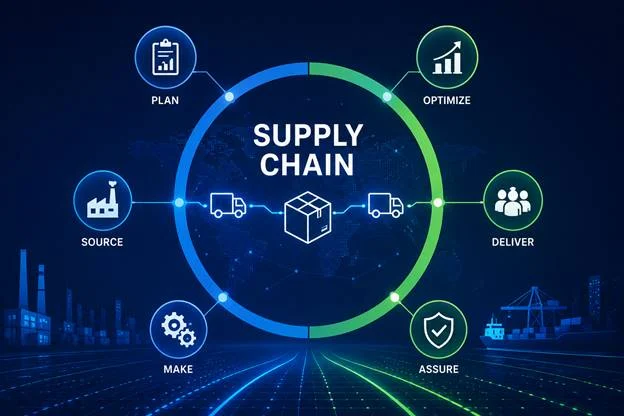
Supply chain leaders are under pressure to improve resilience, control costs, optimize working capital and respond faster to changing customer demand. Generative AI in Supply Chain is creating new opportunities to address these priorities by improving access to operational knowledge, accelerating analysis and supporting decisions across planning, sourcing, manufacturing and logistics. Yet implementing AI does not automatically create financial value.
AI ROI provides a framework for determining whether AI investments are delivering sufficient operational and financial returns. By connecting use cases to specific supply chain performance measures, organizations can prioritize the opportunities with the strongest value potential and make more informed decisions about where AI should be scaled.
This article explores Generative AI in Supply Chain, how organizations can evaluate AI ROI, key use cases, business benefits and the practices required to translate AI capabilities into sustainable supply chain value.
What is Generative AI in Supply Chain?
Generative AI in Supply Chain refers to the application of generative artificial intelligence across supply chain processes and decision-making. These capabilities can interpret natural language, summarize operational information, generate reports and help employees interact with complex supply chain data more intuitively.
Supply chain teams can use generative AI across demand planning, inventory management, supplier management, manufacturing, logistics and risk management.
Unlike traditional analytics, which typically presents predefined reports or dashboards, generative AI can synthesize information from multiple sources and provide contextual explanations that help employees understand changing business conditions.
What is AI ROI?
AI ROI measures the value created by an artificial intelligence investment relative to the costs required to implement and operate it. For supply chain organizations, value can include financial savings, productivity improvements, working capital benefits, service improvements and risk reduction.
The cost side should extend beyond software licenses. Organizations also need to consider data preparation, technology integration, infrastructure, implementation, governance, employee training and ongoing model management.
A comprehensive AI ROI assessment gives leaders a more realistic understanding of whether an AI initiative is creating sufficient value to justify continued investment.
Why AI ROI matters for supply chain investments
Supply chains contain numerous potential AI applications, but organizations rarely have the resources or management capacity to implement all of them simultaneously.
Without a value framework, teams may prioritize use cases based on technical novelty rather than business impact.
AI ROI helps leaders compare opportunities according to expected value, implementation cost, feasibility, risk and time to value. This enables organizations to direct resources toward applications most likely to improve supply chain performance.
For Generative AI in Supply Chain, this discipline becomes particularly important as organizations move from small experiments toward enterprise-scale implementation.
Core technologies supporting generative AI in supply chain
Generative AI works alongside several complementary technologies.
Large language models
Large language models allow employees to ask questions, retrieve information and receive contextual responses using natural language.
Machine learning
Machine learning analyzes historical and real-time operational data to identify patterns across demand, suppliers, inventory and logistics.
Predictive analytics
Predictive analytics helps organizations anticipate demand changes, supply constraints and operational risks.
Intelligent automation
Automation executes repetitive workflows and approved actions, while generative AI can support activities requiring interpretation and knowledge retrieval.
AI agents
AI agents can potentially coordinate multistep activities across planning, procurement, manufacturing and logistics while escalating strategic or high-risk decisions for human review.
Together, these technologies expand the potential of Generative AI in Supply Chain beyond individual productivity tools.
Key use cases of Generative AI in Supply Chain
Organizations can apply generative AI across multiple supply chain activities.
Demand planning
Generative AI can summarize forecast changes, explain potential demand drivers and help planners interpret complex planning information more quickly.
Supplier management
AI can summarize supplier information, contracts and performance data, helping teams understand potential issues and commercial implications.
Inventory management
Generative AI can explain inventory positions, highlight exceptions and help planners understand the factors affecting inventory requirements.
Manufacturing
AI can summarize production information, technical documentation and maintenance knowledge to support faster operational problem-solving.
Logistics
Generative AI can synthesize transportation information, explain delays and help teams evaluate potential responses to logistics disruptions.
Supply chain risk management
AI can consolidate information about suppliers, markets and operations to provide contextual summaries of emerging risks.
These applications demonstrate how Generative AI in Supply Chain can support both productivity and decision-making.
Where AI ROI can come from
The economic value of supply chain AI can emerge through several performance levers.
Improved employee productivity
AI can reduce time spent searching for information, preparing reports and analyzing routine operational issues.
Lower inventory costs
Better decision support can help organizations improve inventory positions and reduce unnecessary working capital.
Reduced operating costs
Automation can reduce manual work across planning, procurement, logistics and administrative processes.
Better service performance
Faster access to information and improved decisions can support product availability and more reliable customer fulfillment.
Risk avoidance
Earlier identification of potential supply or operational disruptions can give organizations more time to respond and potentially reduce financial impact.
These benefits should be translated into financial or operational measures wherever possible when calculating AI ROI.
How to measure AI ROI in supply chain
Organizations should establish a clear performance baseline before implementing AI. Without a baseline, it is difficult to determine whether observed improvements resulted from the technology.
Relevant measures may include:
- Planning productivity and cycle time.
- Forecast quality.
- Inventory levels and carrying costs.
- Working capital.
- Logistics and transportation costs.
- Supplier performance.
- Service levels and fulfillment performance.
- Production downtime.
- Exception resolution time.
- Cost or loss avoidance.
The appropriate metrics depend on the use case. A generative AI application supporting planners should be evaluated differently from one designed for supplier risk management.
Moving from productivity gains to financial value
One challenge in evaluating Generative AI in Supply Chain is converting employee time savings into realized economic benefits.
Reducing the time required to prepare a planning report does not automatically reduce operating costs. Organizations need to determine how the released capacity will be redeployed.
Teams may use that capacity to manage more products, suppliers or markets without increasing headcount. Employees may also spend more time on scenario planning, supplier collaboration or resolving high-value exceptions.
AI ROI should therefore measure both the immediate productivity improvement and how that improvement translates into actual business performance.
Best practices for improving AI ROI
Organizations can strengthen returns by applying a disciplined approach to AI investment:
- Start with specific supply chain problems rather than individual AI technologies.
- Establish baseline performance before implementation.
- Prioritize use cases based on value, feasibility and time to value.
- Include data, integration, infrastructure and governance costs in the investment case.
- Integrate generative AI into existing supply chain workflows.
- Define ownership for realizing expected financial and operational benefits.
- Maintain human accountability for strategic and high-risk decisions.
- Measure actual performance against the original business case.
- Scale successful use cases and reconsider initiatives that consistently underperform.
This approach helps organizations manage Generative AI in Supply Chain as an investment portfolio rather than a collection of technology experiments.
Common challenges in realizing AI ROI
Fragmented supply chain data can increase implementation costs and reduce AI effectiveness. Information may be distributed across ERP, planning, procurement, manufacturing and logistics systems.
Another challenge is attributing performance improvements directly to AI when multiple transformation initiatives are occurring simultaneously. Clear baselines and use-case-specific KPIs can improve measurement.
Organizations can also overestimate AI ROI by counting theoretical productivity savings that never translate into financial or operational value.
Finally, ongoing expenses for security, governance, model monitoring and technology infrastructure need to remain part of the ROI calculation after implementation.
The future of Generative AI in Supply Chain
Generative AI in Supply Chain is likely to evolve from conversational assistance toward intelligent workflow orchestration. AI agents may increasingly coordinate activities across demand planning, procurement, inventory and logistics while interacting with multiple enterprise systems.
This could increase AI ROI by extending value from individual tasks to broader end-to-end processes. However, more autonomous capabilities will also introduce additional costs and governance requirements.
Organizations will therefore need to evaluate agentic AI using the same value discipline: whether the additional autonomy creates sufficient financial and operational benefits relative to cost and risk.
Conclusion
Generative AI in Supply Chain can improve how organizations access information, analyze operational conditions and support decisions across increasingly complex supply networks. But the number of AI capabilities deployed is not a meaningful measure of transformation success.
AI ROI provides the financial and operational discipline required to determine which investments are creating genuine value. Organizations that establish clear baselines, account for total costs and connect AI improvements to supply chain performance will be better positioned to scale the right capabilities.
The long-term opportunity is to build a more intelligent supply chain while ensuring every AI investment contributes to stronger productivity, resilience, working capital and enterprise performance.
