Artificial intelligence is evolving from specialized tools into increasingly sophisticated systems capable of understanding language, generating content and supporting complex business processes. The Large Language Model has become an important part of this shift, enabling organizations to build conversational applications, knowledge assistants, content-generation tools and intelligent workflows.
At the same time, AI development is becoming more focused on connecting these models with enterprise data, applications and business processes. Organizations are no longer evaluating AI only for experimentation; they are looking for practical applications that can improve productivity, decision-making and service delivery.
This article explores how Large Language Model technology supports AI development, its enterprise applications, business benefits, implementation considerations and the future of intelligent applications.
What is a Large Language Model?
A Large Language Model, commonly known as an LLM, is an artificial intelligence model designed to understand and generate human language. These models are trained on extensive amounts of text and learn patterns in language that enable them to predict and generate sequences of words.
An LLM can perform tasks such as summarizing documents, answering questions, generating content, translating text and assisting with software code.
Unlike traditional rules-based software, a Large Language Model can work with natural-language instructions and adapt its responses according to context. This flexibility makes LLM technology useful across a broad range of enterprise applications.
What is AI development?
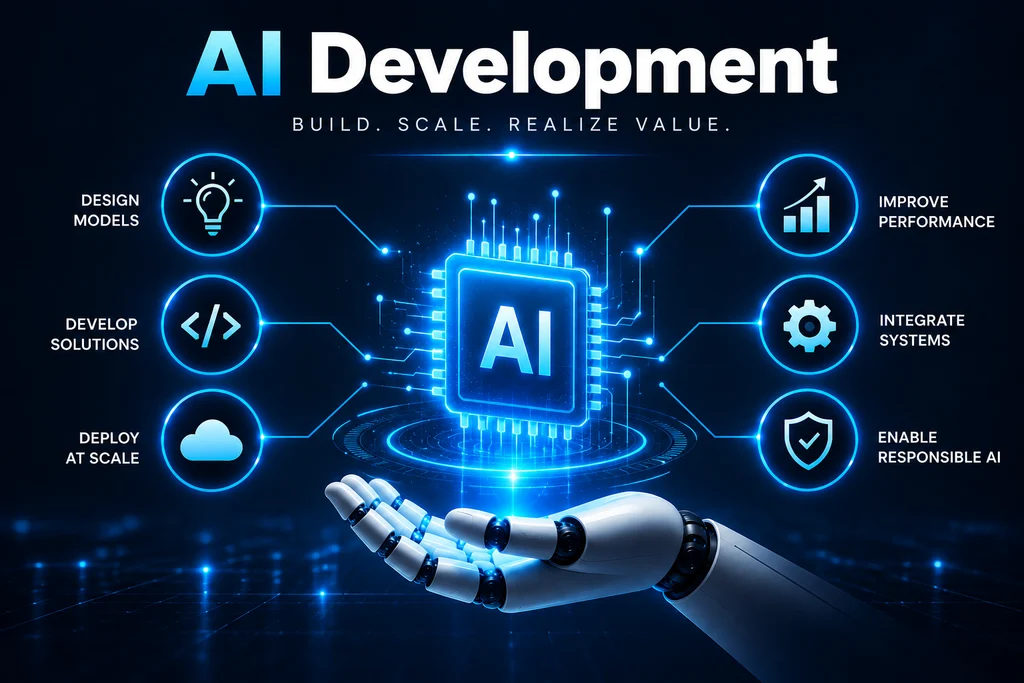
AI development is the process of designing, building, integrating and maintaining artificial intelligence applications and capabilities. It can include machine learning models, generative AI applications, intelligent automation, predictive analytics and AI agents.
Modern AI development involves more than training a model. Organizations also need to consider enterprise data, architecture, application integration, security, governance, testing and user experience.
When an organization builds an LLM-powered application, for example, developers need to determine how the model will access relevant information, what actions it can perform and how its outputs will be evaluated.
How Large Language Models support AI development
Large Language Models provide a flexible intelligence layer that developers can integrate into enterprise applications.
Instead of building separate language-processing logic for every use case, AI development teams can use LLM capabilities for activities such as summarization, classification, information extraction and conversational interaction.
Developers can also connect models with enterprise knowledge sources so employees receive responses based on organizational information rather than relying solely on a model’s general training.
This enables businesses to develop AI applications that address specific processes while using natural language as the primary interface.
Core capabilities of a Large Language Model
Several capabilities make LLM technology particularly relevant for enterprise applications.
Natural-language understanding
An LLM can interpret questions, instructions and documents written in everyday language, reducing the need for rigid user interfaces.
Content generation
Models can generate reports, summaries, emails, documentation and other business content based on user instructions and available information.
Information extraction
Large Language Models can identify and structure relevant information from documents, contracts and other unstructured content.
Summarization
LLMs can condense lengthy documents, conversations and reports into shorter summaries that help employees process information faster.
Code assistance
Models can generate, explain and document software code, supporting developers throughout the software development lifecycle.
These capabilities allow AI development teams to address a wide range of knowledge-intensive processes.
Key enterprise applications of Large Language Models
Organizations can integrate LLMs across multiple business functions.
Enterprise knowledge management
A Large Language Model can provide conversational access to policies, procedures, technical documentation and other enterprise knowledge.
Customer service
LLM-powered assistants can answer routine questions, summarize customer interactions and provide service representatives with relevant information.
Finance
AI applications can summarize financial information, support management reporting and improve access to finance policies and documentation.
Human resources
Large Language Models can support employee self-service, HR case management, recruiting communications and learning content.
Procurement
LLMs can summarize contracts, assist with sourcing documentation and make procurement knowledge easier to retrieve.
Information technology
Models can support software development, technical documentation, incident management and technology knowledge retrieval.
These applications demonstrate how Large Language Model technology can become part of broader enterprise AI development.
The role of enterprise data in AI development
An LLM becomes more useful to an organization when it can work with relevant, reliable and appropriately governed enterprise information.
Many business applications therefore connect models with internal knowledge repositories, databases or enterprise systems. Retrieval techniques can allow an application to find relevant information and provide it to the model when generating a response.
This can improve contextual relevance without requiring the organization to train an entirely new model for every application.
However, data quality remains critical. Incomplete or outdated information can result in unreliable responses even when the underlying model is highly capable.
Business benefits of Large Language Models
When implemented against clearly defined use cases, LLM technology can improve several dimensions of business performance.
Greater employee productivity
Large Language Models can reduce time spent searching for information, preparing routine content and completing repetitive knowledge work.
Faster access to information
Conversational interfaces can make complex enterprise knowledge easier for employees to find and interpret.
Improved scalability
AI-powered applications can support increasing service or information requests without proportional growth in manual work.
Faster software development
LLMs can assist developers with coding, testing and documentation, potentially increasing development capacity.
Better service experiences
Conversational AI can provide employees and customers with faster access to information while directing complex issues to specialists.
Best practices for Large Language Model development
Successful AI development requires more than connecting an application to an LLM. Organizations should establish a structured approach.
- Start with a clearly defined business problem and expected outcome.
- Select models based on use-case requirements rather than size alone.
- Connect applications with reliable and governed enterprise data.
- Establish clear controls over what information models can access.
- Test outputs across realistic business scenarios before deployment.
- Maintain human review for sensitive and high-impact decisions.
- Monitor model performance after implementation.
- Establish security, privacy and responsible AI governance.
- Measure whether applications improve productivity, service quality or other business KPIs.
These practices help organizations build LLM applications around measurable business value rather than technical novelty.
Common challenges in AI development
Large Language Models can generate responses that sound credible even when information is incomplete or incorrect. Applications therefore need appropriate validation and grounding mechanisms.
Security presents another challenge. Enterprise AI applications may interact with confidential customer, employee, financial or technical information, making access controls essential.
Cost and performance also require attention. Larger models can require greater computing resources, while some applications may perform effectively using smaller or specialized models.
Integration with legacy systems can create additional complexity when AI applications need information or actions from existing enterprise platforms.
AI development teams need to consider these factors throughout design and implementation.
Large Language Models and AI agents
AI agents represent an important evolution in enterprise AI development. While a conventional LLM application primarily responds to user prompts, an agent can use a model to interpret objectives, plan activities and interact with tools or enterprise systems.
For example, an agent might receive a service request, retrieve relevant information, determine the required workflow and initiate an approved action.
The Large Language Model can provide language understanding and reasoning capabilities, while other components handle enterprise data access, workflow execution and governance.
This architecture expands the role of LLMs from content generation toward more action-oriented AI applications.
Measuring the value of AI development
Successful AI development should be evaluated through business outcomes rather than model performance alone.
Organizations can measure productivity, process cycle time, service resolution, operating costs, user satisfaction and other metrics relevant to the application.
A knowledge assistant, for example, could be evaluated based on reductions in information search time. An AI development assistant might be measured through software delivery productivity.
Establishing performance baselines before deployment helps organizations determine whether the application is generating meaningful value.
The future of Large Language Models and AI development
The future of AI development is likely to involve a wider range of models rather than relying on a single LLM for every task. Organizations may combine large general-purpose models with smaller, specialized models based on performance, cost, privacy and latency requirements.
Multimodal models will also enable AI systems to work across text, images, audio and other types of information.
AI agents will further expand these capabilities by connecting models with enterprise applications and workflows.
As these technologies mature, AI development will increasingly focus on orchestration: determining which models, data sources, tools and agents should work together to complete a business process effectively.
Conclusion
Large Language Model technology is expanding what organizations can build with artificial intelligence by providing flexible capabilities for understanding language, generating content and interacting with enterprise knowledge. Its value, however, depends on how effectively these capabilities are integrated into business processes and technology environments.
AI development provides the framework for turning LLM capabilities into practical enterprise applications. Organizations that combine appropriate models with reliable data, strong governance and clear business objectives will be better positioned to build scalable AI solutions that improve productivity, service delivery and enterprise performance.
