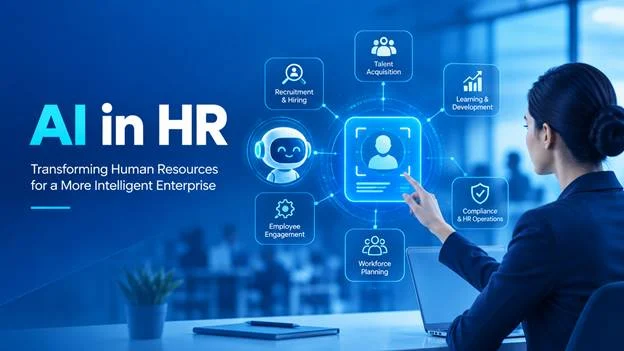
Artificial intelligence is changing how organizations attract talent, support employees, manage workforce data, and deliver HR services. AI in HR enables organizations to automate repetitive activities, generate insights from workforce data, improve employee experiences, and support faster decision-making. As human resource management becomes increasingly data-driven, AI is becoming an important capability for modern HR organizations.
How AI Is Changing Human Resources
AI can help HR teams move beyond administrative processes toward more strategic and predictive workforce management. From recruitment and employee support to workforce planning and talent development, intelligent technologies can help organizations improve efficiency while giving HR professionals more time to focus on higher-value priorities.
Improving HR Operations
AI can streamline HR operations by automating repetitive activities such as employee inquiries, document processing, data analysis, scheduling, and routine administrative tasks. This allows HR teams to reduce manual effort, improve processing speed, and provide more consistent services across increasingly complex organizational environments.
Supporting HR Leaders With Better Insights
For HR leaders, AI can provide faster access to workforce insights by analyzing employee data, organizational trends, skills information, and operational metrics. These insights can support workforce planning, talent decisions, cost optimization, and strategic discussions while helping leaders respond more effectively to changing business needs.
AI Applications Across HR Functions
The potential of AI for HR extends across recruitment, onboarding, employee services, learning, performance management, workforce planning, and talent analytics. By applying AI to specific processes, organizations can improve efficiency and decision-making while creating more personalized experiences for employees and managers.
Smarter Recruitment and Talent Acquisition
AI can help HR teams analyze job requirements, identify relevant candidates, automate screening activities, and support interview preparation. Intelligent capabilities can reduce administrative workload and accelerate recruitment processes while helping recruiters focus more of their time on candidate engagement, assessment, and strategic talent decisions.
Enhancing Employee Experience
AI-powered HR solutions can provide employees with faster access to policies, benefits information, organizational knowledge, and routine support. Conversational interfaces and intelligent search can help employees find answers without navigating multiple systems, creating a more responsive experience while reducing the workload placed on HR support teams.
Supporting Learning and Development
AI can analyze skills, career interests, job requirements, and learning histories to recommend relevant development opportunities. Personalized learning experiences can help organizations address skills gaps, support internal mobility, and create more targeted workforce development programs aligned with evolving business and technology requirements.
AI Tools and Intelligent Capabilities for HR
Organizations have access to a growing range of AI tools for HR, including generative AI, predictive analytics, conversational assistants, intelligent automation, and workforce analytics platforms. Selecting appropriate technologies requires organizations to consider business objectives, data quality, integration requirements, governance, security, and employee needs.
Using AI Agents for HR
AI agentsfor HR can perform multi-step activities with limited human intervention, such as responding to employee requests, gathering information, initiating workflows, and coordinating routine HR processes. These capabilities can help HR departments improve responsiveness while allowing employees to focus on complex issues requiring human judgment.
Improving Workforce Planning
AI can analyze workforce trends, organizational structures, skills data, attrition patterns, and business requirements to support workforce planning. These capabilities can help HR teams identify potential talent gaps, anticipate workforce needs, and make more informed decisions about hiring, reskilling, mobility, and resource allocation.
Building Responsible AI Adoption in HR
Successful AI adoption requires more than deploying technology. HR departments must address data privacy, bias, transparency, employee trust, governance, security, and workforce readiness. A responsible approach ensures that AI enhances human decision-making while maintaining appropriate oversight for sensitive workforce-related activities.
Balancing Automation With Human Judgment
AI can automate many routine HR activities, but important decisions often require context, empathy, and human judgment. Organizations should establish clear boundaries around automated decision-making and ensure employees and HR professionals can review, challenge, or escalate AI-generated recommendations when appropriate.
Establishing AI Governance
Strong governance helps organizations define how AI can be used across HR processes. Policies should address data access, privacy, security, model monitoring, accountability, and responsible use. Clear governance frameworks can reduce risk while creating greater confidence among employees, managers, and HR stakeholders.
From AI Adoption to AI Transformation
AI transformation in HR involves redesigning processes and operating models around intelligent capabilities rather than simply adding AI to existing workflows. Organizations can identify high-value opportunities, redesign employee services, connect data sources, and create scalable capabilities that improve both operational performance and workforce experiences.
Connecting AI With HR Systems
Effective AI requires integration with existing HR platforms, workforce data, workflows, and enterprise applications. AI development should therefore consider interoperability, security, data architecture, and scalability from the beginning. Strong integration allows intelligent capabilities to work within existing processes rather than creating disconnected technology experiences.
Measuring AI Performance
AI performance should be measured through business and workforce outcomes rather than technology deployment alone. Organizations can track productivity, process cycle times, employee adoption, service quality, automation rates, cost improvements, and user satisfaction to determine whether AI initiatives are delivering meaningful value.
Building an AI-Enabled HR Operating Model
An AI-enabled HR operating model brings together people, processes, technology, data, and governance. Organizations can determine which activities should be automated, augmented, or retained as human-led processes, creating a balanced approach that improves efficiency while protecting the human elements of human resource management.
Preparing HR Departments for Change
AI adoption changes how HR departments operate and how employees interact with HR services. Organizations should prepare teams through training, communication, process redesign, and clearly defined responsibilities. This helps employees understand how AI supports their work and encourages effective use of new capabilities.
Creating Scalable HR Solutions
Modern HR solutions should be designed to scale across functions, geographies, and employee populations. Organizations can prioritize reusable AI capabilities, standardized processes, and connected data foundations to avoid fragmented implementations and create a consistent approach to intelligent HR services across the enterprise.
Advancing Human Resources With AI Expertise
The successful application of AI requires a combination of HR knowledge, technology capabilities, data expertise, and organizational change management. AI consulting can help organizations assess readiness, identify high-value use cases, prioritize investments, and develop practical roadmaps that align AI capabilities with workforce and business objectives.
Integrating AI Into HR Strategy
Organizations can use AI consulting services to evaluate existing HR processes, identify opportunities for automation and augmentation, establish governance, and define implementation priorities. A structured approach helps HR teams connect technology investments with measurable improvements in employee experience, operational efficiency, workforce productivity, and strategic decision-making.
Developing the Next Generation of HR Capabilities
AI consultants can support organizations in designing and implementing intelligent capabilities across recruitment, employee services, workforce planning, talent management, and HR operations. By combining business expertise with technology and data capabilities, organizations can develop scalable solutions that evolve alongside changing workforce expectations.
Building the Future of AI-Enabled HR
AI in human resources is becoming an important part of how organizations manage talent, deliver employee services, and make workforce decisions. The opportunity extends beyond individual automation projects to creating connected, intelligent HR capabilities that improve efficiency, insight, and employee experience across the enterprise.
The Hackett Group® helps organizations evaluate AI opportunities across HR, establish practical transformation priorities, and develop capabilities aligned with enterprise objectives. By combining AI-enabled processes, workforce insights, intelligent automation, and responsible governance, organizations can create a more agile HR function prepared to support changing business needs.
As AI capabilities continue to evolve, organizations that take a structured approach to AI for human resources can move beyond experimentation and build scalable capabilities that strengthen HR performance, improve employee experiences, and create greater strategic value across the enterprise.
