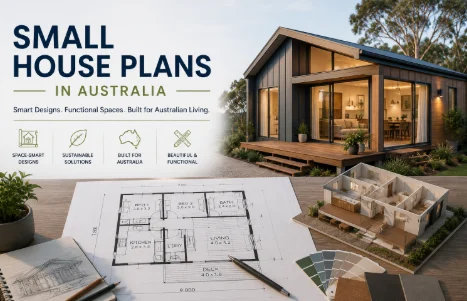
When a floor plan looks tidy, but daily life says otherwise
A floor plan can lie without saying a word. It may show a neat bed, sofa, and table, yet ignore every open cupboard door. It may leave no place for wet towels, shopping bags, or a visitor’s chair. Once those details arrive, the spacious drawing can feel surprisingly tight. We should test compact designs against daily movement before admiring their clean lines. Choices guided by small house plans in Australia can begin with real routines, furniture sizes, and storage needs. The best plan does not hide the limits of a small home. It uses them to shape a clearer and more useful layout.
This guide explains how to review small homes before choosing a design. We cover downsizing, mobile dwellings, site rules, storage, accessibility, and changing needs. You will learn why the smallest plan is not always the smartest one. We also explore how climate and land affect a home’s layout. A compact dwelling should reduce wasted space without making ordinary tasks awkward. It needs room for privacy, cleaning, cooking, rest, and the occasional guest. When the plan supports those moments, less space can feel like a practical choice rather than a daily compromise.
What small house plans Australia must show beyond room sizes
Small house plans Australia buyers compare should include accurate furniture layouts. A room’s dimensions mean little if doors strike chairs or drawers block walkways. Check the position of windows, power points, storage, appliances, and plumbing. The drawing should also show ceiling heights and any loft access. These details reveal whether the home will work once it is furnished.
Test every plan for:
- Clear paths between rooms
- Space around beds and tables
- Doors and drawers opening fully
- Useful storage near daily tasks
- Safe access to bathrooms and exits
Do not rely only on the plan’s total floor area. A narrow hallway or poorly placed door can waste valuable space. Ask for scaled drawings and mark your existing furniture on them. Check where bins, linen, cleaning tools, and outdoor gear will go. Good design gives each item a sensible home. If the layout needs constant furniture moving, it may not be as efficient as it first appears.
How downsizing homes in Australia starts with honest decisions
Downsizing homes Australia-wide is not simply a matter of owning fewer things. It often changes how people host family, work, rest, and manage hobbies. The new home should suit the life you expect to live next, not the one you had years ago.
Decision one: What must stay
List the items that support daily comfort or hold real value. Measure them before choosing a floor plan. This prevents favourite furniture from becoming an awkward surprise.
Decision two: What may change
Consider future mobility, health, work, and family needs. A ground-level bedroom or wider doorway may become useful later. Planning early can avoid costly changes.
Decision three: What can be shared
A spare room may not be needed every day. A dining area could also handle work or hobbies. Flexible space often gives more value than a room with one narrow purpose.
Research from the Australian Institute of Family Studies found that 26% of Australian households had one occupant in 2021. That was up from 24% in 2016 and 18% in 1981. Average household size also fell from 2.6 people in 2016 to 2.5 in 2021. These shifts help explain growing interest in homes designed for smaller households.
Why mobile homes Australia need a legal site strategy
Mobile homes Australia buyers consider may sit under different rules across states and councils. Wheels alone do not guarantee that a dwelling can be placed or occupied anywhere. Land zoning, road access, wastewater, fire safety, and length of stay can affect approval. The rules may also change when a structure connects permanently to services. Speak with the council before buying the home or preparing the site.
Confirm these matters first:
- Whether residential occupation is permitted
- Road and delivery access
- Water and wastewater systems
- Power and internet connections
- Insurance and transport requirements
Ask whether the proposed use needs planning, building, or other approval. If the home will move later, confirm its dimensions and transport method. Trees, gates, bridges, and overhead cables can restrict delivery. Site preparation may cost more than expected, especially on sloping or remote land. A mobile home needs two workable plans: one for living and another for reaching the site.
How tiny houses Australia balance movement and permanence
Tiny houses Australia-wide may look portable while operating like permanent homes. Occupants still need reliable water, power, drainage, ventilation, and safe access. Climate also matters because a small interior can heat or cool quickly. Storage should stay secure if the dwelling may move. Practical tiny houses in Australia balance transport needs with long-term comfort.
Recent analysis from the Australian Government Centre for Population shows Australia’s population reached 27.7 million in September 2025. It grew by 424,000 people over the year, an annual rise of 1.6%. Net overseas migration accounted for 311,000 of that growth. Continued growth places more focus on varied housing sizes and locations.
A tiny home should still provide:
- Effective insulation and shade
- Secure storage during transport
- Natural light and airflow
- Comfortable kitchen workspace
- A practical maintenance plan
Small size should simplify life, not reduce safety or comfort.
Where fewer rooms create space for a more deliberate life
A smaller home works when the plan reflects honest needs and real measurements. We believe good design should make movement easy, storage useful, and future changes less stressful. Start by mapping one normal day and noting every task the home must support. Then review the site, approval path, climate, delivery access, and full project cost. Keep the plan that solves those needs with the fewest awkward compromises. When the right layout begins to feel obvious, take it to a qualified builder and let careful planning do the heavy lifting.
