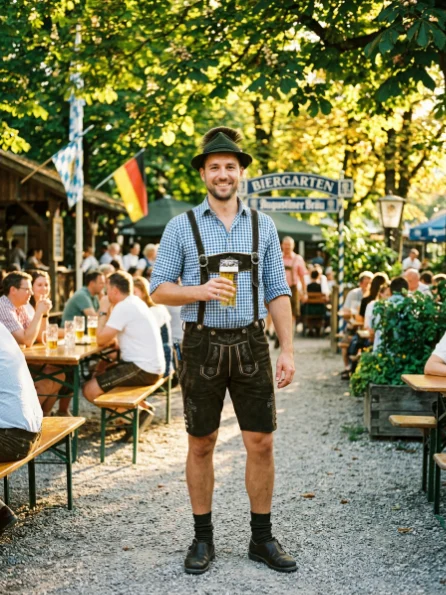
Every tradition has one garment that stands for the whole, and Bavarian festival dress chose its long ago: the blue and white checkered shirt. Walk any beer tent from Munich to Milwaukee and the blue-white gingham Trachtenhemd is the visual baseline — the single most-worn shirt at every Oktoberfest on earth, the default groom’s-party choice, the pattern printed on festival posters when designers need “Bavaria” in one image. Its dominance is not accident or fashion cycle; it is built from the Bavarian flag itself and reinforced by a century of festival practice. This guide explains the classic’s logic, how to choose the genuine article, and how to wear the most familiar shirt in the tradition so it still looks unmistakably right in 2026.
Why Blue-White Rules: Flag, Function, Familiarity
Three forces made blue-white the classic. The flag: Bavaria’s white-and-blue lozenges are among Europe’s most recognizable state symbols, and a shirt in those colors is civic identity worn on the body — the reason no other colorway could ever have taken the throne. Function: blue-white sits harmoniously against every lederhosen tone from pale tan to near-black, hides festival wear gracefully, and photographs cleanly in every light a festival day produces. Familiarity: a century of Wiesn photography, poster art, and inherited wardrobes has compounded the association until the pattern itself signals the event.
The result is the rare garment that is simultaneously the safest choice and a genuinely meaningful one — default and declaration at once.
Choosing the Genuine Classic
Because the classic is the most-produced shirt in the category, it is also the most-imitated, and choosing well means holding the standard Trachtenhemd screen firmly. Fabric: yarn-dyed woven cotton, the check identical on both faces — the printed-polyester tier’s blank reverse and synthetic shine are instant disqualifiers. Construction: real buttons, interfaced collar holding its shape, finished seams, generous tuck length. Check scale: medium gingham is the canonical classic; fine checks lean dressy, oversized checks lean party. Blue depth: the traditional royal-to-medium blues carry the flag association; washed-out pale blues read costume.
The 2026 quality band runs roughly $35 to $70. Below it sits the tier that photographs adequately and fails by the second wearing — the classic’s ubiquity makes the screen more necessary here, not less.
The Classic’s Place in Trachten
Understanding why one shirt can carry so much meaning requires the wider frame of trachten — the complete traditional-dress system in which every garment holds a defined role. Trachten’s logic is structural: the ensemble (shirt, leather, suspenders, socks, shoes, jacket, hat) is the constant, and each element carries codified significance refined across generations. Within that structure the blue-white Trachtenhemd occupies the anchor position — the element most tied to Bavarian identity itself, around which the ensemble’s other choices (leather tone, jacket, hat character) become personal variation.
That structural role explains the practical advice throughout this guide: the classic rewards correctness because the tradition assigned it the job of holding the whole outfit’s center. Wear it by the conventions and everything around it reads intentional.
Wearing the Classic Correctly
The blue-white check has a canonical wearing, and small correctness is what separates classic from costume. Tucked into the lederhosen, always; suspenders over the shirt, the check sitting calm beneath the breastplate; collar open one button for festival ease, closed under a jacket for formal moments; sleeves rolled cleanly to the forearm in warm tents — the rolled blue-white sleeve being practically the Wiesn’s signature gesture — and down for ceremony.
Pairing is effortless by design: every leather tone works, gray or green loden jackets frame it traditionally, and the check echoes naturally beside a partner’s blue or cream dirndl for couples’ looks. The classic asks only that its surroundings stay traditional — modern sneakers and logo layers break the frame faster around blue-white than around any other shirt, precisely because the pattern raises expectations.
Owning the Classic for the Long Run
The blue-white check is the first shirt to buy and the last to retire. Ownership follows the category playbook: machine-wash the cotton gently, iron the collar crisp, rotate with a second shirt (white for formal register, green or red check for variety) across multi-day events, and let it moonlight year-round — blue gingham over jeans is classic casual everywhere on earth. Longevity is the quality tier’s quiet argument: a woven-cotton classic serves five to ten seasons of festivals plus ordinary wear, making its cost-per-wear the best in the entire traditional wardrobe.
Order by midsummer for 2026 — the most-worn shirt in the category is, predictably, also the first to sell through in common sizes as the season opens.
Frequently Asked Questions
Why is blue-and-white THE Oktoberfest shirt?
It wears the Bavarian flag’s own colors and civic identity as gingham reinforced by a century of festival practice and photography.
What defines the genuine article?
Yarn-dyed woven cotton (check identical on both faces), real buttons, interfaced collar, medium check scale, traditional blue depth $35 to $70 in 2026.
What’s the canonical way to wear it?
Tucked into lederhosen, suspenders over, collar open one button, sleeves rolled in warm tents surrounded by traditional pieces, not modern breaks.
Does it pair with every lederhosen color?
Yes that universal harmony against tan through dark brown is one reason the colorway became the standard.
Can it be worn outside festivals?
Constantly; blue gingham over jeans is classic casual worldwide, which is why the quality version’s cost-per-wear is unbeatable.
When should I buy it for 2026?
Midsummer the category’s most-worn shirt sells through common sizes first every season.
