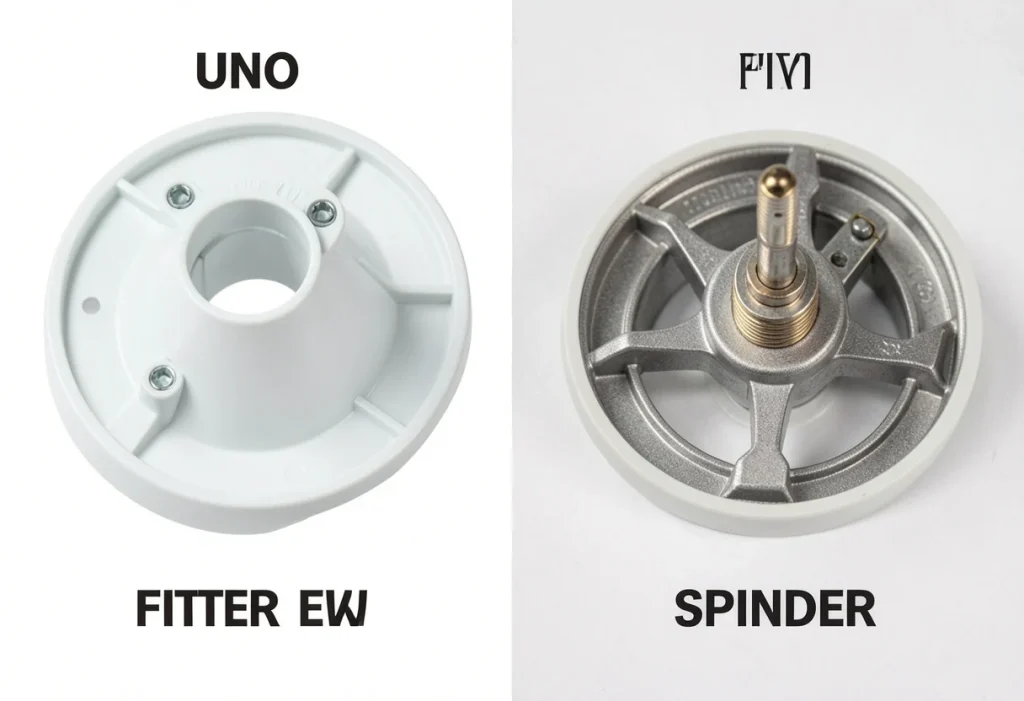
If you’ve ever found a vintage ceramic lamp at a thrift store or ordered a stunning lampshade online, only to realize the shade won’t attach to the base, you’ve met the ultimate hardware frustration.
In the American lighting market, lampshades don’t just sit on bases; they rely on specific attachment systems called fitters. The two most popular styles across US homes are Uno fitters and Spider fitters.
Choosing between Uno fitter vs spider fitter options determines how your shade mounts, what kind of bulb you can use, and how easy it is to swap out shades. Here is everything you need to know about how these two popular attachment systems work, how they compare, and which one is right for your home.
What Is a Spider Fitter?
The spider fitter is the undisputed king of American table and floor lamps. If you walk into a lighting store or buy a standard lamp in the United States, odds are high that it uses a spider mechanism. A spider fitter consists of a small center ring held in place by three or four wire spokes radiating outward like spider legs to the top rim of the shade.
How It Works:
- Requires a Harp: The center ring sits directly on top of a detachable U-shaped metal wire frame called a lamp harp.
- Secured by a Finial: A decorative screw-on cap (a finial) threads onto the top of the harp stem, locking the shade firmly in place above the light bulb.
What Is an Uno Fitter?
Uno fitters take a completely different, minimalist approach. Popularized in antique bridge floor lamps and modern minimalist fixtures, an Uno fitter eliminates the need for an external wire harp. Instead of sitting on top of a wire frame above the bulb, an Uno fitter features a large center ring that attaches directly to the light bulb socket below or around the bulb.
Types of Uno Fitters:
- Threaded Uno: The center ring has interior threads that screw directly onto a threaded light socket. The shade hangs downward or sits upright, locked in place by a threaded socket ring.
- Slip Uno (Drop Uno): The center ring slips over a smooth light socket and sits on a built-in flange beneath the bulb.
Head-to-Head: Uno Fitter vs Spider Fitter
When deciding between an Uno Fitter vs Spider Fitter, here is how they stack up across key features:
| Feature | Spider Fitter | Uno Fitter |
| Harp Required? | Yes | No |
| Primary Use | Standard US Table & Floor Lamps | Small Table Lamps, Downward Lights |
| Height Adjustability | Easy (change harp size) | Fixed (cannot adjust height) |
| Shade Variety | Massive selection available | Limited selection |
| Installation | Requires 3 parts (harp, shade, finial) | Simple 1-piece installation |
Which Fitter Should You Choose?
Choose a Spider Fitter If:
- You Want Maximum Options: Because spider fitters are the industry standard in North America, you’ll find the widest variety of off-the-shelf and custom lampshades in spider configurations.
- You Want Height Flexibility: If a shade sits an inch too low or high, swapping out the wire harp for a different size easily corrects the proportion without returning the shade.
- You Have Medium to Large Lamps: Spider fitters offer superior structural support for wide, heavy linen, parchment, or silk shades.
Choose an Uno Fitter If:
- You Have Wall Sconces or Swing-Arm Lights: Uno fitters excel on downward-pointing fixtures, making them ideal for modern wall lamp shades and bedside reading lights where a harp would look bulky and exposed.
- You Own a Vintage Bridge Lamp: Many antique American floor lamps feature threaded Uno sockets designed exclusively for downward-hanging Uno shades.
- You Prefer Sleek, Minimalist Hardware: Eliminating the harp keeps the area around the light bulb clean and uncluttered.
Conclusion
When comparing an Uno fitter vs spider fitter, the best choice ultimately comes down to your lamp’s socket style and how much flexibility you need. Spider fitters remain the gold standard for standard American table and floor lamps, offering unmatched stability, height adjustability via harp swaps, and the widest selection of off-the-shelf and custom shades.
On the other hand, Uno fitters provide a clean, harp-free setup that shines on smaller fixtures, down-facing bridge lamps, and compact wall lamp shades. Match the fitter to your fixture’s hardware, and you’ll get a secure, proportional fit every single time.
FAQs
Q: Can you convert a spider fitter shade to an Uno fitter lamp?
A: Yes, you can buy a harp adapter kit or an Uno-to-spider converter that slips over the socket.
Q: Are Uno fitters common on Custom Lamp shades in the US?
A: While spider fitters dominate, artisan makers frequently craft custom shades with Uno fitters upon request.
Q: Do wall shades usually use Uno or spider fitters?
A: Most compact wall shades use Uno fitters or bulb clip-on fitters to keep the hardware hidden and lightweight.
Q: How do I know what size Uno fitter ring I need?
A: Measure the outside diameter of your light socket; standard threaded Uno rings fit 1.25-inch sockets.
Q: Why is my spider fitter shade wobbling on the lamp?
A: Ensure your harp legs are seated firmly in the saddle caps and tighten the top finial securely down.
