The corporate workforce landscape is undergoing an unprecedented structural shift, placing immense pressure on human resource departments worldwide. In the current business environment, human resource professionals face a complex combination of operational challenges that threaten to overwhelm traditional administrative workflows. Corporate workloads continue to rise rapidly due to organizational scaling, global compliance requirements, and ongoing restructuring. At the same time, executive leadership teams are introducing tighter budget constraints and calling for strategic headcount reductions across back-office functions. This challenging environment leaves leaders with a substantial operational deficit, making it impossible to sustain high-quality service delivery solely through conventional manual processes.
For decades, human resource technology relied almost exclusively on static, rule-based systems. Early automation software was designed to handle highly predictable, transaction-oriented tasks, such as tracking basic employee clock-in hours or storing contact information in a centralized database. While these initial tools provided basic efficiencies, they remained fundamentally limited by their rigid architecture. They lacked the cognitive capacity to interpret nuanced employee scenarios, analyze conversational intent, or synthesize qualitative performance feedback. Consequently, when complex organizational issues arose, human teams still had to dedicate extensive manual labor to resolve them, leaving little room for long-term strategic planning.
Today, the corporate mandate for Chief Human Resource Officers has shifted completely away from pure administrative management toward proactive enterprise enablement. Modern executives must transform their operational structures to operate as agile, data-centric centers of strategic value. Achieving this objective requires a comprehensive modernization of the underlying corporate infrastructure. Instead of spending valuable operational hours drafting repetitive communications, screening endless stacks of candidate profiles, or manually cross-referencing disparate compliance documents, human capital leaders are turning to adaptive enterprise intelligence. This transition represents a major evolution in corporate technology, moving past simple automation to embrace cognitive tools that fundamentally redefine the relationship between workforce management and corporate productivity.
The Rise of Generative AI in HR
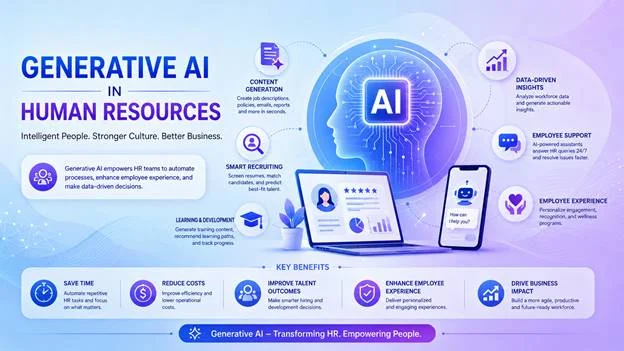
To successfully navigate this changing landscape, organizations are increasingly turning toward the strategic deployment of generative artificial intelligence. This advanced technology introduces a highly adaptive layer of enterprise intelligence that stands in sharp contrast to traditional software architectures. While legacy systems require fixed, step-by-step programming to execute simple tasks, generative models use deep learning algorithms to process large volumes of unstructured data. By implementing generative AI in HR, enterprise leaders can automate the generation of highly contextual content, interpret complex behavioral patterns, and deliver highly personalized employee communications that reflect specific organizational realities.
The economic and operational forces accelerating this transition are fully documented in recent global enterprise research. Studies indicate that 66% of human resource organizations have already integrated generative intelligence tools into their day-to-day operations. This rapid adoption curve is not driven by mere technological curiosity, but rather by an urgent operational requirement to bridge a widening productivity gap. Corporate workloads in the human resources sector are projected to increase by a substantial 10%, while departmental operating budgets face an average contraction of 1.5% and overall back-office headcount declines by 2%. This specific combination of factors leaves corporate leaders facing a severe 12% operational productivity gap that cannot be addressed by simply asking existing teams to work harder.
In response to these compounding structural challenges, approximately 77% of forward-looking human resource leaders have launched formal corporate initiatives designed to leverage advanced technology for operational efficiency. The primary focus of these initiatives is to remove administrative friction from core service delivery models systematically. By delegating high-volume, transactional responsibilities to sophisticated, context-aware platforms, enterprises can effectively protect their existing staff from burnout while simultaneously expanding their capacity to focus on high-priority corporate goals. This widespread structural modernization marks the beginning of an entirely new era for human capital management.
Benefits of Generative AI in HR
Transitioning from localized pilot programs to widespread enterprise execution unlocks major competitive advantages for global organizations. The systematic integration of cognitive software platforms fundamentally alters core performance metrics while elevating the daily experience of the entire corporate workforce.
1. Closing the enterprise productivity gap
The most immediate operational advantage of adopting generative solutions is the rapid elimination of administrative bottlenecks. When intelligent applications take over the continuous intake of repetitive data entry and routine policy inquiries, human resource professionals reclaim thousands of operational hours annually. This newly recovered operational capacity allows internal teams to shift their primary focus away from answering emails and toward high-value strategic initiatives. HR leaders can leverage their expertise to execute specialized workforce planning strategies, develop complex organizational restructuring plans, and design highly sophisticated retention initiatives to protect critical enterprise talent.
2. Enhancing the employee and candidate experience
Modern corporate workforces and external job applicants expect rapid, transparent, and accurate communication throughout their professional interactions. Generative software platforms meet this expectation by providing around-the-clock, localized, and highly personalized support systems. Whether an external candidate wants to check their active interview status or an internal employee needs to understand a localized parental leave policy, conversational systems provide immediate clarity. These tools can analyze an individual’s unique tenure, country of residence, and role history to deliver precise, contextually accurate answers without requiring a human service agent to intervene, significantly elevating overall organizational engagement.
3. Enabling data-driven talent intelligence
Maintaining a clear competitive edge requires corporate leaders to possess deep visibility into the aggregate skills and hidden capabilities of their global workforce. Cognitive platforms process massive amounts of qualitative enterprise data to build dynamic skill taxonomies, enabling leadership to identify critical capability gaps before they affect business outcomes. Partnering with experienced AI consultants during this phase allows enterprises to establish robust data governance frameworks. This expert alignment ensures that underlying data models remain highly secure, fully compliant with global labor regulations, and perfectly optimized to drive long-term return on technology investments.
Use Cases of Generative AI in HR
The practical deployment of generative applications spans across every phase of the employee lifecycle, transforming traditional administrative friction points into seamless, intelligent workflows.
1. Automated talent acquisition and recruitment
Drafting clear, compelling, and accurate job descriptions routinely requires extensive manual alignment between corporate recruiters and hiring managers. Generative platforms dramatically compress this timeline by instantly creating customized descriptions that precisely map to an organization’s pre-established skills framework. Furthermore, these intelligent tools review incoming applicant profiles within their full structural context, evaluating complete professional trajectories rather than executing basic keyword matching. By evaluating candidates against a standardized, objective set of criteria derived from data-driven parameters, companies can introduce a highly effective layer of structural bias mitigation into their hiring pipelines.
2. Conversational AI for HR service delivery
Global service centers are routinely inundated with thousands of repetitive employee questions regarding complex payroll distributions, medical benefit options, and changing corporate compliance rules. Enterprise data shows that 45% of human resource teams plan to deploy advanced conversational virtual assistants to handle these high-volume inquiries. Unlike legacy, rule-based chatbots that provide generic answers, context-aware generative tools generate precise, legally compliant responses tailored to the specific corporate guidelines of the employee’s region, reducing overall ticket volumes and lowering mean resolution times.
3. Learning, development, and training assessments
Upskilling the corporate workforce has become a fundamental priority as industry dynamics and technical requirements shift. Approximately 29% of progressive companies intend to use generative technology to manage skills documentation and execute automated training assessments. Instead of relying on static, semi-annual corporate training modules that fail to address immediate skill deficits, enterprises are introducing dynamic capability-building systems. These systems monitor real-time changes in business goals and individual employee performance, automatically curating hyper-personalized learning paths that adapt as individual job roles evolve.
4. Performance management and continuous feedback
The annual employee review cycle typically imposes a massive cognitive burden on corporate managers, who must manually synthesize a year’s worth of project metrics, peer feedback, and informal performance notes. Generative software platforms eliminate this administrative strain by compiling diverse qualitative inputs into clear, well-structured, narrative summaries. In addition, intelligent performance tools can deliver real-time manager coaching prompts, notifying corporate leaders of subtle changes in team engagement metrics or recommending proactive check-ins when important project timelines face unexpected delays.
Why Choose The Hackett Group® for Implementing Generative AI in HR?
Successfully scaling cognitive technologies across a global enterprise requires an optimal combination of deep domain expertise, proprietary technology assets, and proven performance benchmarks. The Hackett Group® provides an advanced, platform-enabled strategic Applied Intelligence model designed specifically to guide global enterprises through the complexities of artificial intelligence integration. By grounding technology architecture in client-specific operating contexts and clear economic metrics, they enable human resource organizations to move past basic experimentation and achieve full value realization at scale.
The firm offers unique, IP-driven platforms that dramatically accelerate the digital transformation lifecycle. Organizations can leverage the Hackett AI XPLR™ platform to assess operational readiness rapidly, systematically prioritize high-impact use cases, and simulate the exact return on investment of specific automation solutions. This approach ensures that every technological investment is supported by objective, data-backed evidence. During the implementation phase, internal teams gain immediate access to AskHackett™, a specialized system that provides real-time, self-service answers to complex business queries powered by world-class performance intelligence.
Additionally, corporate leaders can engage with the Hackett Connect® community, a collaborative environment that allows executives to share proven change-management frameworks and coordinate strategies with industry peers. Partnering with The Hackett Group® allows human capital leaders to confidently close their operational productivity gaps and build highly resilient operating structures.
Conclusion
Traditional human resource operating models are no longer able to keep pace with the rapidly increasing workloads and budget constraints of the modern business world. Generative technology has successfully evolved from an interesting experimental tool into an essential strategic imperative for global enterprises seeking to maintain a clear competitive edge.
By fully automating high-volume administrative tasks, delivering personalized localized support, and surfacing deep talent insights, these cognitive platforms empower human resource teams to reclaim their positions as vital strategic business architects. Implementing these tools with the guidance of benchmark-driven Applied Intelligence frameworks allows global companies to protect their internal teams from burnout, close lingering efficiency gaps, and cultivate a highly agile, future-ready workforce that drives sustained corporate growth.
