For decades, the objective of home water treatment was always making water cleaner. That is why filtration technologies were developed to reduce unwanted substances and improve the quality of water for people consumed it every day. But there is always scope for advancement in water science.
This curiosity of enhancing water brought greater attention to electrolysis. A technology that changed how modern water systems could process water after purification. Electrolysis makes it possible to generate water with different characteristics and intended uses rather than simply filtering water.
Today, this principle is central to technologies such as the hydrogen water ionizer, contributing to growing interest in electrolytic hydrogen water and functional hydration.
Moving Beyond Conventional Water Filtration
The main goal of traditional water filtration is to eliminate or minimize undesirable materials from water. This could include residual chlorine, specific contaminants, smells, suspended particles, and other impurities, depending on the filtration technology.
Electrolysis introduced an additional stage.
An electrolytic system uses electrodes separated by a membrane to pass an electric current through water after it has been properly filtered. This process produces water streams with different properties.
Whereas acidic electrolyzed water is produced at the anode side, alkaline electrolyzed water is produced at the cathode side and may contain dissolved molecular hydrogen.
One reason electrolysis was a significant advancement in domestic water technology was its capacity to produce various kinds of water from a single system.
How Electrolysis Produces Hydrogen-Rich Water
At the heart of an electrolytic hydrogen water generator is the electrolyzer. Electrical energy propels electrochemical reactions at the electrodes when appropriate water flows through the electrolysis chamber.
A portion of the hydrogen produced at the cathode may stay dissolved in the water as molecular hydrogen (H₂). Therefore, depending on the system and its properties, the resultant water may be referred to as hydrogen alkaline water or electrolytic hydrogen water.
The amount of dissolved hydrogen produced is not determined by electrolysis alone. The final concentration can be affected by several variables, such as electrode design, electrical current, water composition, temperature, flow rate, and electrolyzer efficiency.
For this reason, the engineering of a modern hydrogen water machine is just as important as the fundamental idea of electrolysis.
Why Electrode Technology Matters
One of the most crucial parts of a water ionization system is an electrode. The electrolysis performance can be affected by their composition, surface area, quantity, coating, and arrangement.
Because titanium electrodes with platinum-based coatings are appropriate for the electrochemical environment inside an electrolyzer, they may be used in contemporary systems.
Water technology has advanced toward more reliable electrolysis, enhanced hydrogen production, regulated pH levels, and more economical water use thanks to the creation of more effective electrode and electrolyzer designs.
Manufacturers have been concentrating more on monitoring and controlling the properties of the water produced as well as producing hydrogen water as technology has advanced.
From Water Purification to Functional Water
Electrolysis contributed to the introduction of a more comprehensive idea into modern water technology: one kind of water need not be used for every purpose.
In addition to purified, acidic, or other water types meant for various purposes, an advanced water system may be able to produce alkaline ionized water for appropriate drinking applications.
This represents an important shift from conventional water treatment.
Filtration focuses primarily on water purity. Electrolysis introduces the possibility of water functionality.
By combining these two methods, modern systems can first deal with undesirable materials before using electrolysis to produce water with particular qualities.
Interest in functional hydration and technologies like the hydrogen water ionizer has grown as a result of this idea.
Why Electrolytic Hydrogen Water Is Receiving Attention
Another reason electrolysis has gained attention is the growing scientific interest in molecular hydrogen.
Researchers are looking into molecular hydrogen and its effects on oxidative stress and biological processes, but research into its potential health applications is still in its early stages and should not be interpreted as proof that hydrogen water can prevent or treat disease.
However, from a technological point of view, electrolysis offers a practical means of producing drinking water with dissolved molecular hydrogen.
Because of this, the design of the hydrogen water machine has continued to evolve, with current systems concentrating on dissolved hydrogen concentration, electrode efficiency, pH control, water quality monitoring, and less water waste.
Japanese Engineering and the Evolution of Electrolysis
Japan has played a notable role in the development and adoption of household electrolyzed water technology. Japanese producers have kept improving electrolyzers, electrode configurations, filtration systems, and water monitoring technologies over time.
This engineering philosophy reflects a more comprehensive approach to water: while purification is crucial, it’s also important to understand how water is produced and utilized.
Because of this, electrolysis technology has developed from comparatively straightforward water ionization systems to complex apparatuses that can integrate filtration, electrolysis, hydrogen production, and adjustable water settings into a single appliance.
Bringing Advanced Electrolysis Technology Into the Home
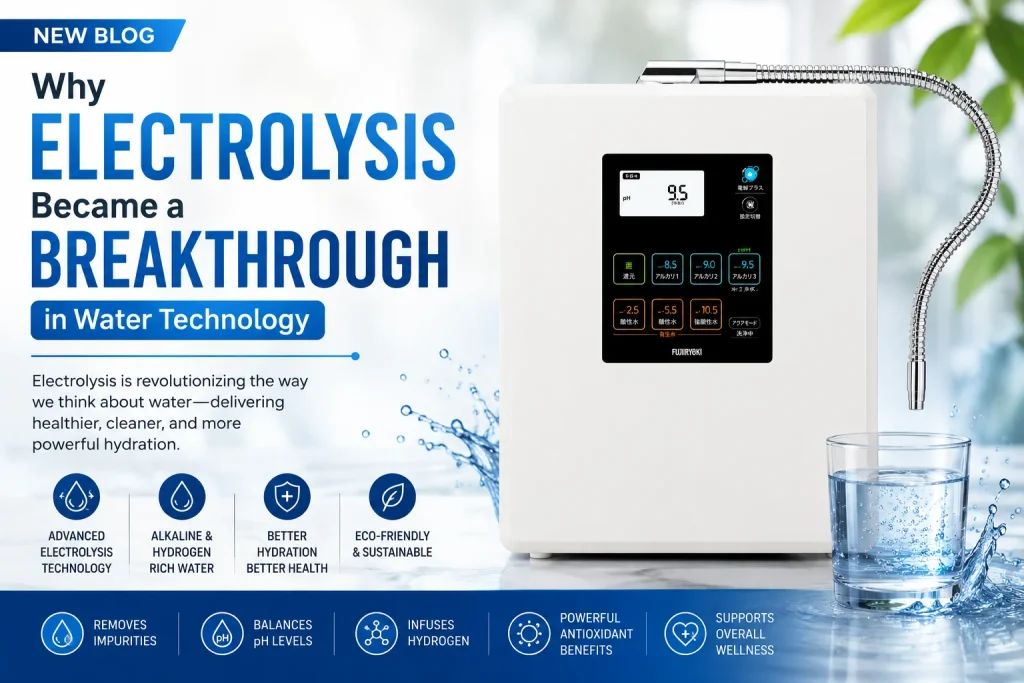
One example of this evolution is the Fujiiryoki HWP-77 Hydrogen Plus Alkaline Water Ionizer.
Filtration and a cutting-edge, highly efficient double electrolyzer are combined in the HWP-77. Ten electrode plates—five primary plates and five additional plates—as well as solid titanium plates with a platinum fine coating are used in the system, according to Fujiiryoki India. According to the company, the system provides a variety of water types for various intended uses and can produce up to 1,300 ppb of dissolved hydrogen under certain conditions. Additionally, it offers real-time monitoring of various parameters, such as pH, water flow, dissolved hydrogen level, and filter life.
The system illustrates how electrolysis technology has advanced beyond the fundamental idea of water separation at positive and negative electrodes. Purification, hydrogen production, pH control, water efficiency, and user control are now all combined in modern engineering.
Explore the Fujiiryoki HWP-77 product details.
Conclusion
Electrolysis became an important breakthrough in water technology because it expanded the possibilities of what a household water system could do. Electrolysis allowed for the production of various types of water and water with dissolved molecular hydrogen, rather than stopping at filtration.
Advances in electrolyzer and electrode engineering are helping to shape the next generation of water systems as interest in hydrogen water, electrolytic hydrogen water, and functional hydration grows.
The transformation from basic filtration to advanced electrolysis signifies a more comprehensive shift in our perception of water, not only in terms of its cleanliness but also in terms of how technology can modify it for various aspects of daily life.
