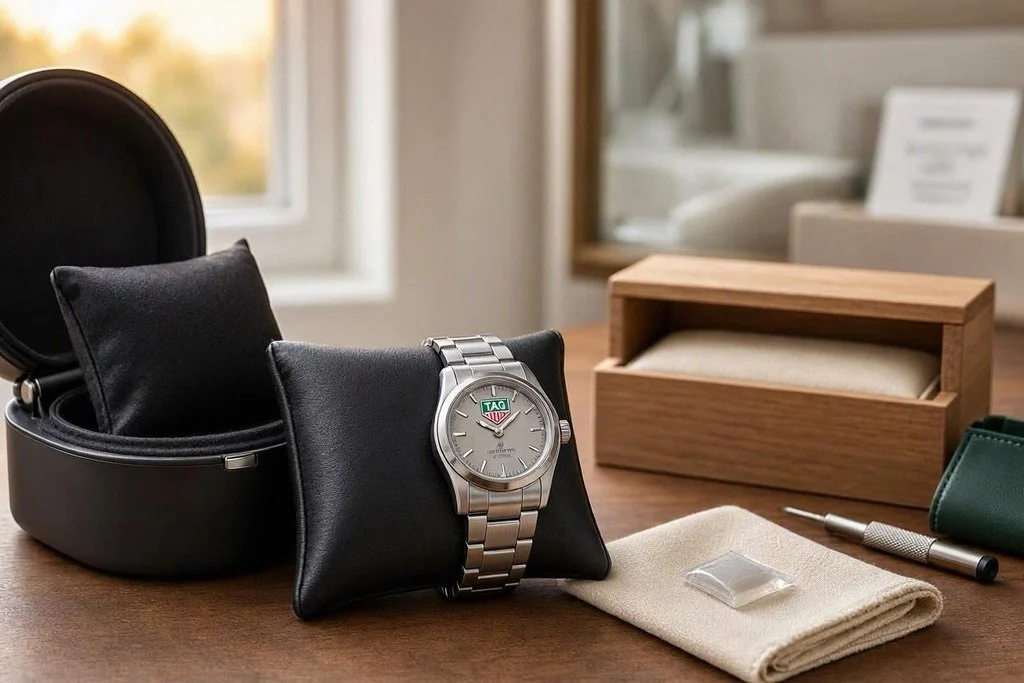
A TAG Heuer automatic watch is built to run for decades, but it only performs at its best when you store it correctly between wears. Automatic movements rely on motion to stay wound, and they’re sensitive to temperature swings, humidity, and long stretches of inactivity. Get the storage part wrong, and you risk a watch that stops keeping accurate time, gaskets that dry out, or lubricants that thicken inside the movement.
This guide walks through exactly how to store, wind, and maintain a TAG Heuer automatic — whether you own one piece or you’re building out a small rotation of watches.
Why Automatic Watches Need More Than a Drawer
An automatic movement uses a rotor that spins with your wrist motion to wind the mainspring. When the watch sits still, that winding stops, and most automatics only hold a power reserve of 38 to 80 hours depending on the caliber. Once the reserve runs out, the watch stops.
That’s not damaging on its own. The real issue is what happens over months of stopping and restarting a watch without proper care:
- The date complication (if fitted) can jump awkwardly if reset at the wrong time of day, straining the date-change mechanism
- Lubricants inside the movement settle unevenly if the watch sits motionless for extended periods
- Repeated manual winding and setting puts more wear on the crown and stem than gentle automatic winding does
None of this is dramatic, but it adds up. A watch that’s properly maintained between wears needs fewer service visits and holds its accuracy better over the years.
Do You Actually Need a Watch Winder?
Not every automatic watch owner needs one. If you wear the same watch daily, a winder is unnecessary — your wrist does the job. Winders earn their place when:
- You own more than one automatic watch and rotate between them
- You have a piece with a perpetual calendar or moon phase complication that’s tedious to reset
- You want a watch ready to wear the moment you pick it up, rather than waiting for it to gain power reserve
TAG Heuer’s Calibre 5 and Calibre 16 movements, both common across the Carrera and Monaco lines, benefit from a winder that matches their rotational direction and turns-per-day (TPD) requirements. Using the wrong settings — spinning a bidirectional-wind movement one direction only, or running too many TPD — won’t damage the watch, but it wastes energy and doesn’t wind efficiently. For anyone shopping specifically for compatible options, it’s worth looking at more on watch winders for tag heuer, since TPD and direction settings vary by caliber and getting them right matters more than most owners realize.
Choosing the Right TPD and Direction
Most TAG Heuer Calibre 5 movements wind bidirectionally and run well at 650–950 TPD. Older Calibre 6 and some chronograph modules are clockwise-only. If you’re unsure which your watch uses, the case back or the original documentation will usually specify it, and a reputable winder brand will list compatible settings for common calibers.
Where and How to Store the Watch Itself
Whether or not you use a winder, where you physically store the watch matters just as much.
Keep it away from direct sunlight. UV exposure fades dials, degrades luminous material, and can dry out gaskets faster than normal use would.
Control the temperature. Automatic movements are engineered to run within a specific temperature range, typically 5°C to 35°C. Extreme heat thins out lubricants; extreme cold thickens them and can cause the movement to run slow or stop.
Manage humidity. High humidity is one of the most common causes of moisture ingress and dial corrosion in watches that aren’t worn regularly. A stable, moderate humidity level protects both the case seals and the movement inside.
If you’re setting up a dedicated storage space rather than just a watch box on a shelf, it’s worth doing it properly from the start. Aevitas UK’s How to Build a Climate range covers the full process of building a climate-controlled storage solution, including humidity targets, insulation, and sizing a space for a growing collection rather than just a single watch.
Daily and Weekly Care Habits
Good storage habits are only half the picture. A few simple routines keep a TAG Heuer running well between services:
- Wipe the case and bracelet with a soft, dry cloth after each wear to remove skin oils and sweat, which can corrode metal over time
- Avoid magnetic fields — phones, laptop speakers, and induction chargers can magnetize a movement’s hairspring, causing it to run fast
- Check the crown is pushed in or screwed down before storing, particularly on dive watches like the Aquaracer, to maintain water resistance
- Rotate wear if you own several pieces, rather than leaving one watch dormant for months at a time
- Have the water resistance tested annually if you swim or dive with the watch, since gasket seals degrade gradually even without visible damage
When to Send It In for Service
Even with excellent storage and care, an automatic movement needs professional servicing roughly every 4 to 6 years. Signs it’s due sooner include:
- Noticeable loss of accuracy (gaining or losing more than 15–20 seconds a day)
- The power reserve dropping shorter than it used to
- Moisture or condensation visible under the crystal
- A crown that feels loose, gritty, or doesn’t wind smoothly
Catching these early is far cheaper than waiting for a full stop or water damage. The Federation of the Swiss Watch Industry publishes general guidance on movement care and servicing intervals that’s a useful reference point regardless of which brand you own, since the underlying mechanical principles are shared across most Swiss automatic movements.
Building a Simple At-Home Routine
For most owners, a practical routine looks like this:
- Store watches not in daily rotation in a case or box away from windows and heat sources
- Use a properly configured winder for complicated pieces or watches worn infrequently
- Wipe down the case after wear and check the crown position before storing
- Keep an eye on accuracy and note it down occasionally so drift is easy to spot
- Book a service the moment you notice performance changes rather than waiting
If you’re starting to build out a proper storage setup rather than relying on a single box, browsing the Aevitas online store is a good starting point — cases, winders, and accessories are easier to choose once you know your specific caliber’s requirements and how many pieces you’re storing.
Final Thoughts
Caring for a TAG Heuer automatic doesn’t require a lot of specialist knowledge, just a bit of consistency. Store it away from heat, light, and moisture, wind it correctly if it’s not worn daily, and pay attention when something feels off. Do that, and there’s no reason a well-made automatic movement shouldn’t run smoothly for decades with only routine servicing along the way.
FAQs
Do I need to reset the date every time my watch stops?
Yes, if the date complication resets to a stopped date, you’ll need to correct it. Avoid adjusting the date between roughly 9 PM and 3 AM, since the date-change gears are engaged during that window and forcing it can cause damage.
How often should I wear an automatic watch to keep it running?
There’s no strict rule, but wearing it a few times a week, or using a winder in between, is usually enough to keep the power reserve topped up and the movement’s oils circulating.
Can a watch winder damage my TAG Heuer?
Not if it’s set to the correct direction and TPD for your specific caliber. An incorrectly configured winder won’t cause damage, but it can overwind inefficiently or fail to keep the watch properly powered.
Is it bad to store a watch fully wound and then let it stop?
No, letting an automatic wind down naturally and stop is normal and won’t harm the movement. It’s a normal part of owning a watch you don’t wear daily.
What humidity level is best for watch storage?
Most horologists recommend keeping storage humidity between 40% and 50%. Anything consistently higher increases the risk of moisture-related corrosion inside the case.
