1. Why Industrial Robots Need Lightweight Design
As industrial robots evolve toward higher speeds, greater payload capacities, and better repeatability, the weight of their mechanical structures is becoming an important factor affecting overall performance. The heavier the robotic arms, joint connectors, and end effectors are, the greater the inertia generated when the robot starts, stops, or changes direction. This not only requires the motors to deliver more torque but also increases the long-term load on the transmission system.
Therefore, lightweight robot design is not simply about using less material. It involves reducing the weight of moving components while maintaining strength, rigidity, and operational stability. Appropriate material selection and optimized component structures can improve robot response speed, energy efficiency, and motion accuracy while creating opportunities to increase payload capacity.
2. Benefits of Reducing the Weight of Moving Components
Reducing the weight of robotic arms, joint connectors, and end effectors directly lowers inertia during robot movement. Lighter structures can start, stop, and change direction more quickly, enabling robots to respond more efficiently in tasks such as assembly, material handling, and high-speed sorting while reducing the load on motors and gear reducers.
Lightweight design also helps reduce energy consumption and the long-term wear of bearings, gears, and joint components. However, robot parts cannot be designed based on weight alone. If the material lacks sufficient strength or the structure lacks adequate rigidity, high-speed movement may cause vibration, deformation, and end-effector positioning errors. Effective lightweight design must therefore balance strength, rigidity, and weight.
3. Common Lightweight Materials Used in Industrial Robots
Aluminum alloys, magnesium alloys, carbon-fiber composites, and engineering plastics are commonly used in lightweight industrial robot designs. Aluminum alloys offer a favorable balance of weight, strength, machinability, and cost, and are often used for robotic arm housings, joint brackets, and mounting plates. Magnesium alloys have a lower density but require more stringent corrosion protection and machining safety measures.
Carbon-fiber composites have high specific strength and specific stiffness, making them suitable for components with demanding speed and weight requirements, although their manufacturing and joining processes are more complex. Engineering plastics are used for protective covers, guide components, and certain low-load structures. Material selection should account for component loads, rigidity, operating environment, machining difficulty, and production cost.
4. Applications of High-Strength Aluminum Alloys in Critical Structural Components
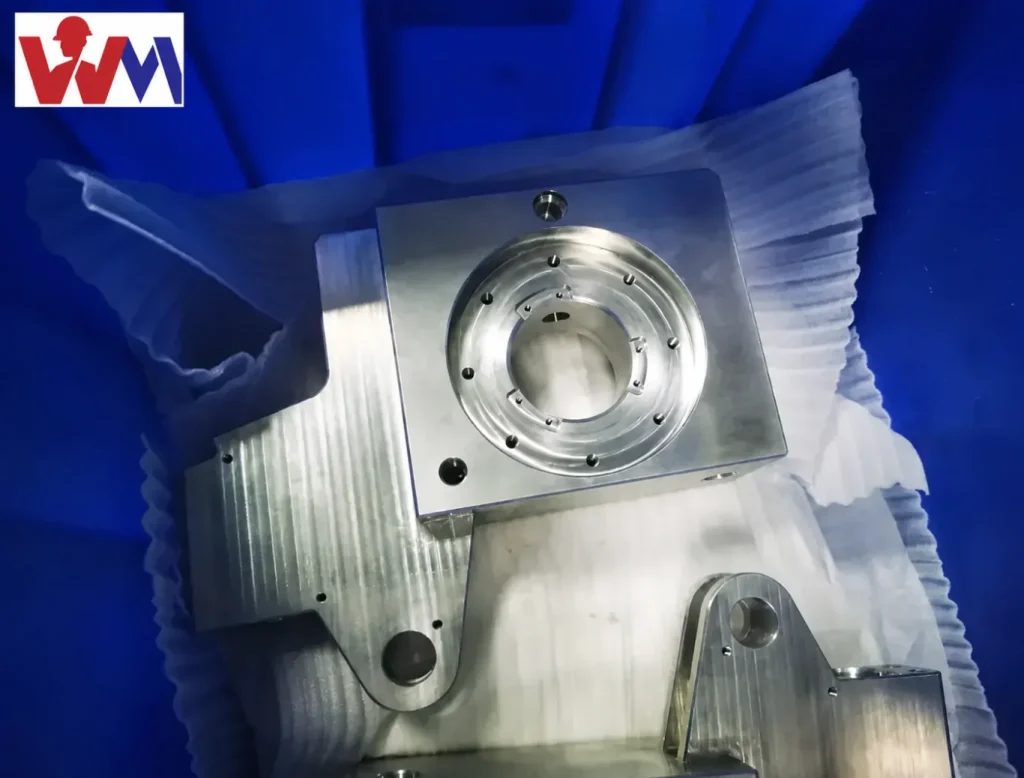
The joint brackets, connecting plates, and end-effector mounts of industrial robots must withstand frequent starts, stops, directional changes, and repeated loads. These components must not only control their own weight but also provide sufficient strength and dimensional stability. For critical structural components that must combine lightweight performance, load-bearing capacity, and precision machinability, 7075-T6 is a high-strength aluminum alloy worth considering.
However, high strength does not mean it is suitable for every robot component. Designers must still evaluate fatigue loads, corrosive environments, joining methods, and stress concentrations, and determine fillet radii, wall thicknesses, and reinforcement features according to actual operating conditions. In humid or potentially corrosive environments, suitable anodizing or other surface protection processes should also be selected.
5. Structural Design and Precision Machining Are Equally Important
Lightweight robot components cannot be achieved solely by switching materials. Hollow structures, thin-wall designs, reinforcing ribs, and topology optimization are also needed to eliminate unnecessary weight. A well-designed structure can concentrate material in the primary load-bearing areas, preserving sufficient rigidity while controlling component weight and reducing the risk of vibration and deformation during high-speed movement.
The design must ultimately be converted into a physical component through precision machining. The positional accuracy of joint bores, bearing seats, mounting surfaces, and connecting holes affects robot assembly quality and repeatability. By planning the machining sequence appropriately, controlling clamping deformation, and inspecting critical dimensions, manufacturers can reduce accumulated errors and help lightweight components remain stable in actual operation.
6. From Material Selection to Integrated Manufacturing Optimization
Lightweight industrial robot design is a comprehensive undertaking that must account for material strength, structural rigidity, fatigue life, machining accuracy, and the operating environment. Simply reducing wall thickness or pursuing lighter materials may increase the risk of component deformation, vibration, and failure. Only by integrating material selection, structural optimization, and manufacturing processes can weight be reduced while stable load-bearing capacity and motion accuracy are maintained.
For custom components such as robot joint brackets, connecting plates, mounts, and end effectors, manufacturers must accurately control hole positions, mounting surfaces, and critical geometric tolerances. Weldo Machining provides manufacturing support for lightweight robot structural components from design validation to mass production through multi-axis CNC machining, surface finishing, and dimensional inspection.
