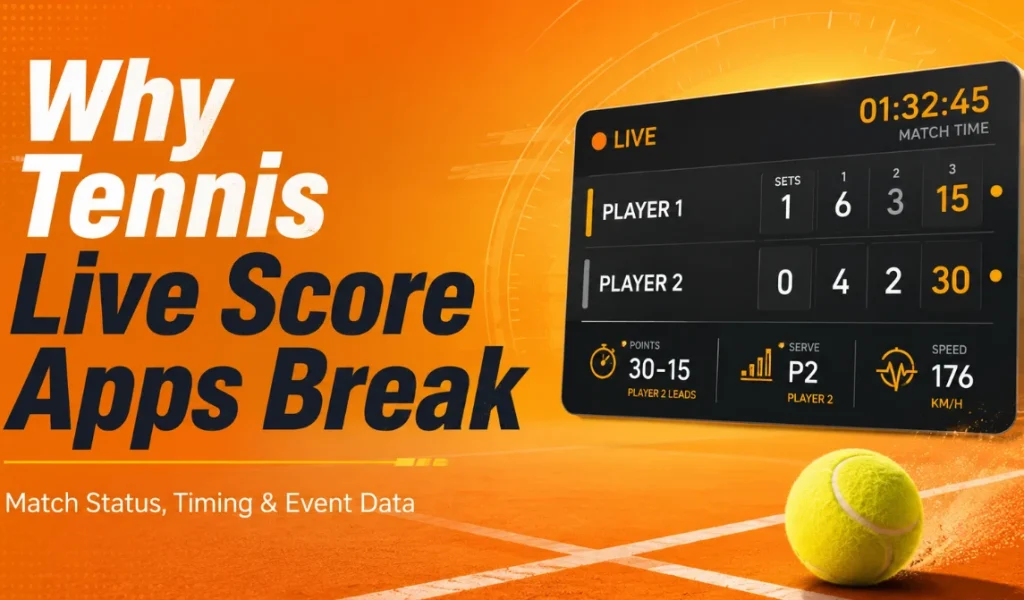
Live tennis apps do not fail because they cannot show a score. They fail when they cannot explain what the score means, when it changed, or whether the match is actually still being played.
Introduction
A tennis live score app can look finished long before it is production-ready. The homepage shows today’s matches, the scoreboard refreshes, and completed results move into a results section. The problems begin when tennis creates delays, suspensions, retirements, walkovers and schedule changes.
Reliable live score products need more than score values. They need match status, timing data and event-level context so the application understands what changed, when it changed and how the user interface should respond.
Teams evaluating a tennis live score API or the Tennis Live API on RapidAPI should look closely at status and update structure, not just whether the current score appears quickly.
Key Takeaway
A live tennis product needs reliable status, timing and event data. Without those layers, the app may display stale scores, trigger wrong notifications, mislabel unusual results and damage user trust during the moments users care about most.
The Score Is Only the Visible Layer
Users open live score apps for the score, but the score is only the visible layer. The product also needs to know whether the match is scheduled, live, delayed, suspended, completed, retired, cancelled or won by walkover.
A partial score can mean several things. It may be a live match in progress, a suspended match waiting to resume or a match that ended because a player retired. If the app only reads the score line, it may display the wrong state.
Match Status Is Product Logic
Match status should drive product behaviour. It affects where the match appears, how often it refreshes, whether alerts fire, whether the result is archived and whether AI content can safely be generated.
A completed match may move into results. A suspended match should remain visible but not appear final. A delayed match should not look broken just because no score has appeared. A walkover should not display like a played match with missing score data.
- Scheduled
- In progress
- Delayed
- Suspended
- Completed
- Retired
- Walkover
- Cancelled
Timing Data Prevents Confusion
Timing is more complicated in tennis than many developers expect. Matches may be scheduled after another match, moved because of weather or delayed by tournament decisions. A single start time rarely tells the full story.
Good timing data helps the product display local time, tournament time, last updated time and the difference between scheduled and actual state. It also helps backend services decide when to refresh, cache or stop polling.
- Scheduled time
- Actual start time where available
- Last updated timestamp
- Completion time
- Tournament local time
- Normalized UTC time
Event Data Explains What Changed
A static score tells the current state. Event data helps explain how the match reached that state. A score update, set completion, suspension, retirement or final result are different events with different product consequences.
Without event awareness, developers often compare snapshots and guess what happened. That can work until updates arrive late, a correction appears or a match changes status unexpectedly.
Notifications Depend on Clean Status
Push alerts are one of the first places bad live data becomes visible. If the app cannot distinguish a normal final result from a retirement, it may send misleading alerts. If it does not know a match is suspended, it may keep users waiting for updates that will not arrive.
Status and timing data make notifications more responsible. The app can alert users when a match starts, when a set finishes, when play is suspended and when the match is officially complete.
Common Mistakes to Avoid
The most common mistake is building for a clean demo instead of real tennis. Demos usually show scheduled matches, live scores and normal completed results. Production needs to handle delays, suspensions, retirements, walkovers, tiebreaks, duplicate-looking names and changing tournament context.
Another mistake is treating data fields as isolated. Player IDs, match IDs, tournament IDs, round values, surfaces, rankings and status fields should work together. If they do not, every future feature becomes harder to maintain.
- Using player names instead of stable IDs.
- Ignoring match status and result type.
- Failing to connect fixtures to live scores and final results.
- Adding AI summaries before the data layer is trustworthy.
- Caching all tennis data with the same refresh rules.
Expert Perspective
“Live tennis products should not force the frontend to guess why a score changed. Status and timing fields need to be structured enough for developers to build reliable interfaces, alerts and archives around them.”
— James Morris, Founder
Implementation Detail That Matters
One practical way to improve reliability is to design the database around the lifecycle of a match. A fixture should not be treated as a temporary object that disappears when play begins. It should become the live match, then the completed result, while retaining the same identity and relationships.
This approach helps frontend teams, backend services and content workflows use the same source of truth. The player page, tournament page, live scoreboard, archive and AI summary should all point back to the same underlying records rather than separate copies of similar data.
It also makes testing easier. Developers can test scheduled, live, suspended, retired, walkover and completed states against one consistent model. That is much safer than building one-off handling for each page template.
Implementation Detail That Matters
One practical way to improve reliability is to design the database around the lifecycle of a match. A fixture should not be treated as a temporary object that disappears when play begins. It should become the live match, then the completed result, while retaining the same identity and relationships.
This approach helps frontend teams, backend services and content workflows use the same source of truth. The player page, tournament page, live scoreboard, archive and AI summary should all point back to the same underlying records rather than separate copies of similar data.
It also makes testing easier. Developers can test scheduled, live, suspended, retired, walkover and completed states against one consistent model. That is much safer than building one-off handling for each page template.
Final Verdict
Why Tennis Live Score Apps Break Without Reliable Match Status, Timing and Event Data is ultimately about product trust. A tennis site or app can look polished while still breaking when match states change, rankings move, fixtures shift, or historical records need context.
The strongest implementations start with structure. They connect players, matches, tournaments, rankings, scores, stats and results through stable IDs and clear status fields. That gives developers a foundation for live pages, archives, search, analytics and AI-assisted product features.
For teams building serious tennis products, the priority is not just getting data onto a page. It is making the data reliable enough that users, editors, developers and automated systems can depend on it every day.
