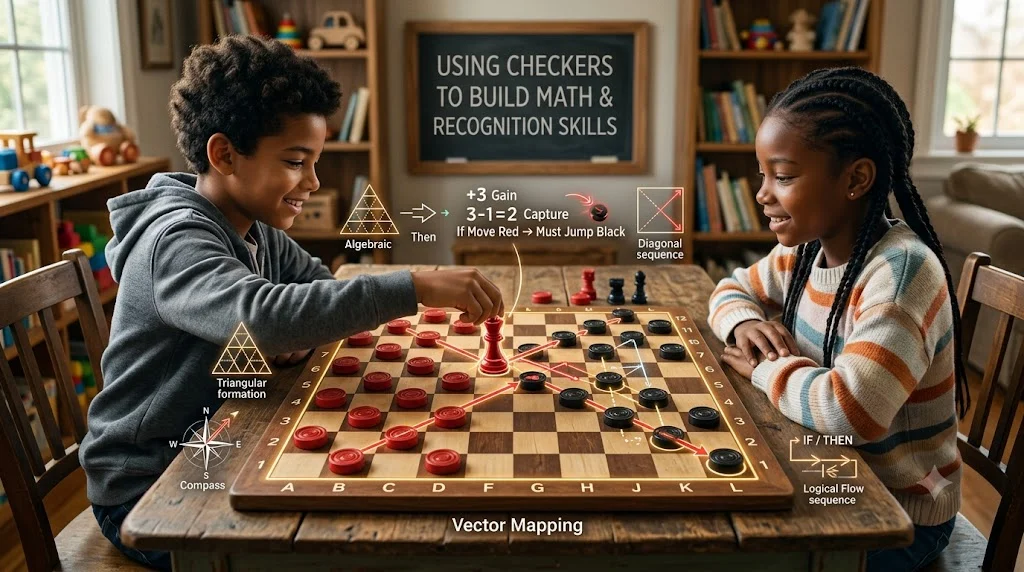
In a world full of bright screens and loud videos, finding fun ways to use checkers to build math and pattern recognition skills can be hard. Both teachers and parents hope to get their children involved in activities that would allow them to learn without having to deal with homework. The perfect answer is actually very simple. It is a classic board game that people have played for hundreds of years.
Most people consider checkers to be an easy game for children. However, it turns out that this seemingly simple game can serve as an excellent way to develop mathematical skills, geometric thinking, and logical abilities. Regularly playing checkers is one of the easiest ways to do this. If you decide to play checkers online on easily accessible websites, you will have the opportunity to practice in a free class that helps develop your brain.
Using Checkers to Build Math and Spatial Skills
At its core, playing checkers forces the human brain to interact with a geometric coordinate. When you play checkers, your brain is actually working with a math grid. The game is played only on the dark squares, which means every piece must move along diagonals.
To play well, you have to measure distances and paths in your head. Kids also practice basic addition and subtraction during trades. For example, they have to calculate: “If I lose one checker but jump two of my opponent’s pieces, is that a good deal?” This is a real-life lesson in positive and negative numbers.
Pattern Recognition: Training the Mind to Read the Board
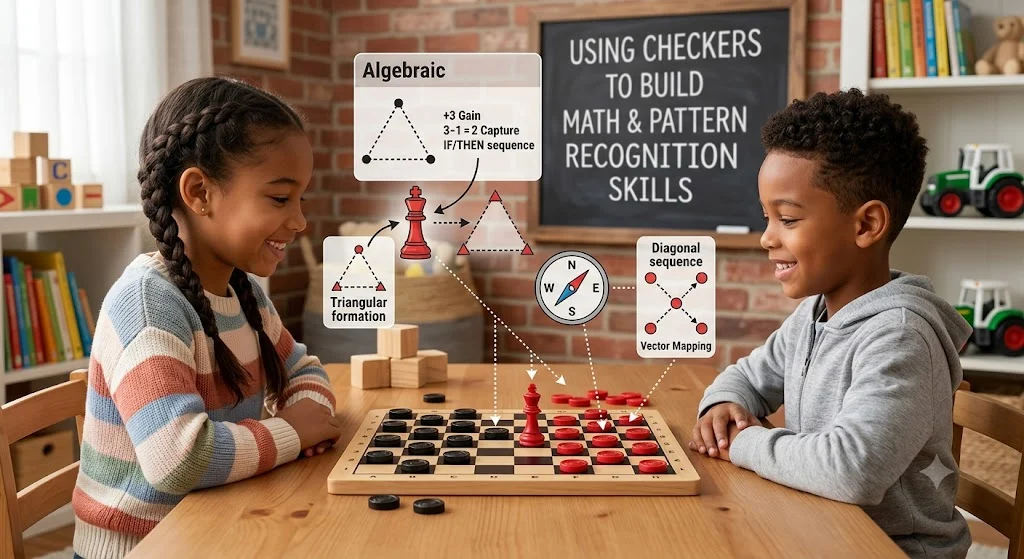
Pattern recognition refers to the identification of repeated forms or patterns in information. This ability is extremely useful in mathematics and computer programming, as it enables one to solve difficult equations and write code.
In checkers, the brain learns to stop focusing on each piece and start looking for groups. The beginner looks at the one red piece, while the expert sees a protective barrier, a weak pair, or an unprotected path. Studying unique checkers variations expands a player’s mental flexibility and visual processing speed by altering these foundational shapes. Being able to identify such formations makes it easy to predict the opponent’s moves.
Comparative Skill Development
| Core Cognitive Skill | How Checkers Teaches It | Classroom Equivalent |
| Spatial Reasoning | Predicting diagonal movement and tracking jumping vectors | Geometry, plotting coordinate planes |
| Pattern Recognition | Spotting classic defensive shapes and opening formations | Algebraic sequencing, coding loop logic |
| Logical Deduction | Analyzing forced-jump scenarios and branching options | Scientific hypothesis testing, variable analysis |
Critical Thinking and If-Then Logic
One of the most powerful educational aspects of checkers is the “forced jump” rule. If a capture is available, the rules state you must take it. This mechanic introduces players to strict conditional logic, the foundational building block of computer science (If X happens, then Y must occur).
Experienced players use this rule to build intricate traps. The players will deliberately sacrifice one of their pieces so that the opponent ends up on a particular square where they can jump more than once on the board. Another aspect worth pointing out about this game is that reaching a draw counts as a win for you. If you manage to checkmate the other player, you win. Mastering these forced endgame scenarios requires a deep dive into proven checkers strategy rules that emphasize position over raw piece count.
30 Ways to Maximize Learning on the Board
- Coordinate Naming: Have the player announce the row and column numbers before making a move.
- Predictive Speech: Have the children speak about their opponent’s next two likely moves before making their own move.
- Vector Mapping: Draw diagonals with fingers to visualize the path.
- Sacrifice Calculations: Find the numerical value of a sacrifice; e.g., if one gives away 1 piece to gain 3 other pieces, it is +2.
- Pattern Recognition: Show children the geometrical shapes that pieces form, e.g., triangles and straight lines.
- If-Then Prompts: Ask out loud: Ask aloud, “What will my opponent be forced to do if I make this move?”
- Endgame Problems: Create endgame problems with 3 pieces remaining to find the fastest way to victory.
- Symmetry Tracking: Observe how mirroring an opponent’s opening alters the board balance.
- Mistake Audits: Rewind a lost game by three turns to find the mathematical error in positioning.
- Piece Counting: Maintain a running tally of remaining pieces to teach active data tracking.
- Time-Limit Drills: Use a chess clock to force rapid mathematical estimation.
- Backward Planning: Start from a desired winning layout and work backward to the current state.
- Variation Studies: Switch between American Checkers and International Draughts to test adaptation to rules.
- Defensive Audits: Count how many secure anchor points exist along the back row.
- Probability Tracking: Estimate the odds of an opponent choosing a left versus a right diagonal escape.
- Pattern Logging: Keep a notebook of board setups that regularly lead to victory.
- Blindfold Drills: Try to play the first five moves of a game purely from memory.
- The Trap Challenge: Win a game where your first three moves must be intentional sacrifices.
- Grid Division: Divide the board mentally into four quadrants to manage tactical focus.
- King Navigation: Calculate the increased geometric freedom a King has compared to a regular piece.
- Forced Lane Tracing: Identify paths where an opponent has zero optional deviations.
- Data Graphing: Track win/loss ratios over a month to plot progress on a scatter chart.
- Rule Coding: Translate the basic rules of checkers into pseudo-code to connect logic to programming.
- Anxiety Management: Use the game’s steady rhythm to practice patience under pressure.
- Impulse Checks: Implement a 5-second rule where hands cannot touch a piece after a decision is made.
- Double-Jump Sweeps: Scan the board specifically looking for intersecting zig-zag paths.
- Spatial Inversion: Turn the board around mid-game and try to solve the puzzle from the opponent’s view.
- Weight Assessment: Rank board squares by strategic value (e.g., side edges versus central columns).
- Stalemate Hunting: Actively play to block all paths rather than to capture all pieces.
- Peer Coaching: Have experienced players explain their tactical reasoning to a beginner aloud.
Conclusion
The beauty of checkers is that the learning happens quietly. The challenge of defeating your competitor is what drives you to learn complex ideas such as mathematics, logic, and geometry without feeling exhausted by school lessons. The regular gaming process becomes an intense mental exercise. The next time you play a game on the chessboard, be aware that you not only play but also exercise your mind like a mathematician.
