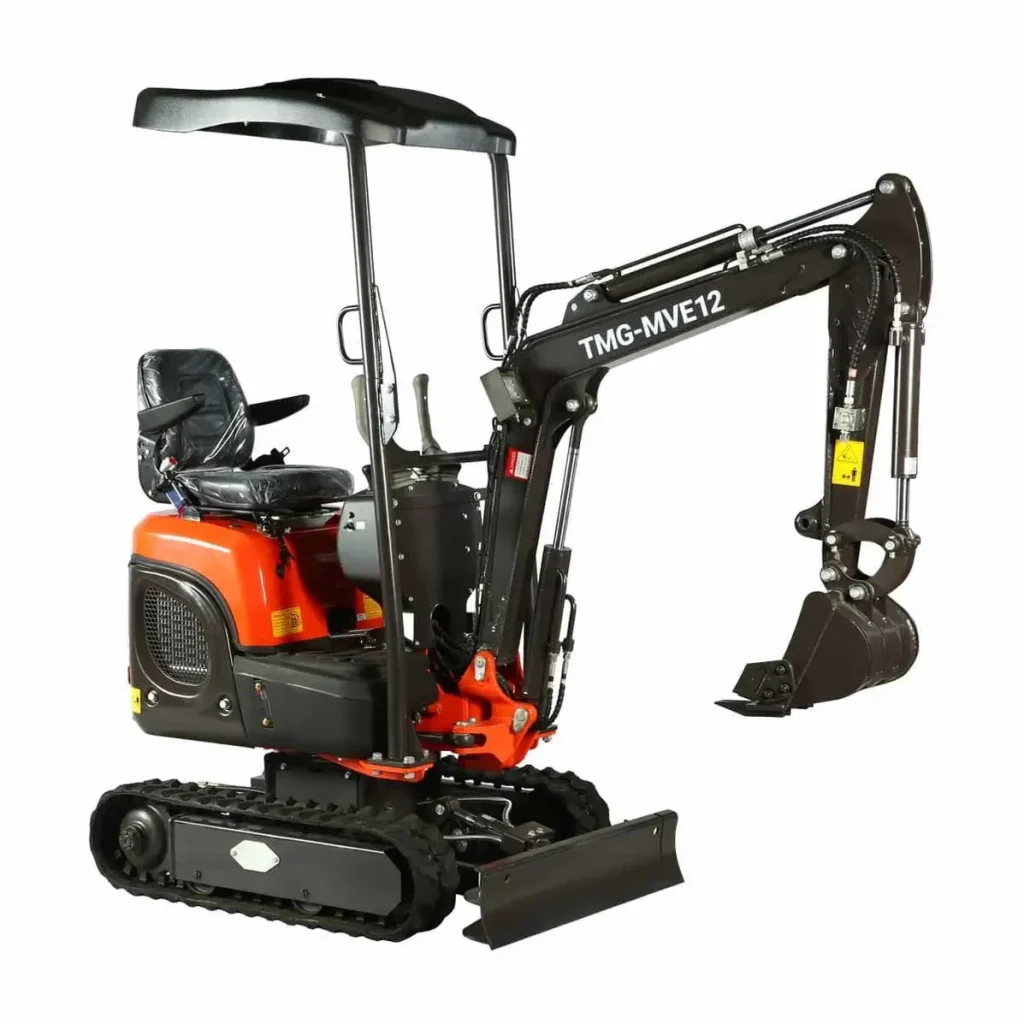
Narrow enough to arrive, heavy enough to dig
Late July is peak ground season in Canada. Drainage trenches before autumn rain, septic repairs, footing excavations, and landscape rebuilds all compete for the same few frost-free months, and most of that work sits behind a house rather than on open ground. A mini excavator earns its place there by fitting through a side gate, which immediately conflicts with the second requirement: staying planted while it digs.
Those two demands pull in opposite directions, and nearly every design decision on a compact machine tries to stop the choosing.
Width is a passage problem and a stability problem at once
A residential gate is often between thirty-six and forty-two inches clear. A machine that cannot pass through has to be craned over the fence, and that costs more than the day of digging.
Stability pulls the other way. A mini excavator tips about the outer edge of a track, so the resisting moment depends on how far that edge sits from the center of mass. Widen the stance and the lever lengthens, letting the machine hold a heavier bucket swung out to the side.
An adjustable chassis refuses the choice. The tracks retract for transit, letting the machine walk through the gate under its own power, then extend on site before any load is lifted. Narrow width becomes a travel condition rather than a working one.
Zero tail overhang buys back the ground behind the machine
On a conventional excavator the counterweight swings outside the track width every time the upper structure rotates. That sweep has to be kept clear, so the operator reserves a radius of empty ground behind the machine even while digging in front.
Zero tail overhang keeps the rear inside the track envelope through a full rotation. The machine can work with its back against a fence or a foundation wall, and trenching along a property line no longer needs a spotter posted to watch the tail.
It is the same problem solved from the other end: one feature controls the room a mini excavator needs to reach the work, the other the room it needs to perform it.
Digging force comes from oil pressure, not from mass
A common misreading is that a heavier machine digs harder. It does not. Breakout force comes from hydraulic cylinders, and cylinder force is fluid pressure multiplied by piston area, supplied by a pump the diesel engine turns.
Machine weight does something else. It provides the reaction holding the excavator down while the bucket pulls against packed soil, because every push the cylinder makes into the earth is answered by an equal push back into the machine.
So the two figures have to be matched. Fit oversized cylinders to a light chassis and the bucket lifts the front of the machine instead of moving dirt. Roughly twelve hundred kilograms of operating weight paired with a fourteen horsepower diesel engine is a balanced pairing for a mini excavator, not an arbitrary one. When a bucket stalls in heavy clay and the tracks begin to lift, the answer is a smaller bite, never more throttle.
Seen this way, a compact machine is a set of deliberate compromises rather than a shrunken large one. The chassis narrows to arrive and widens to work, the tail stays inside the tracks so walls stop being obstacles, and the hydraulics are sized to what the weight can hold down. A mini excavator chosen with those relationships understood moves real ground in a tight Canadian backyard without wrecking the lawn to get there.
