In science class, I remember a simple experiment. The teacher mixed two chemicals in a beaker, and the beaker became hot. Another time, we mixed different chemicals, and the beaker became cold. That day, I learned about endothermic or exothermic reactions. These two terms describe how energy moves during a reaction. In simple words, one reaction takes heat, and the other gives heat.
Understanding endothermic or exothermic reactions is important in real life. These reactions happen in cooking, engines, weather, plants, and even in our bodies. Many students and even professionals sometimes confuse endothermic or exothermic because both involve heat and energy. But the direction of heat flow makes them different.
If you understand endothermic or exothermic, you can understand how energy works in chemistry, nature, and daily life.
Key Difference Between the Both
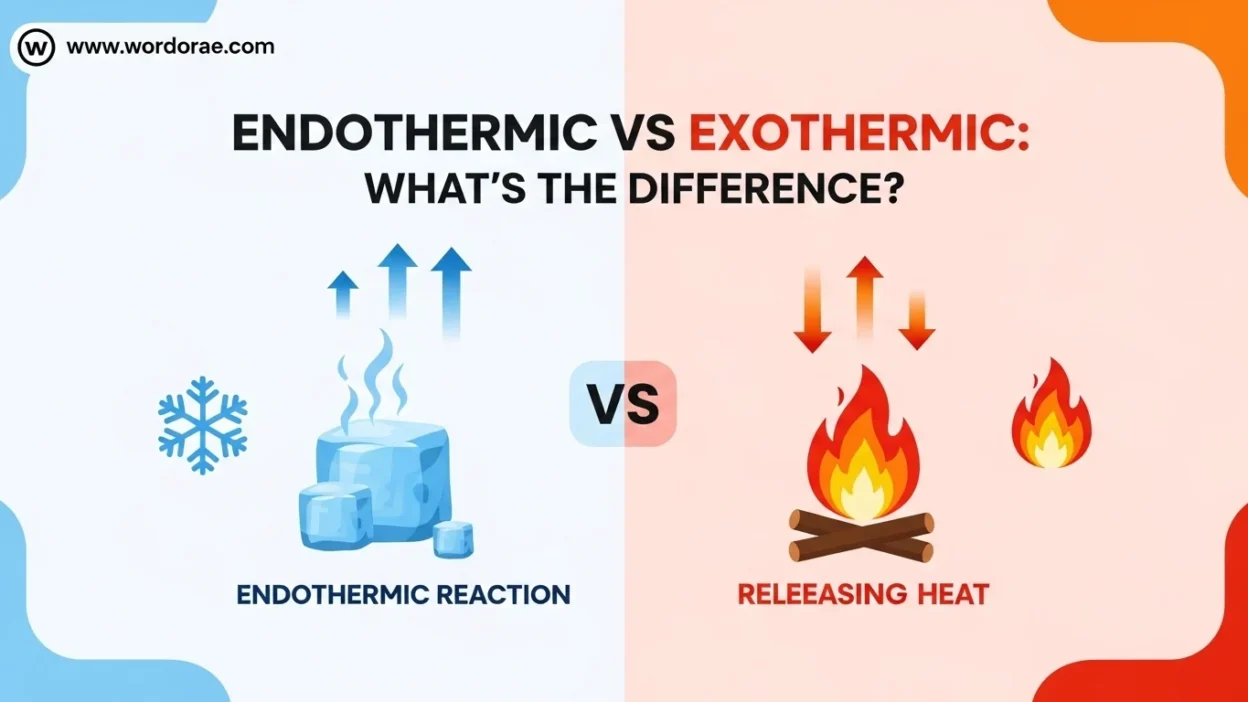
The main difference between endothermic or exothermic reactions is simple:
- Endothermic reactions absorb heat from the surroundings.
- Exothermic reactions release heat to the surroundings.
So, one reaction makes the surroundings cold, and the other makes them hot.
Why Is Their Difference Necessary to Know for Learners and Experts?
It is important to understand endothermic or exothermic reactions because they are used in many fields.
Students need this concept to understand chemistry and physics. Engineers use exothermic reactions in engines and fuel systems. Doctors and biologists study endothermic reactions in the human body. Environmental scientists study these reactions in climate and nature.
In society, these reactions are used in:
- Cooking gas
- Refrigerators
- Batteries
- Explosives
- Plants (photosynthesis)
- Human body metabolism
So, understanding endothermic or exothermic is not just for exams. It helps us understand how the world works.
Pronunciation (US & UK)
| Word | US Pronunciation | UK Pronunciation |
|---|---|---|
| Endothermic | en-do-THER-mik | en-do-THER-mik |
| Exothermic | ek-so-THER-mik | ek-so-THER-mik |
Both are pronounced almost the same in US and UK English.
Linking Hook
Now that you understand the basic idea of endothermic or exothermic, let’s look at the detailed differences between them.
Difference Between Endothermic and Exothermic
(Using simple explanations and examples)
1. Heat Flow
Endothermic: Takes heat in.
Examples:
- Ice melting
- Photosynthesis in plants
Exothermic: Gives heat out.
Examples:
- Burning wood
- Explosion of firecrackers
2. Temperature Change
Endothermic: Surroundings become cold.
Examples:
- Instant cold packs
- Evaporation of water
Exothermic: Surroundings become hot.
Examples:
- Candle burning
- Hand warmers
3. Energy Direction
Endothermic: Energy goes into the reaction.
Examples:
- Cooking food
- Boiling water
Exothermic: Energy comes out of the reaction.
Examples:
- Fuel burning
- Respiration in the body
4. Energy Storage
Endothermic: Energy is stored.
Examples:
- Plants store energy from sunlight
- Charging a battery
Exothermic: Energy is released.
Examples:
- Battery discharging
- Burning coal
5. Chemical Bond Energy
Endothermic: Needs energy to break bonds.
Examples:
- Electrolysis of water
- Photosynthesis
Exothermic: Releases energy when bonds form.
Examples:
- Water formation from hydrogen and oxygen
- Combustion reaction
6. Feeling
Endothermic: Feels cold.
Examples:
- Ice pack
- Alcohol evaporation on skin
Exothermic: Feels hot.
Examples:
- Fire
- Hot pack
7. Natural Occurrence
Endothermic: Happens with sunlight.
Examples:
- Photosynthesis
- Ice melting
Exothermic: Happens in burning and respiration.
Examples:
- Volcano eruption
- Digestion
8. Energy Requirement
Endothermic: Needs continuous energy.
Examples:
- Plant growth
- Cooking
Exothermic: Can continue once started.
Examples:
- Fire
- Explosion
9. Enthalpy Change
Endothermic: Positive energy change.
Exothermic: Negative energy change.
Examples:
- Endothermic → Melting ice
- Exothermic → Burning fuel
10. Real Life Use
Endothermic: Used in cold packs and cooling systems.
Exothermic: Used in engines and heating systems.
Nature and Behaviour of Both
Endothermic reactions absorb energy. They store energy and are usually slow. They are useful for cooling and energy storage.
Exothermic reactions release energy. They produce heat and light and are usually fast. They are useful for heating and power.
Examples:
- Photosynthesis → Endothermic
- Respiration → Exothermic
Why People Are Confused About Their Use?
People are confused about endothermic or exothermic because both involve heat and energy. Students often forget whether heat is absorbed or released.
Another reason is the spelling. Both words look similar and end with -thermic, which relates to heat. The only difference is endo (inside) and exo (outside).
Memory trick:
- Endo = Energy goes in
- Exo = Energy goes out
Table Showing Difference and Similarity
| Feature | Endothermic | Exothermic |
|---|---|---|
| Heat | Absorbed | Released |
| Temperature | Decreases | Increases |
| Energy | Stored | Released |
| Example | Photosynthesis | Burning |
| Surroundings | Cold | Hot |
| Similarity | Both involve energy change | Both are chemical reactions |
Which Is Better in What Situation?
Endothermic reactions are better when we need cooling. For example, cold packs used in sports injuries work on endothermic reactions. These reactions absorb heat and make things cold. Endothermic reactions are also important in plants because photosynthesis is endothermic. Without it, plants cannot make food.
Exothermic reactions are better when we need heat and energy. For example, engines, cooking gas, and heaters use exothermic reactions. These reactions release heat and energy, which helps in transportation, cooking, and electricity production.
So, both reactions are important. One is useful for cooling and storing energy, and the other is useful for heating and producing energy.
How Are the Keywords Used in Metaphors and Similes?
Sometimes endothermic and exothermic are used as metaphors.
- An endothermic person may describe someone who needs energy from others to stay motivated.
- An exothermic person may describe someone who spreads energy, excitement, and warmth to others.
Examples:
- She is an exothermic personality, always spreading positivity.
- He is endothermic, he works better when others motivate him.
Connotative Meaning (Positive, Negative, Neutral)
| Word | Connotation |
|---|---|
| Endothermic | Neutral |
| Exothermic | Positive (energy, heat, power) |
Examples:
- The team had an exothermic reaction after winning (positive energy).
- The process was endothermic and slow (neutral description).
Idioms or Proverbs Related to the Words
These exact words are not common in idioms, but similar heat-related idioms exist:
| Idiom | Meaning | Example |
|---|---|---|
| Burn the candle at both ends | Work too hard | He is burning the candle at both ends. |
| Where there is smoke, there is fire | Something is wrong | The rumors must be true. |
| Add fuel to the fire | Make situation worse | His comment added fuel to the fire. |
Works in Literature Related to the Keywords
- “The Periodic Table” – Primo Levi (Science memoir, 1975)
- “A Brief History of Time” – Stephen Hawking (Science, 1988)
- “The Disappearing Spoon” – Sam Kean (Science history, 2010)
These books discuss chemical and energy reactions including endothermic and exothermic processes.
Movies Related to Heat, Energy, and Chemical Reactions
- Back to the Future (1985, USA) – Energy reactions and power
- The Core (2003, USA) – Heat and Earth energy
- Oppenheimer (2023, USA/UK) – Nuclear reactions (exothermic)
Five Frequently Asked Questions
1. What is the main difference between endothermic and exothermic?
Endothermic absorbs heat, exothermic releases heat.
2. Is photosynthesis endothermic or exothermic?
Photosynthesis is endothermic because it uses sunlight energy.
3. Is burning fuel endothermic or exothermic?
Burning fuel is exothermic because it releases heat.
4. Why does endothermic feel cold?
Because it absorbs heat from surroundings.
5. Why does exothermic feel hot?
Because it releases heat into surroundings.
How Are Both Useful for Surroundings?
Both endothermic and exothermic reactions are useful for the environment and human life.
Endothermic reactions help in cooling systems, plant growth, and climate balance. Exothermic reactions help in energy production, transportation, heating, and cooking.
Without these reactions, life would not exist. Plants use endothermic reactions, and humans use exothermic reactions for energy.
Final Words for the Both
Endothermic means energy goes in.
Exothermic means energy comes out.
Remember this simple rule, and you will never forget the difference.
Conclusion
Understanding endothermic or exothermic reactions is very important in science and daily life. These reactions explain how energy moves in the world around us. Endothermic reactions absorb heat and make things cold, while exothermic reactions release heat and make things hot.
I believe the easiest way to remember the difference is this: Endo = Energy in, Exo = Energy out. Once you understand this, the concept becomes very simple.
From cooking food to driving cars, from plant growth to electricity production, these reactions are everywhere. So, learning endothermic or exothermic is not just for exams. It helps you understand how the world works.