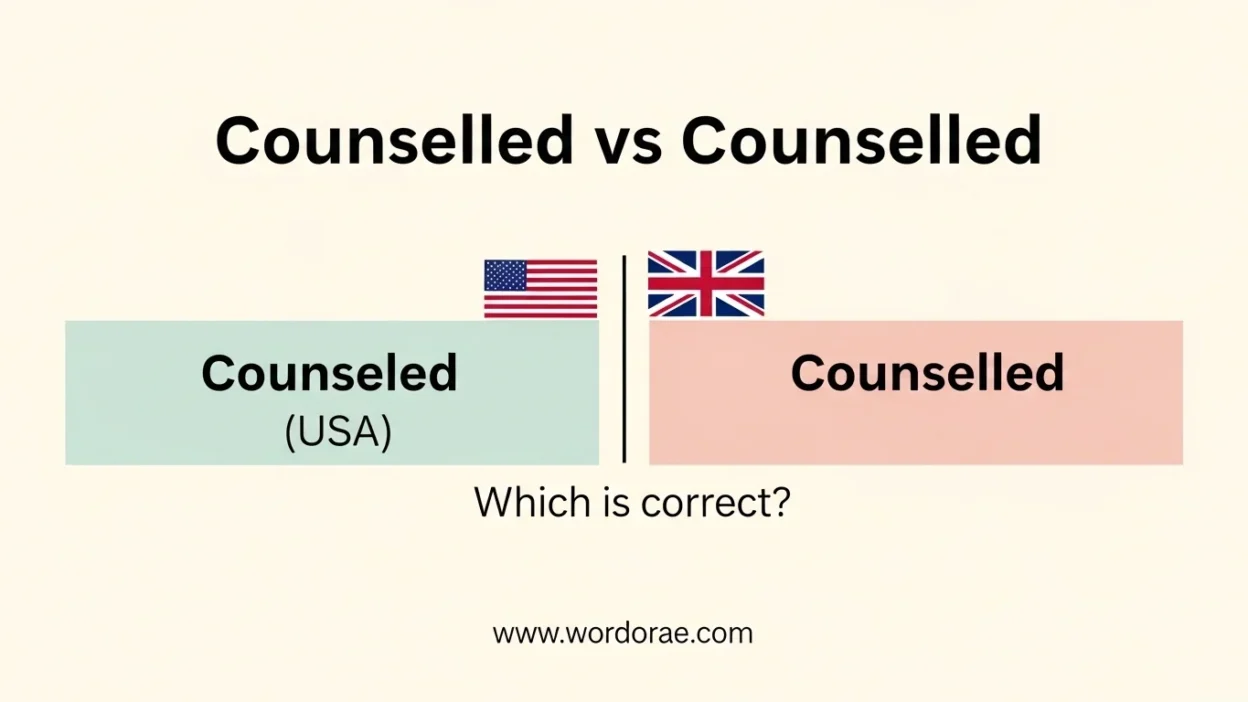
Quick answer: “Counseled” is American English, while “counselled” is British English—both are correct.
I once paused while writing a report and wondered, counselled or counseled? It looked like a small detail, but I knew it could affect how professional my writing appeared.
If you’ve searched counselled or counseled, you’re likely facing the same confusion.
Many writers ask questions like “is counseled correct,” “counselled vs counseled difference,” or “how to spell counseled.”
This confusion exists because English has two major systems: American and British. Each follows slightly different spelling rules.
That’s why both counselled or counseled appear online, in books, and even in formal writing.
In this guide, I’ll show you the exact difference, when to use each, and how to avoid mistakes.
By the end, you’ll never second-guess this word again.
Counselled or Counseled – Quick Answer
Both spellings are correct, but used in different regions:
- Counseled → American English
- Counselled → British English
Examples:
- US: She counseled him during the meeting.
- UK: She counselled him during the meeting.
- Meaning: to give advice or guidance
Key Differences Between Counselled or Counseled
1. Spelling Rule
- Counseled uses one “l”
- Example: He counseled me yesterday.
- Example: She counseled her team.
- Counselled uses double “l”
- Example: He counselled me yesterday.
- Example: She counselled her team.
2. Regional Usage
- Counseled → USA
- Example: Used in American schools.
- Example: Found in US newspapers.
- Counselled → UK, Canada
- Example: Used in British education.
- Example: Found in UK news.
3. Spelling Pattern Rule
- Counseled follows American simplification
- Example: Cancel → canceled
- Example: Travel → traveled
- Counselled follows British doubling rule
- Example: Cancel → cancelled
- Example: Travel → travelled
4. Professional Use
- Counseled common in US law and therapy
- Example: The lawyer counseled the client.
- Example: The therapist counseled the patient.
- Counselled used in UK institutions
- Example: The advisor counselled students.
- Example: The officer counselled the witness.
5. Search Popularity
- Counseled appears more online
- Example: More common in blogs
- Example: Dominates global SEO
- Counselled less frequent globally
- Example: Mostly UK websites
- Example: Less in global content
6. Pronunciation
- Both sound the same
- Example: Counseled = counselled
- Example: No change in speech
7. Writing Consistency
- Use one style only
- Example: Don’t mix both in one article
- Example: Stay consistent in essays
8. Academic Preference
- Counseled → US universities
- Example: Used in research papers
- Example: Preferred in US journals
- Counselled → UK universities
- Example: Used in UK theses
- Example: Preferred in British academia
9. Digital Writing
- Counseled → global content
- Example: Blogs and SEO articles
- Example: Online guides
- Counselled → regional sites
- Example: UK blogs
- Example: Local publications
10. Simplicity
- Counseled easier to write
- Example: Fewer letters
- Example: Faster typing
- Counselled more traditional
- Example: Follows classic rules
- Example: Looks formal
Grammar / Concept Breakdown
The base word is “counsel.”
It means: to give advice or guidance.
When changing to past tense:
- American English → counseled
- British English → counselled
Rule:
- Words ending in “l” often double in British English
- American English usually keeps one “l”
The Origin of Counselled or Counseled
The word “counsel” comes from Latin consilium, meaning advice or plan.
Over time:
- British English kept traditional spelling → counselled
- American English simplified spelling → counseled
This split created two correct versions of the same word.
Common Usage & Meaning
Both words mean the same thing:
👉 To give advice, support, or guidance
Used in:
- Therapy
- Education
- Law
- Daily life
Examples:
- The teacher counseled the student.
- The mentor counselled the intern.
Why People Get Confused About Counselled or Counseled
The confusion happens because:
- Both spellings are correct
- Both sound identical
- Both appear in formal writing
People think one must be wrong—but the real difference is region, not meaning.
British vs American English
| Feature | American English | British English |
|---|---|---|
| Spelling | counseled | counselled |
| Double “l” | No | Yes |
| Region | USA | UK |
| Example | He counseled me | He counselled me |
Which One Should You Use?
If your audience is in the US, use counseled. It is simpler and more common online.
If your audience is in the UK or follows British English, use counselled. It matches local standards.
If your audience is global, choose one style and stay consistent. Consistency builds trust and professionalism.
Common Mistakes
❌ Writing “counselled” in US content
✔ Use “counseled”
❌ Mixing both spellings
✔ Stick to one version
❌ Thinking one is incorrect
✔ Both are correct
❌ Overthinking pronunciation
✔ Both sound the same
Counselled or Counseled in Everyday Examples
Emails:
- I counseled him about the issue.
- I counselled him about the issue.
Social Media:
- She counseled her friend today.
- He counselled his teammate.
Formal Writing:
- The lawyer counseled the client.
- The advisor counselled the patient.
Counselled or Counseled – Usage Trends
- “Counseled” is more popular worldwide
- “Counselled” is common in UK regions
👉 For SEO and global reach, counseled is more widely used
Quick Comparison Table
| Feature | Counseled | Counselled |
|---|---|---|
| Region | USA | UK |
| Spelling | One “l” | Double “l” |
| Meaning | Same | Same |
| Pronunciation | Same | Same |
| Popularity | Higher | Lower |
FAQs
Q1: Which is correct, counselled or counseled?
Both are correct depending on region.
Q2: Is counseled correct in formal writing?
Yes, especially in American English.
Q3: Why does British English use double “l”?
It follows traditional spelling rules.
Q4: Do they have different meanings?
No, both mean giving advice.
Q5: Which is better for SEO?
“Counseled” is more common globally.
Q6: Can I use both in one article?
No, stay consistent.
Q7: How do you spell counseled correctly?
US: counseled | UK: counselled
Q8: Is one more professional?
No, both are equally professional.
Conclusion
So, counselled or counseled—which should you use? The answer is simple. Both are correct, but they belong to different forms of English.
American English prefers counseled, while British English uses counselled.
What matters most is your audience. If you are writing for the US or global readers, “counseled” is often the better choice.
If your audience is in the UK, “counselled” is the right option.
In the end, clarity and consistency matter more than the spelling itself.
Now that you understand the rule, you can write with confidence and avoid this common mistake forever.

I’m David Miller, a grammar expert and author at Wordorae.com, specializing in clear, simple explanations of confusing English grammar and word usage.
I help readers write with confidence by turning complex grammar rules into easy, practical guidance.