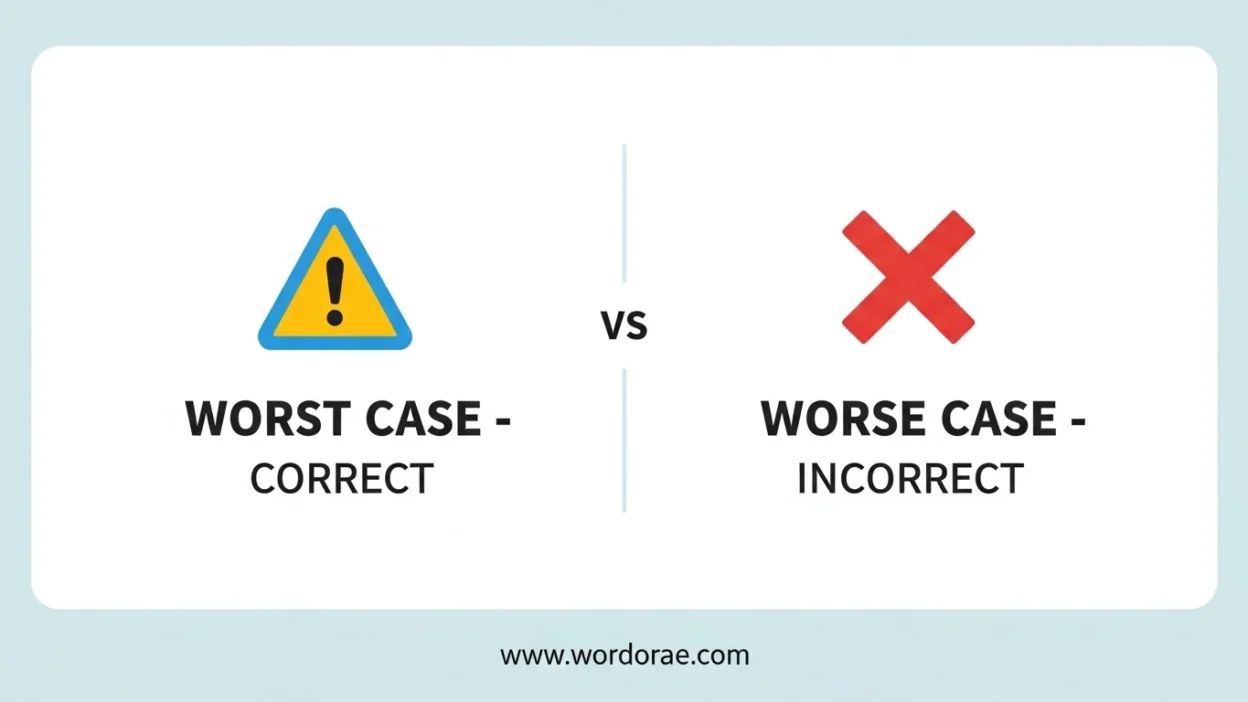
Quick answer first: “Worst case” is correct. “Worse case” is usually wrong.
If you’ve ever paused while writing and thought, “Is it worse case or worst case?”, you’re not alone.
I see this confusion everywhere in emails, articles, exams, and even professional reports.
I know why this trips you up. Worse and worst look almost the same, and both relate to bad situations.
When you’re writing quickly, it’s easy to second-guess yourself. I’m writing this to clear that confusion once and for all.
I’ll explain the difference in simple words, show you real examples, and give you an easy rule you can remember.
By the end, you’ll know exactly which phrase to use and you won’t hesitate again.
Worse Case or Worst Case – Quick Answer
The correct phrase is “worst case.”
It refers to the most bad or extreme possible situation.
Examples:
- In the worst case, we may lose the project.
- Plan for the worst case scenario.
“Worse case” is usually incorrect because worse is a comparative, not a superlative.
The Origin of Worse Case or Worst Case
To understand this fully, you need to know how comparison works in English.
- Bad → Worse → Worst
Worse compares two things.
Worst describes the extreme end, the most negative outcome possible.
The phrase “worst case” developed to describe the maximum risk or damage in planning, logic, business, engineering, and everyday speech. That’s why you hear it in phrases like worst case scenario.
“Worse case” never developed as a standard phrase in English. When people use it, it’s usually a mistake.
British English vs American English Usage
This confusion is not regional. Both British and American English follow the same rule.
| Version | Correct Phrase | Incorrect Phrase |
| American English | Worst case | Worse case |
| British English | Worst case | Worse case |
| Canadian English | Worst case | Worse case |
| Australian English | Worst case | Worse case |
So if you’re wondering “worse case or worst case British English” or American English—the answer is the same.
Which One Should You Use?
Here’s the rule I personally use, and you can use it too.
Use worst case when:
- You mean the most negative outcome
- You’re talking about risk, planning, or extremes
- You can replace it with most bad
Correct:
- Worst case scenario
- In the worst case
- Prepare for the worst case
Avoid worse case unless you are comparing two cases directly, which is rare and usually unnecessary.
Common Mistakes with Worse Case or Worst Case
These are very common errors:
❌ In the worse case, we fail.
✅ In the worst case, we fail.
❌ Let’s plan for the worse case scenario.
✅ Let’s plan for the worst case scenario.
❌ This is the worse case I’ve seen.
✅ This is the worst case I’ve seen.
The mistake happens because people confuse comparison with extremes.
Worse Case or Worst Case in Everyday Examples
Emails
- Worst case, the delivery arrives tomorrow.
- In the worst case, we rescheduled the meeting.
News
- Analysts warned of a worst case economic downturn.
- The report outlines the worst case scenario.
Social Media
- Worst case, I’ll try again tomorrow.
- Always prepare for the worst case.
Formal Writing
- The model evaluates best-case and worst-case outcomes.
- Risk assessment focuses on worst case projections.
Comparison Table: Worse vs Worst
| Word | Type | Meaning | Example |
| Worse | Comparative adjective | More bad (between two) | This option is worse. |
| Worst | Superlative adjective | Most bad (of all) | This is the worst case. |
This table explains why “worst case” is grammatically correct.
Worse Case or Worst Case – Trends & Usage
Search data shows:
- “Worst case” is widely used and accepted.
- “Worse case” appears mainly in:
- Grammar questions
- ESL learning
- Usage confusion searches
People searching “worse case or worst case which is correct” want certainty, not theory. The clear answer is always the worst case.
FAQs
1. Is “worse case” ever correct?
Almost never. It’s usually a mistake.
2. Why do people say “worse case”?
Because worse and worst sound similar.
3. Is “worst case scenario” correct?
Yes, it’s a fixed and correct phrase.
4. Can I say “best case and worst case”?
Yes, that pairing is correct.
5. Is this a grammar mistake or usage issue?
It’s both, but mainly usage.
6. Is “worst-case” hyphenated?
Yes, when used as an adjective (worst-case outcome).
7. Does this rule apply in formal writing?
Yes, especially in formal writing.
8. Is “worse case scenario” acceptable informally?
No, it’s still incorrect.
9. Do native speakers make this mistake?
Yes, often in casual writing.
10. How can I remember the rule?
Extreme situation → worst, not worse.
Conclusion
Let me make this crystal clear for you. Worst case is the correct phrase because it refers to the most negative possible outcome.
Worse case doesn’t work because worse compares only two things, and a case usually refers to an extreme.
If you remember just one thing, remember this:
You prepare for the worst case, not the worse case.
Once you lock this in, your writing instantly sounds more confident and polished if you’re sending an email, writing an article, or answering an exam question.

I’m David Miller, a grammar expert and author at Wordorae.com, specializing in clear, simple explanations of confusing English grammar and word usage.
I help readers write with confidence by turning complex grammar rules into easy, practical guidance.