Quick answer: It’s vice versa, never visa versa.
Have you ever typed “visa versa”, only to wonder if it was right? You’re not alone. Many people get confused because both sound almost identical when spoken.
Writers, students, and even professionals often search “vice versa or visa versa” to make sure their work looks polished and correct.
The truth is, using the wrong spelling might seem minor, but it can make emails, essays, or social posts look careless.
Knowing the correct form not only helps your writing look professional, but also ensures your readers immediately understand your meaning.
In this article, we’ll explain everything you need to know about vice versa from its Latin roots to British vs American usage, common mistakes, and real-world examples.
By the end, you’ll never have to second-guess yourself when writing this simple yet important phrase.
Vice Versa or Visa Versa – Quick Answer
Vice versa means the other way around or with positions reversed.
Visa versa is incorrect.
Correct examples:
- You can teach me, or I can teach you vice versa.
- Parents influence children, and vice versa.
- She helps him, and vice versa.
Incorrect example:
- ❌ You help me and visa versa.
So whenever you’re unsure, remember: it’s always vice versa.
The Origin of Vice Versa or Visa Versa
The phrase vice versa comes from Latin. In Latin:
- vice = in place of
- versa = turned
Put together, it means “with positions reversed”. English borrowed it directly, keeping the spelling intact.
So where did visa versa come from? Most likely, people just heard it spoken and assumed it was spelled “visa” like the travel document.
Over time, this mistake spread through casual writing, emails, and social media. But in standard English, it has never been correct.
British English vs American English Spelling
Some people wonder if one spelling is British and the other American. That’s not the case. Both varieties of English use vice versa as the correct form.
| Spelling | British English | American English |
| vice versa | ✅ Correct | ✅ Correct |
| visa versa | ❌ Incorrect | ❌ Incorrect |
No matter who your audience is, vice versa is the spelling you should use.
Which Spelling Should You Use?
The answer is simple: always use “vice versa.”
- US audience: vice versa
- UK audience: vice versa
- Academic writing: vice versa
- Business emails: vice versa
- Social media posts: vice versa
It’s a small detail, but using the correct spelling makes your writing clear, professional, and easy to read.
Common Mistakes with Vice Versa or Visa Versa
Even though the rule is simple, people still slip up. Common errors include:
- ❌ Writing visa versa
- ❌ Capitalizing it unnecessarily in mid-sentence
- ❌ Using it redundantly, like “reverse vice versa”
- ❌ Spelling it incorrectly in emails, essays, or reports
Tips for correct usage:
- Always write two words: vice versa
- Keep it lowercase unless it starts a sentence
- Use it sparingly for clarity
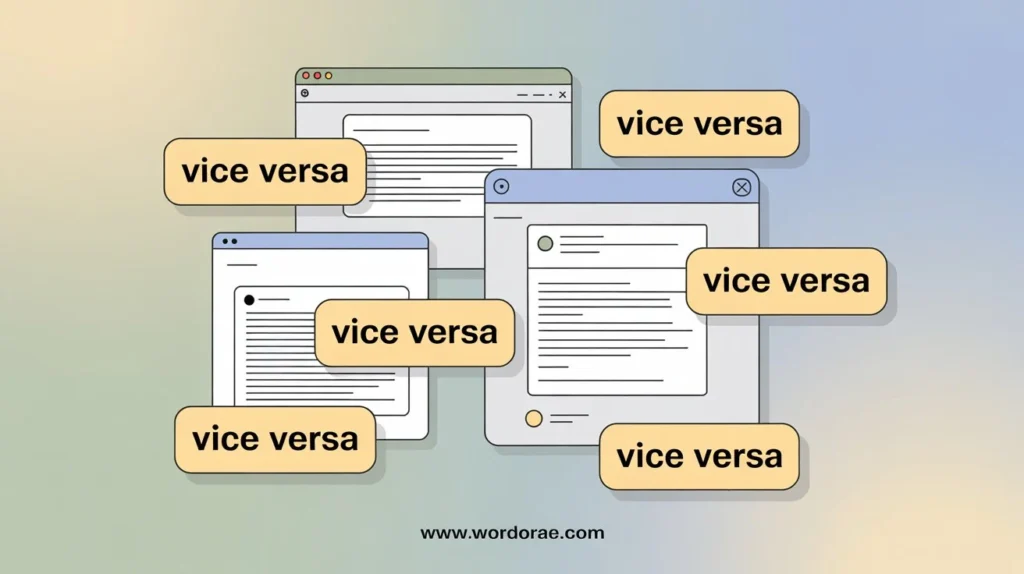
Vice Versa in Everyday Examples
Emails:
- “You can review the draft today, or I can review it tomorrow vice versa.”
Workplace Communication:
- “Managers support employees, and vice versa.”
Academic Writing:
- “Language influences culture, and vice versa.”
Social Media:
- “Some days motivate me, and other days I motivate myself vice versa.”
Formal Writing:
- “The contract protects both buyer and seller, and vice versa.”
Vice Versa – Trends & Usage Data
People frequently search “vice versa or visa versa”, especially:
- Students checking homework
- ESL learners verifying spelling
- Professionals proofreading emails
- Writers ensuring accuracy
Dictionaries, style guides, and most online articles use vice versa, which also performs better for search visibility on Google.
Comparison Table: Vice Versa vs Visa Versa
| Feature | Vice Versa | Visa Versa |
| Correct spelling | ✅ Yes | ❌ No |
| Dictionary accepted | ✅ Yes | ❌ No |
| British English | ✅ Yes | ❌ No |
| American English | ✅ Yes | ❌ No |
| Professional writing | ✅ Yes | ❌ No |
| SEO-friendly | ✅ Yes | ❌ No |
FAQs
1. Is it vice versa or visa versa?
Always vice versa. Visa versa is wrong.
2. What does vice versa mean?
It means the other way around or in reverse.
3. Can visa versa ever be correct?
No, it is always incorrect.
4. Is vice versa Latin?
Yes, it comes from Latin and was borrowed directly into English.
5. Should I italicize vice versa?
No, it’s fully accepted in English.
6. Can I use it in professional writing?
Yes, it’s perfectly professional.
7. Is it one word or two?
It’s two words: vice versa.
Conclusion
The confusion between vice versa or visa versa is common but easy to fix. Vice versa is the correct spelling in all varieties of English, while visa versa is simply a phonetic mistake.
Its Latin roots “with positions reversed” make it easy to remember.
Using the correct spelling ensures your writing looks polished, professional, and clear.
Whether you’re writing emails, academic papers, or social media posts, vice versa fits naturally and conveys your meaning accurately.
Avoiding the common mistakes listed above will also make your work appear more credible.
Remember, this is one of those small details that can make a big difference in how your writing is perceived.
Once you get it right, you’ll never have to worry about it again, and your readers will appreciate the clarity.
Keep this guide handy, and vice versa will always be your go-to spelling.

I’m David Miller, a grammar expert and author at Wordorae.com, specializing in clear, simple explanations of confusing English grammar and word usage.
I help readers write with confidence by turning complex grammar rules into easy, practical guidance.