Quick answer:
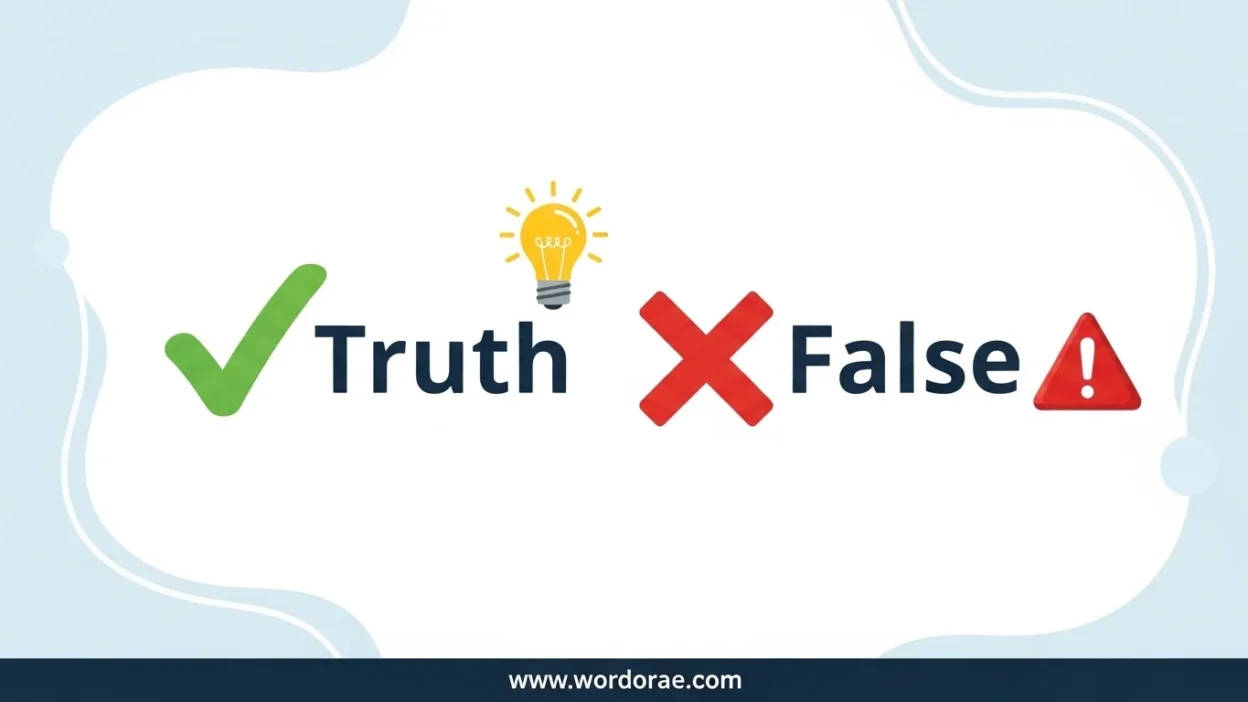
Truth is a noun that means something is real or correct, while false is an adjective that means something is not true.
I know why you’re here. You’ve seen truth or false used in quizzes, exams, headlines, and online posts. Sometimes it sounds right.
Other times it feels off. You stop and think, Is this correct English,
or am I missing something? I’ve asked that same question before, and you’re not alone.
People often search truth or false because they want a simple answer.
They want to know which word to use, when to use it, and why one sounds wrong in certain sentences.
This confusion shows up a lot in school questions, true/false tests, and even professional writing.
In this guide, I’ll walk you through the difference in a clear, human way.
I’ll show you how these words work, where mistakes happen, and how you can use them correctly every time.
By the end, you won’t second-guess yourself again.
Truth or False – Quick Answer
Truth is a noun.
False is an adjective.
Example:
- The truth is hard to accept.
- That statement is false.
You don’t usually say “truth or false” in standard English. The correct pair is true or false.
The Meaning of Truth
Truth means something that is real, correct, or based on facts.
It answers the question: What is real?
Examples:
- She told the truth.
- The truth came out later.
- It’s the truth, even if it hurts.
Truth is a thing. You can talk about it, search for it, or hide it.
The Meaning of False
False means something is not true, not correct, or fake.
It describes something else.
Examples:
- The claim is false.
- That rumor is false.
- The alarm was false.
False cannot stand alone as an idea like truth. It must describe something.
Why “Truth or False” Sounds Wrong
This is where confusion starts.
You’re pairing:
- A noun (truth)
- With an adjective (false)
They don’t match grammatically.
That’s why English uses:
- True or false (adjective + adjective)
Truth or false feels wrong because the grammar is uneven.
The Origin of Truth and False
The word truth comes from Old English trēowth, meaning faith or honesty.
The word false comes from Latin falsus, meaning deceptive or untrue.
Over time, English kept their roles clear:
- Truth became a noun.
- False stayed an adjective.
That difference still matters today.
Truth or False vs True or False
| Phrase | Correct? | Reason |
|---|---|---|
| Truth or false | ❌ No | Noun + adjective |
| True or false | ✅ Yes | Adjective + adjective |
| The truth is false | ❌ No | Logical conflict |
| The statement is false | ✅ Yes | Correct grammar |
Which One Should You Use?
Here’s the simple rule.
Use truth when:
- You are naming a fact or reality
- You want to talk about honesty
Use false when:
- You are describing a statement
- You are correcting wrong information
Use true or false when:
- Writing quizzes
- Asking yes/no questions
- Testing facts
Never use truth or false in formal writing.
Common Mistakes with Truth or False
These errors happen often.
Mistake 1: Writing truth or false in exams
✅ Correct: true or false
Mistake 2: Saying this truth is false
✅ Correct: this statement is false
Mistake 3: Using false as a noun
✅ Correct: use falsehood instead
Mistake 4: Mixing grammar forms
Match noun with noun. Adjective with adjective.
Truth or False in Everyday Examples
In school:
❌ Truth or false: The earth is flat.
✅ True or false: The earth is flat.
In news:
- The report revealed the truth.
- The rumor was false.
In social media:
- That post is false.
- People want the truth.
In emails:
- Please confirm if this information is true or false.
- We need the truth before deciding.
Grammar Comparison Table
| Word | Part of Speech | Use Case |
|---|---|---|
| Truth | Noun | Facts, reality |
| True | Adjective | Describes correctness |
| False | Adjective | Describes incorrectness |
| Falsehood | Noun | A lie |
Why This Matters for Writing and SEO
Using the wrong phrase can:
- Confuse readers
- Lower credibility
- Look careless in exams or articles
Search engines favor clear, correct language.
Readers trust writers who use words properly.
That’s why knowing the difference matters.
FAQs
Is “truth or false” ever correct?
No. Standard English uses true or false.
Why do people say truth or false?
It’s often a direct translation or a common learner mistake.
Can false be a noun?
Not usually. Use falsehood instead.
Is truth always positive?
No. Truth can be uncomfortable or painful.
What’s better for exams?
Always use true or false.
Can I say “the truth is false”?
No. That creates a logical contradiction.
Is this mistake common?
Yes, especially among students and non-native speakers.
Conclusion
I know this seems like a small detail, but it makes a big difference.
When you understand truth or false, you start to see how English really works.
Truth names reality. False describes error. They don’t compete in the same space.
If you remember just one thing, remember this: true or false is the correct pair.
Once you lock that in, your writing becomes cleaner and more confident.
I want you to feel sure when you write, speak, or answer questions. You don’t need to guess anymore. You already know the rule.

I’m David Miller, a grammar expert and author at Wordorae.com, specializing in clear, simple explanations of confusing English grammar and word usage.
I help readers write with confidence by turning complex grammar rules into easy, practical guidance.