Have you ever paused while writing and wondered, “Is it time flies or time flys?” You’re not alone.
Thousands of people search this phrase every month, usually when typing an email, a post, or even a caption.
Many people also search “time flys or flies” because they’re unsure which verb form follows the word “time.”
The confusion comes from English spelling rules, where many words change when pluralized or conjugated.
Some words keep “y” while others change it to “i.” Because of this, writers often second-guess themselves.
We’ll also look at common mistakes, everyday examples, and real usage data. By the end, you’ll know not only the correct spelling but also why it matters. Let’s dive in.
Time Flies or Time Flys – Quick Answer
The correct phrase is “time flies.”
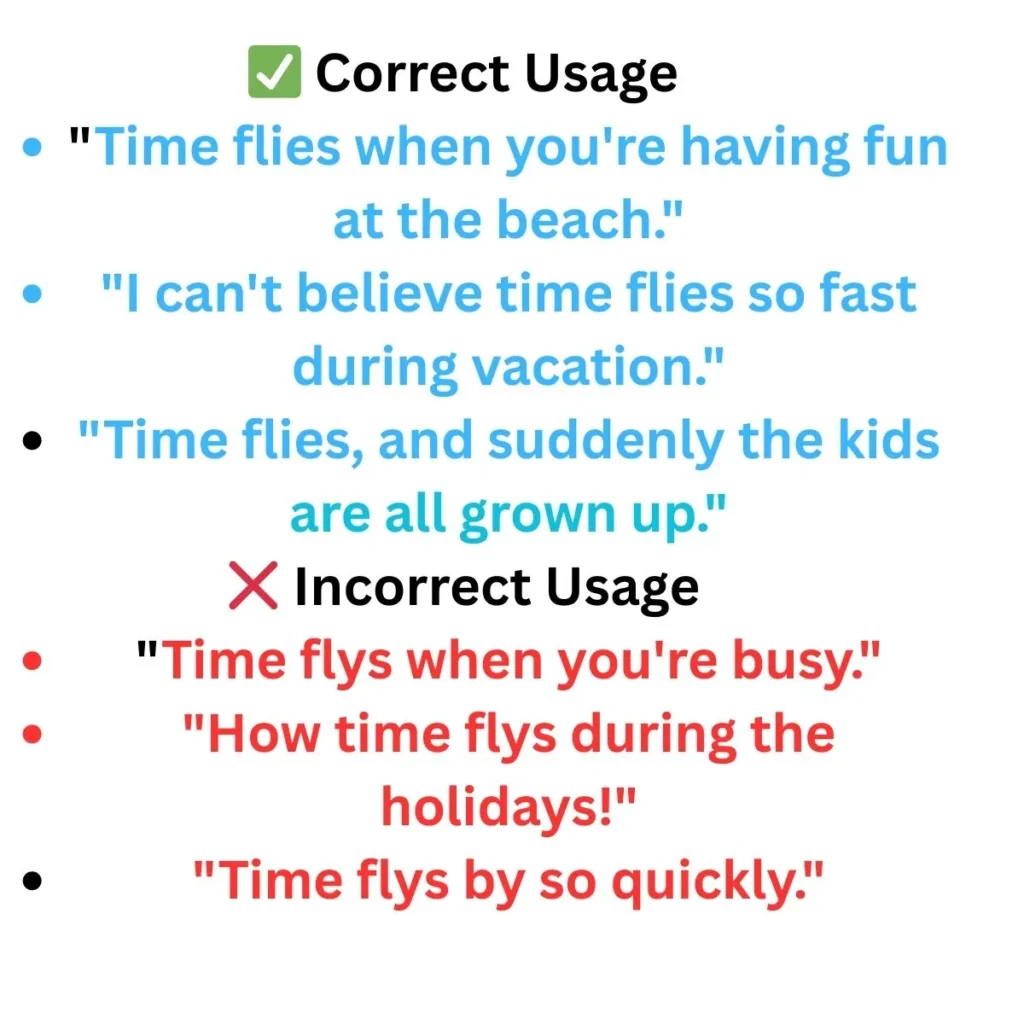
❌ Wrong: time flys
✅ Correct: time flies
Example:
- Correct: Time flies when you’re having fun.
- Wrong: Time flys when you’re having fun.
“Flies” is the third-person singular form of the verb “fly.”
Grammar Breakdown
The confusion often arises from the spelling of the verb “fly” in its different forms:
- Base form: fly
- Third-person singular: flies (not “flys”)
- Past tense: flew
- Past participle: flown
Some writers also ask, “Is it time fly or time flies?” Since “time” is singular, it needs a singular verb. That means the correct form is “time flies,” not “time fly.”
In the phrase “time flies,” we’re using the third-person singular present tense because “time” is treated as a singular noun that performs the action of flying.
Common Usage and Meaning
“Time flies” is typically used to express surprise at how quickly time has passed. It’s often extended to the fuller saying “time flies when you’re having fun,” though the shortened version conveys the same sentiment.
The expression suggests that time moves swiftly, almost imperceptibly, like something flying through the air.
How Time Flies or Flys?
Many people search “how time flies or flys” or even “how time flys or flies.” In every case, the correct spelling is “how time flies.”
So if you’re writing a sentence like “How time flies when we’re busy,” always use “flies.”
Why People Write “Time Flys”
The misspelling “time flys” or flys occurs because many people assume that adding an “s” to any verb creates the third-person singular form.
However, English has irregular spelling rules, and when a word ends in “y” preceded by a consonant, the “y” typically changes to “ies” in the third-person singular form.
Easy Trick to Remember the Correct Form
Here’s a simple rule you can use.
When a verb ends in consonant + y, change y → ies in third-person singular.
Fly → flies
Try → tries
Cry → cries
Dry → dries
Since “time” is singular, it follows this rule. That’s why we write time flies, not “time flys.”
If you remember this small grammar rule, you’ll never make this mistake again.
The Origin of “Time Flies or Time Flys”
The phrase “time flies” comes from the Latin saying tempus fugit, meaning “time escapes” or “time runs away.”
English writers adopted it centuries ago. The verb “fly” in this phrase is about time passing quickly, not literal flying.
The confusion happens because English nouns like “fly” (the insect) become “flies” in plural form.
Writers mistakenly apply the same logic when using “fly” as a verb, leading to the incorrect “flys.”
British English vs American English Spelling
Both British and American English agree: the correct spelling is “time flies.”
| Variation | British English | American English | Correctness |
|---|---|---|---|
| Time flies | ✅ Accepted | ✅ Accepted | Correct |
| Time flys | ❌ Wrong | ❌ Wrong | Incorrect |
Unlike words such as “color/colour” or “analyze/analyse,” this phrase has no regional difference.
Which Spelling Should You Use?
- In the US → Always write “time flies.”
- In the UK and Commonwealth countries → Also write “time flies.”
- In global English writing → Use “time flies” for emails, social media, and professional communication.
“Time flys” is always a mistake, regardless of audience.
Common Mistakes with “Time Flies or Time Flys”
- Mixing verb and noun rules – Using “flys” as if it were plural of “fly.”
- Autocorrect errors – Some typing tools may not flag “flys.”
- Overthinking grammar – Writers second-guess simple verb forms.
Correction tip: Remember – if it’s about time moving fast, always use “flies.”
“Time Flies” in Everyday Examples
- Emails: Sorry for the delay—time flies so quickly these days.
- News: The article highlighted how time flies in a fast-paced economy.
- Social Media: Can’t believe it’s already September! Time flies.
- Formal writing: As the saying goes, time flies when one is deeply engaged in work.
- Similar verbs that follow this spelling pattern include:
- Try → tries (not “trys”)
- Cry → cries (not “crys”)
- Fry → fries (not “frys”)
- Dry → dries (not “drys”)
Time Flies or Time Flys : Trends & Usage Data
Google Trends shows that “time flies” is searched far more than “time flys.”
- By country: US, UK, Canada, Australia → overwhelmingly “time flies.”
- By context: Popular in quotes, captions, and life reflections.
- “Time flys” appears mostly as a spelling mistake.
| Keyword | Global Usage | Correctness | Notes |
|---|---|---|---|
| Time flies | 95%+ | ✅ Correct | Standard everywhere |
| Time flys | <5% | ❌ Wrong | Common typo/misspelling |
FAQs
Q1: Which is grammatically correct, time flies or time flys?
A1: The correct form is time flies.
Q2: Why is “time flys” wrong?
A2: Because “flies” is the correct verb form of “fly” in third-person singular.
Q3: Does “time flies” mean time passes quickly?
A3: Yes. It’s an idiom meaning time goes by fast.
Q4: Is “time flys” ever acceptable?
A4: No, it is always considered incorrect.
Q5: Is “time flies” used in both British and American English?
A5: Yes, it’s standard in both.
Q6: Where does the phrase “time flies” come from?
A6: From the Latin tempus fugit, meaning “time escapes.”
Q7: Can I use “time flies” in formal writing?
A7: Yes, it’s perfectly fine in professional or academic contexts.
Q8: How time flies or how time flys — which is correct?
A8: The correct phrase is “how time flies.” The word “flies” is the correct third-person form of “fly.” “How time flys” is always incorrect.
Q9: Is it time fly or time flies in a sentence?
A9: The correct form is “time flies.” Since “time” is singular, it needs a singular verb. That means adding “-ies,” not just “-y” or “-s.”
Conclusion
So, is it time flys or time flies? The answer is simple: time flies is the only correct spelling.
The phrase has a rich history, tracing back to Latin, and is used across both British and American English.
While spelling mistakes like “flys” may appear online, they are never correct.
If you want your writing to look polished and professional, always use “time flies.”
If you’re drafting an email, caption, or formal report, this version ensures clarity and correctness.
Remember, language is about communication and small spelling errors can affect how your message is received.
In short: time doesn’t “flys” it only flies.

I’m Jane Austen, a writer at Wordorae.com, where I focus on explaining grammar mistakes and confusing English words in a clear, simple way.
I help readers improve their writing by making tricky language rules easy to understand and use.