Quick Answer: Both sulfur and sulphur are correct spellings. Sulfur is the standard spelling in modern scientific and American English, while sulphur is the traditional British English spelling.
If you’ve ever stopped mid-sentence while writing a chemistry assignment, blog post, or product description and hesitated between typing sulfur or sulphur, you’re not alone.
I’ve seen both spellings used in textbooks, news articles, and even product labels. That single extra “ph” can make you question which one is actually correct.
Many people search for:
- sulfur or sulphur
- sulphur vs sulfur
- sulfur or sulphur which is correct
- difference between sulfur and sulphur
- sulphur spelling
Let’s clear this up properly and permanently.
Sulfur or Sulphur: Quick Answer
Sulfur or sulphur which is correct? Both spellings refer to the same chemical element (atomic number 16).
However, “sulfur” is the official modern spelling used in science and American English, while “sulphur” is the traditional British English spelling.
Today, “sulfur” is the internationally accepted standard in chemistry.
Sulphur vs Sulfur: What’s the Difference?
There is no difference in meaning between sulfur and sulphur.
They refer to:
- A non-metal chemical element
- Symbol: S
- Atomic number: 16
- A yellow solid found naturally near volcanic regions
The only difference is spelling preference.
This is similar to:
- color vs colour
- favor vs favour
- mold vs mould
So if you’re searching for the difference between sulfur and sulphur, the answer is simple:
👉 The difference is spelling, not chemistry.
Why Did the Spelling Change?
Historically, the word entered English from Latin:
- Latin: sulfur
- Later variant: sulphur (influenced by Greek “ph” spelling patterns)
For centuries, both spellings were used.
However, in 1990, the International Union of Pure and Applied Chemistry (IUPAC) officially adopted sulfur as the standard spelling for scientific use worldwide.
Since then:
- Scientific journals use sulfur
- Chemistry textbooks use sulfur
- Periodic tables use sulfur
This is why sulfur is now considered the globally accepted scientific spelling.
Sulfur in Scientific Usage
In chemistry, consistency matters.
You will see:
- Sulfuric acid
- Sulfur dioxide
- Sulfur compounds
- Sulfur cycle
Scientific publications, research papers, and academic textbooks follow the IUPAC standard, which means sulfur is the correct form in chemistry.
Even British scientific journals now use sulfur instead of sulphur.
Sulphur in British English
Although science standardized “sulfur,” traditional British English still uses sulphur in general writing.
Examples in UK English:
- “The smell of sulphur filled the air.”
- “Sulphur springs are common in volcanic areas.”
However, modern UK chemistry materials increasingly use sulfur due to global scientific standards.
So if you’re writing for:
- Academic or scientific content → Use sulfur
- Traditional British literary content → Sulphur may still appear
What Is Sulfur (or Sulphur)?
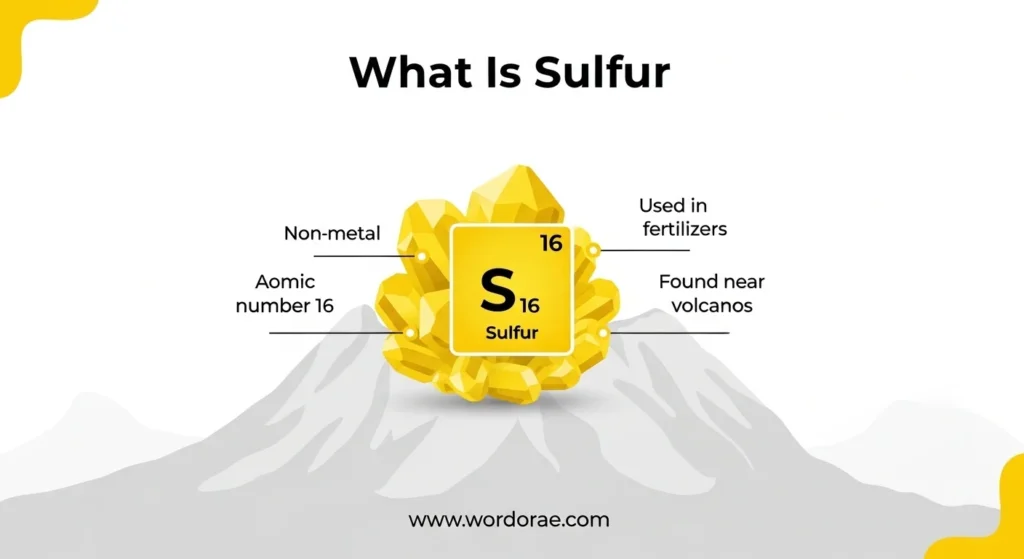
Sulfur is a naturally occurring chemical element.
It is:
- A bright yellow solid
- Found near volcanoes
- Used in fertilizers
- Used in gunpowder
- Essential in industrial processes
- Important for biological systems
Sulfur plays a key role in:
- Protein formation
- Agriculture
- Chemical manufacturing
- Petroleum refining
In simple terms, sulfur is a basic but essential element used in both nature and industry.
Common Compounds Using Sulfur
Here are examples where sulfur is used in scientific naming:
| Compound | Standard Spelling |
|---|---|
| Sulfuric acid | Sulfur |
| Sulfur dioxide | Sulfur |
| Hydrogen sulfide | Sulfur |
| Sulfur trioxide | Sulfur |
Notice that modern chemistry uses “sulfur” consistently.
Common Mistakes with Sulfur or Sulphur
Here are frequent errors people make:
❌ Mixing sulfur and sulphur in the same article
✔ Pick one spelling based on context
❌ Using sulphur in scientific research papers
✔ Use sulfur for academic writing
❌ Thinking they are different elements
✔ They are the same element
❌ Assuming sulphur is outdated everywhere
✔ It still appears in traditional British writing
Consistency improves clarity and SEO.
Sulfur or Sulphur in SEO Writing
If you’re creating educational or science-based content:
👉 Use sulfur
Why?
- It aligns with IUPAC standards
- It matches global scientific databases
- It appears more frequently in modern search results
If you’re targeting UK audience general writing, you may use sulphur — but sulfur is increasingly universal.
Comparison Table: Sulfur vs Sulphur
| Feature | Sulfur | Sulphur |
|---|---|---|
| Meaning | Chemical element | Chemical element |
| Atomic Number | 16 | 16 |
| Scientific Standard | ✅ Yes | ❌ No |
| American English | Standard | Rare |
| British English | Increasingly common | Traditional spelling |
| IUPAC Approved | ✅ Yes | ❌ No |
Sulfur or Sulphur in Australia
In Australia, traditional British spelling rules apply, so “sulphur” has historically been used in general writing.
However, in scientific and academic contexts, Australia also follows IUPAC standards. That means chemistry textbooks and research papers use “sulfur.”
So in Australia:
- General writing → sulphur
- Scientific writing → sulfur
This dual usage often causes confusion.
FAQs About Sulfur or Sulphur
Is sulfur or sulphur correct?
Both are correct, but sulfur is the official scientific spelling.
What is the difference between sulfur and sulphur?
There is no difference in meaning. Only the spelling varies.
Why did sulphur change to sulfur?
IUPAC standardized sulfur in 1990 to create global consistency in scientific naming.
Is sulphur still used in the UK?
Yes, in traditional writing. But scientific contexts now use sulfur.
Which spelling should I use in school?
Use sulfur, especially in science subjects.
Is sulfur American spelling?
Yes, but it is also the international scientific standard.
Is sulphur outdated?
Not completely, but sulfur is now preferred globally.
Is it sulfur or sulphur?
Both are correct spellings of the same chemical element. Sulfur is the modern scientific standard, while sulphur is traditional British English.
Is it spelled sulfur or sulphur?
In modern chemistry and American English, it is spelled sulfur. In traditional British English, sulphur is also used.
Does Homer’s Odyssey mention sulfur or sulphur?
The Odyssey was originally written in ancient Greek, not English. Modern translations typically use the spelling preferred by the translator , usually sulfur in American editions and sulphur in older British translations.
Does the Odyssey mention sulfur or sulphur?
Yes, sulfur is mentioned in translations of Homer’s Odyssey, particularly in references to purification and fumigation. The spelling depends on the edition’s regional style.
Conclusion
Understanding sulfur or sulphur becomes simple once you know the context.
Both words refer to the same chemical element. There is no scientific or chemical difference between them. The only variation is spelling.
However, modern chemistry officially recognizes sulfur as the standard spelling worldwide. If you are writing scientific, academic, or educational content, sulfur is the safest and most accurate choice.
Sulphur still appears in traditional British English, but its use is gradually decreasing in scientific contexts.
The key takeaway is consistency. Choose the spelling that matches your audience and stick with it throughout your content.
Now, whenever you see sulfur or sulphur, you’ll know exactly which one to use and why.

I’m David Miller, a grammar expert and author at Wordorae.com, specializing in clear, simple explanations of confusing English grammar and word usage.
I help readers write with confidence by turning complex grammar rules into easy, practical guidance.