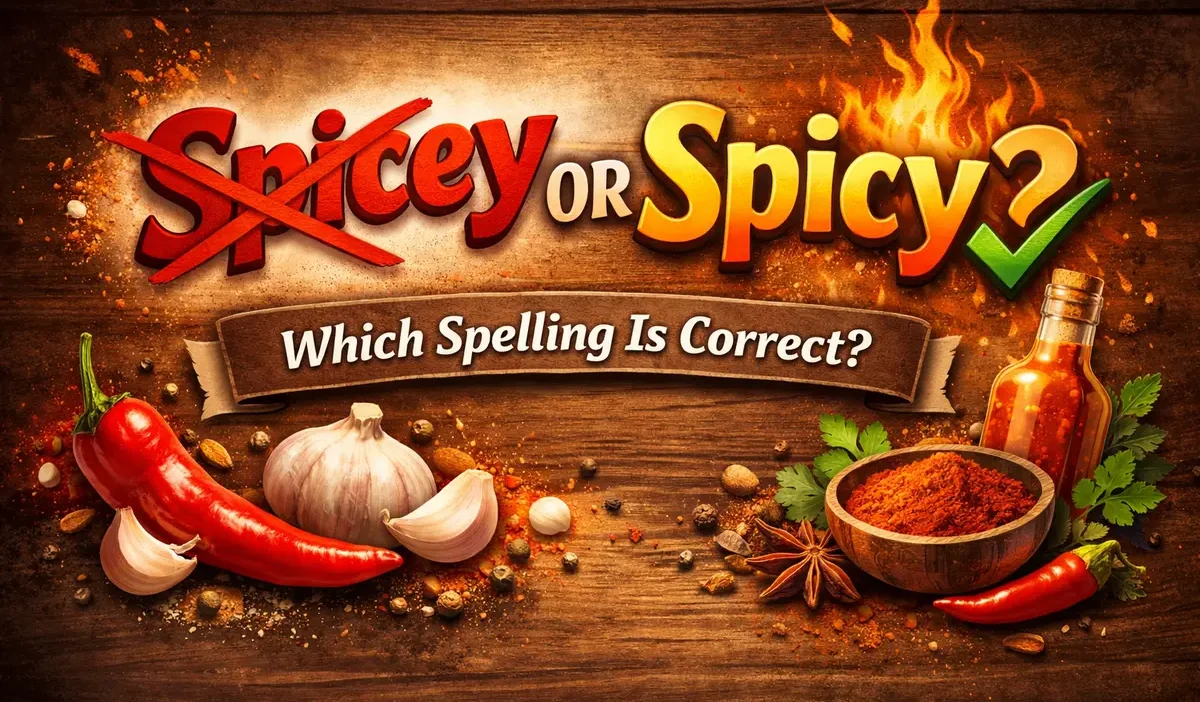
Quick Answer: The correct spelling is “spicy.” “Spicey” is always incorrect in standard English. This confirms the spicey or spicy correct spelling rule for all contexts.
I learned this the hard way. I remember pausing mid-sentence while writing a food description and thinking, “Wait… is it spicey or spicy?”
Both spellings looked right to me because I had seen spicey online so many times that my brain accepted it as normal. Still, something felt off.
Before hitting publish, I searched it and that quick check saved me from making a very common spelling mistake.
If you are reading this, I know exactly where you are. You are not bad at English. You are not careless. You are simply caught in one of those confusing spelling traps that English creates.
People search for spicey or spicy, spicey or spicy correct spelling, and even “how to spell spicey or spicy” because both versions appear everywhere on menus, in recipes, on social media, and even in blogs written by professionals.
This small difference matters more than it seems. One extra letter can affect clarity, credibility, and SEO performance.
In this guide, I will clearly explain the correct spelling, why the confusion exists, and how you can confidently use the word in everyday and professional writing.
Spicey or Spicy – Quick Answer
The correct spelling is “spicy.”
“Spicey” is incorrect in standard English.
Examples:
- ✅ This curry is extremely spicy.
- ❌ This curry is extremely spicey.
Although the word comes from spice, English spelling rules drop the silent “e” before adding -y.
The Origin of Spicey or Spicy

The adjective spicy comes from the noun spice, which traces back to the Latin word species, meaning a kind or type. Over time, the meaning shifted toward flavor, aroma, and intensity.
In English, when we add -y to words that end in a silent “e,” that “e” is usually removed. This spelling rule explains why we write:
- spice → spicy
- ice → icy
- noise → noisy
- shine → shiny
People often write spicey because it feels logical and visually matches the base word spice. However, English spelling rules prioritize pronunciation and structure over appearance.
As a result, spicy became the accepted form, while spicey became a common misspelling.
British English vs American English Spelling
Many spelling debates exist between British and American English, but this is not one of them.
There is no difference between British and American English for this word.
| English Variant | Correct Spelling |
|---|---|
| American English | spicy |
| British English | spicy |
| Australian English | spicy |
| Canadian English | spicy |
Spicey is not standard in any major English system, dialect, or dictionary.
Which Spelling Should You Use?
No matter who you are writing for, the answer stays the same:
- US audience: Use spicy
- UK audience: Use spicy
- Global audience: Always use spicy
If you care about clear communication, professional writing, branding, or SEO optimization, spicy is the only correct and safe choice.
Common Mistakes with Spicey or Spicy
Mistake 1: Writing spicey because it matches spice
✔ Fix: Drop the “e” → spicy
Mistake 2: Assuming spicey is British spelling
✔ Fix: British English also uses spicy
Mistake 3: Using spicey in professional or SEO content
✔ Fix: Use spicy to maintain credibility and search visibility
These mistakes are common, but once you know the rule, they are easy to avoid.
Spicey or Spicy in Everyday Examples
Emails:
- “Just a heads-up—the sauce is quite spicy.”
Recipes & Food Blogs:
- “This dish has a rich, spicy flavor with hints of chili.”
News Writing:
- “The region is famous for its spicy cuisine.”
Social Media:
- “That ramen was 🔥 spicy!”
Recipes & Food Blogs:
“This curry is extremely spicy.” Whether it’s a chili dish or a spicy curry, remember the correct spelling—never spicey.
Formal Writing:
- “The meal offers a mildly spicy profile suitable for most tastes.”
Slang & Figurative Use:
Beyond food, “spicy” can describe stories, jokes, or situations. For example, “That story was really spicy” or “She told a spicy joke at the party.” Even in casual or slang use, spicey is never correct.
Spicey or Spicy – Google Trends & Usage Data
Search behavior clearly shows how people use this word online.
- “Spicy” dominates searches related to food, culture, and product descriptions
- “Spicey” appears mostly as a typo or spelling confusion
- English-speaking countries consistently prefer spicy
Google often treats spicey as a spelling error and may auto-correct it in search queries.
For SEO content, using spicy aligns with real user intent and search engine expectations.
Comparison Table: Spicey vs Spicy
| Word | Correct? | Usage |
|---|---|---|
| spicy | ✅ Yes | Standard English |
| spicey | ❌ No | Common misspelling |
FAQs
1. Is “spicey” ever correct?
No. It is considered a spelling mistake in standard English.
2. Why do people spell it as spicey?
Because it visually resembles the base word spice.
3. Is spicy only used for food?
No. It can also describe language, stories, jokes, or situations.
4. Does British English use spicey?
No. British English uses spicy, just like American English.
5. Will using spicey hurt SEO?
Yes. It can reduce credibility and search relevance.
6. Is spicy an adjective?
Yes. It describes flavor, intensity, or figurative sharpness.
7: How do you spell spicey or spicy?
A: Always spell it spicy. “Spicey” is incorrect in any context.
8: How to spell spicey or spicy correctly?
A: Remember: drop the silent “e” and add “-y” → spicy.
Conclusion
The confusion around spicey or spicy is understandable, but the rule itself is simple. Spicy is the correct and accepted spelling in all forms of English.
Spicey is just a common mistake that spreads because it looks right at first glance.
If you write for readers, brands, or search engines, this choice matters. One small letter can influence how professional your content appears and how well it performs online.
I learned that lesson by stopping to double-check and that habit has improved my writing ever since.
If you ever hesitate between spicey or spicy again, remember this one rule: drop the silent “e” before adding “-y.” Use spicy in recipes, blogs, emails, menus, and formal writing.
It is clear, correct, and trusted everywhere.
Once you lock in this rule, you won’t just fix this word—you’ll avoid similar spelling mistakes with confidence.

I’m Helena Marwick, a grammar-focused writer at Wordorae.com, where I help readers understand confusing English words and usage clearly.
I specialize in making grammar simple, accurate, and easy to apply in everyday writing.