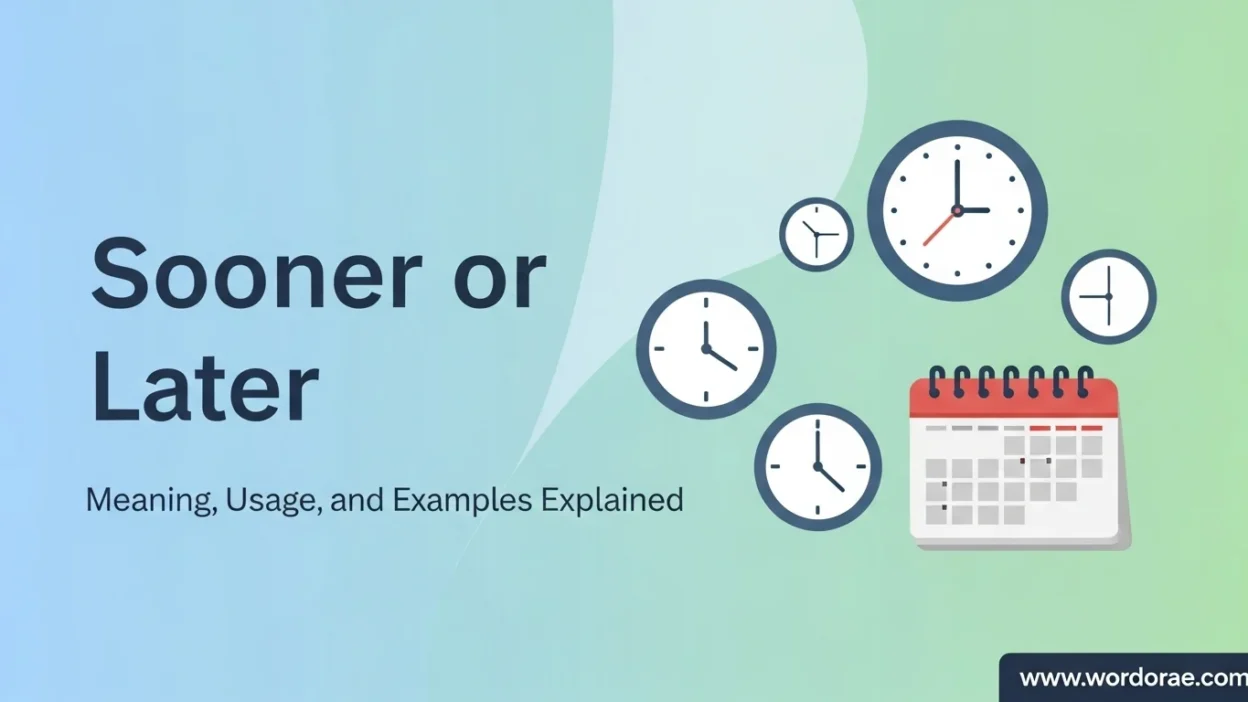
Quick answer: “Sooner or later” means something will definitely happen, but you don’t know exactly when.
If you’ve ever said or heard “It will happen sooner or later,” you already understand the idea. But I know why you’re here.
You might be wondering what this phrase really means, If it’s formal or casual, and how to use it correctly in writing.
I’ve seen many people pause before using it in emails, essays, or professional messages because they’re unsure if it sounds right.
I want to make this easy for you. I’ll explain the meaning in plain English, show you where the phrase comes from, and walk you through real examples you can actually use.
By the end, you’ll feel confident using “sooner or later” naturally, without overthinking it.
Sooner or Later – Quick Answer
“Sooner or later” means at some point in the future, even if the timing is uncertain.
✔ You’ll understand this rule sooner or later.
✔ Sooner or later, everyone faces challenges.
It suggests certainty, not speed.
The Origin of Sooner or Later
The phrase “sooner or later” comes from simple comparative words:
- Sooner → earlier
- Later → after some time
English speakers combined them to express the idea that something will happen If it happens early or late. Over time, it became an idiomatic expression used in everyday speech, writing, and literature.
There is no spelling variation or historical dispute here. The meaning has stayed consistent for centuries.
British English vs American English Spelling
Good news: there is no spelling difference between British and American English.
| Phrase | British English | American English |
| sooner or later | sooner or later | sooner or later |
The phrase is used the same way across all English-speaking countries.
Which Usage Should You Choose?
You don’t need to choose between versions, but you do need to use it correctly in context.
Use “sooner or later” when:
- You’re talking about inevitable outcomes
- The exact time doesn’t matter
- You want to sound natural and conversational
Avoid it when:
- You need specific timing
- Precision matters (legal, technical writing)
Common Mistakes with Sooner or Later
❌ Using it to mean “soon”
✅ It means eventually, not immediately
❌ Writing sooner then later
✅ Correct spelling: than, not then
❌ Overusing it in formal documents
✅ Use sparingly in professional writing
Sooner or Later Examples
Emails
- You’ll need to update the report sooner or later.
News
- Experts say reforms will happen sooner or later.
Social Media
- Sooner or later, hard work pays off.
Formal Writing
- Technological change, sooner or later, reshapes every industry.
Sooner or Later – Trends & Usage Data
Search data shows that “sooner or later” is commonly searched by:
- ESL learners
- Students
- Writers checking tone and meaning
The phrase is most often used in:
- Advice articles
- Motivational content
- Opinion writing
This tells us the main user intent is meaning + correct usage, not spelling correction.
Comparison Table: Sooner vs Later vs Sooner or Later
| Expression | Meaning | Example |
| sooner | earlier | Finish sooner if you can. |
| later | after some time | We’ll talk later. |
| sooner or later | eventually | You’ll understand sooner or later. |
Additional Usage Table
| Context | Is It Appropriate? |
| Casual conversation | ✅ Yes |
| Emails | ✅ Yes |
| Academic writing | ⚠️ Limited |
| Legal documents | ❌ No |
FAQs
What does “sooner or later” really mean?
It means something will happen eventually.
Is “sooner or later” formal or informal?
It’s neutral and fits most situations.
Can I start a sentence with it?
Yes. Sooner or later, you’ll see the results.
Does it mean soon?
No. It means at an unknown time.
Is it used in British English?
Yes, exactly the same way.
Can I use it in essays?
Yes, but don’t overuse it.
Is there a synonym for “sooner or later”?
Yes. Eventually, at some point.
Conclusion
“Sooner or later” is one of those phrases that feels simple but carries strong meaning. It tells the reader that something is inevitable, even if the timing is unclear.
Once you understand that, using it becomes easy.
If you remember just one thing, remember this: sooner or later is about certainty, not speed.
Use it when you want to sound natural, confident, and realistic. With this clarity, you won’t hesitate the next time you’re writing or speaking.
You’ll know exactly when and how to use it.

I’m Helena Marwick, a grammar-focused writer at Wordorae.com, where I help readers understand confusing English words and usage clearly.
I specialize in making grammar simple, accurate, and easy to apply in everyday writing.