I remember pausing mid-sentence while writing a short story and thinking, “Should I write someday or one day here?” The sentence sounded fine either way, but the meaning felt different. That’s exactly why people search for someday or one day. These two time expressions look simple, yet they quietly change tone, certainty, and intent.
This confusion shows up everywhere—emails, goals, storytelling, and even professional writing. English learners and native speakers alike wonder: Which is correct someday or one day? Is someday one word? Does one day sound more confident?
Search engines like Google prioritize clarity and intent, and so should writers. Choosing the right phrase helps readers instantly understand your message. In this guide, I’ll clearly explain the difference between someday vs one day, where each comes from, how they’re used in American and British English, and how to choose the right one every time—with real examples you can trust.
Someday or One Day: Quick Answer
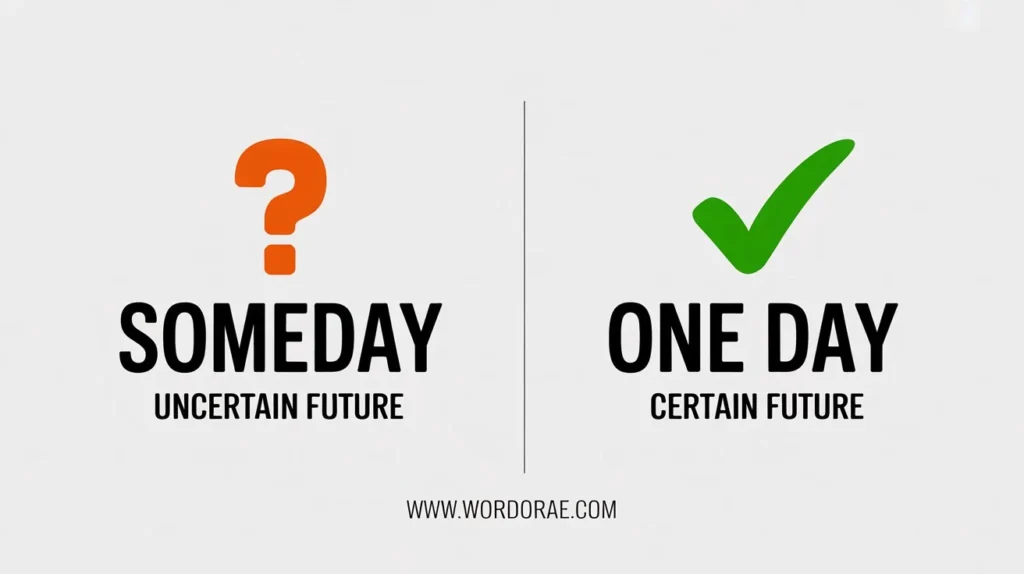
- Someday = an unspecific, uncertain future
- I hope to travel the world someday.
- One day = a specific or expected future moment
- One day, I will start my own business.
If you mean “maybe, eventually”, use someday.
If you mean “it will happen”, use one day.
The Origin of Someday or One Day
The word “someday” comes from Middle English and has always meant an indefinite time in the future. It slowly became a single word through common usage.
“One day”, however, stayed a phrase. It literally meant a single day, then evolved to express a future event with more certainty.
The spelling difference exists because:
- Someday = adverb (one word)
- One day = adverbial phrase (two words)
British English vs American English Spelling
Both American English and British English use someday and one day the same way.
| Phrase | American English | British English |
| someday | ✅ Common | ✅ Common |
| one day | ✅ Common | ✅ Common |
There is no regional spelling difference, only a meaning difference.
Which Spelling Should You Use?
Choose based on intent and audience:
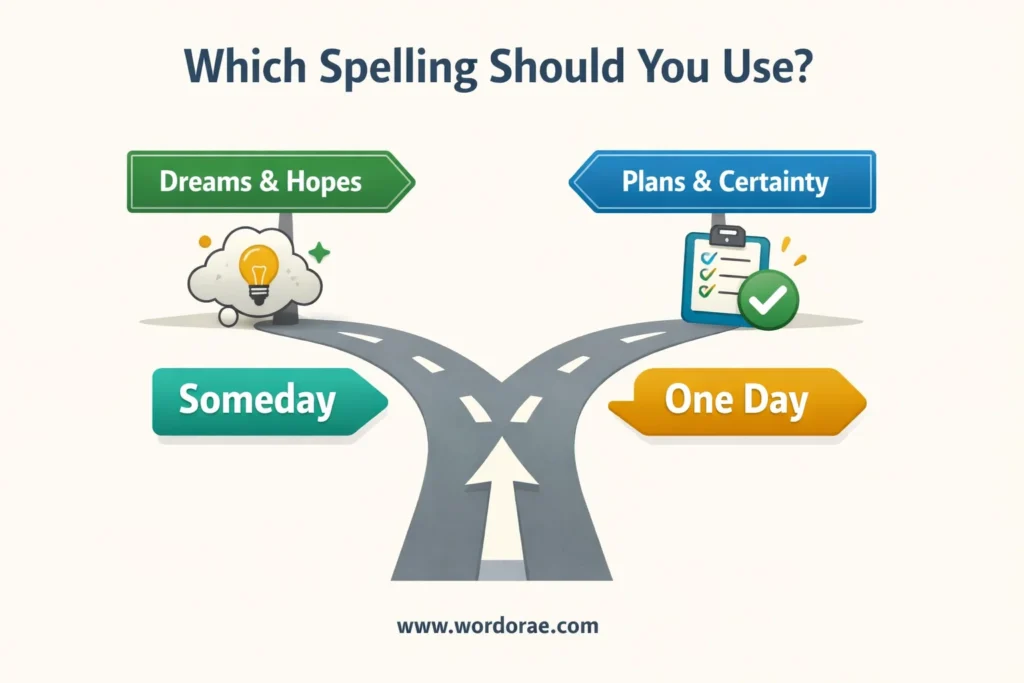
- Use “someday” when talking about dreams, hopes, or vague plans
Someday, I want to write a book. - Use “one day” when expressing certainty or storytelling
One day, she realized the truth.
For global audiences, clarity matters more than style. Google’s algorithm favors content that clearly matches user intent—so choose the word that reflects your meaning.
Common Mistakes with Someday or One Day
❌ One day I might learn French. (sounds uncertain)
✅ Someday I might learn French.
❌ Someday, I will graduate next year.
✅ One day, I will graduate.
Mistake = using certainty where none exists (or vice versa).
Someday or One Day in Everyday Examples
- Email:
Someday, I’d love to work with your team. - News:
One day, the law may change. - Social media:
Someday goals ✨ - Formal writing:
One day, this research may influence policy.
Someday or One Day: Google Trends & Usage Data
Search data shows:
- “Someday” is popular for motivational and personal content.
- “One day” appears more in storytelling, news, and education.
People search “someday or one day difference” because they want certainty, correctness, and confidence—exactly what this guide provides.
Comparison Table: Someday vs One Day
| Feature | Someday | One Day |
| Certainty | Low | High |
| Form | One word | Two words |
| Tone | Hopeful | Confident |
| Usage | Dreams | Events |
FAQs
1. Is there one word someday?
Yes. Someday is always one word.
2. Is one day two words?
Yes. It is never written as one day.
3. Which is correct, someday or one day?
Both are correct. Meaning decides.
4. Is someday informal?
No. It’s acceptable in formal writing when used correctly.
5. Can I use it someday in professional writing?
Yes, but only for uncertain future ideas.
6. Does one day sound more confident?
Yes. It implies certainty.
7. Are they interchangeable?
No. They change meaning.
Conclusion:
Choosing between someday or one day is not about spelling it’s about meaning. Someday speaks to hope, dreams, and uncertainty.
One day carries confidence, expectation, and clarity. Mixing them up can quietly change your message, tone, and even credibility.
I’ve learned that small word choices make a big difference. When you write with intent, readers understand you faster—and search engines reward that clarity too.
Whether you’re writing a story, setting goals, or sending a professional email, pause and ask yourself: Am I hoping, or am I certain?
If it’s a dream, use it someday.
If it’s a plan, choose one day.
Once you see the difference, you’ll never hesitate again.

I’m David Miller, a grammar expert and author at Wordorae.com, specializing in clear, simple explanations of confusing English grammar and word usage.
I help readers write with confidence by turning complex grammar rules into easy, practical guidance.