Quick Answer: “Plain” refers to something simple, flat, or unadorned, while “plane” can mean a flat surface, a level of existence, or an aircraft—they are different words with distinct meanings.
Have you ever typed “plain or plane” in Google, unsure which one fits your sentence? I’ve definitely been there.
I remember writing an essay about geography and accidentally writing “plane surface” instead of “plain surface.”
My teacher gave me a puzzled look, and I realized that confusing these two words can change your meaning completely.
People often search “plain or plane” because the words sound identical, yet their meanings are very different.
This confusion isn’t just about spelling it affects writing, emails, essays, and even philosophical discussions about the plain or plane of existence.
In this guide, I’ll walk you through their origins, correct usage, spelling rules, common mistakes, and real-world examples. By the end, you’ll never have to wonder, “is it plain or plane?” again.
Here’s what this article covers:
Table of Contents
- Plain or Plane – Quick Answer
- The Origin of Plain and Plane
- British vs American English Spelling
- Which Spelling Should You Use?
- Common Mistakes with Plain or Plane
- Plain or Plane in Everyday Examples
- Comparison Table
- Key Differences Between Plain and Plane
- FAQs
- Conclusion
Plain or Plane – Quick Answer
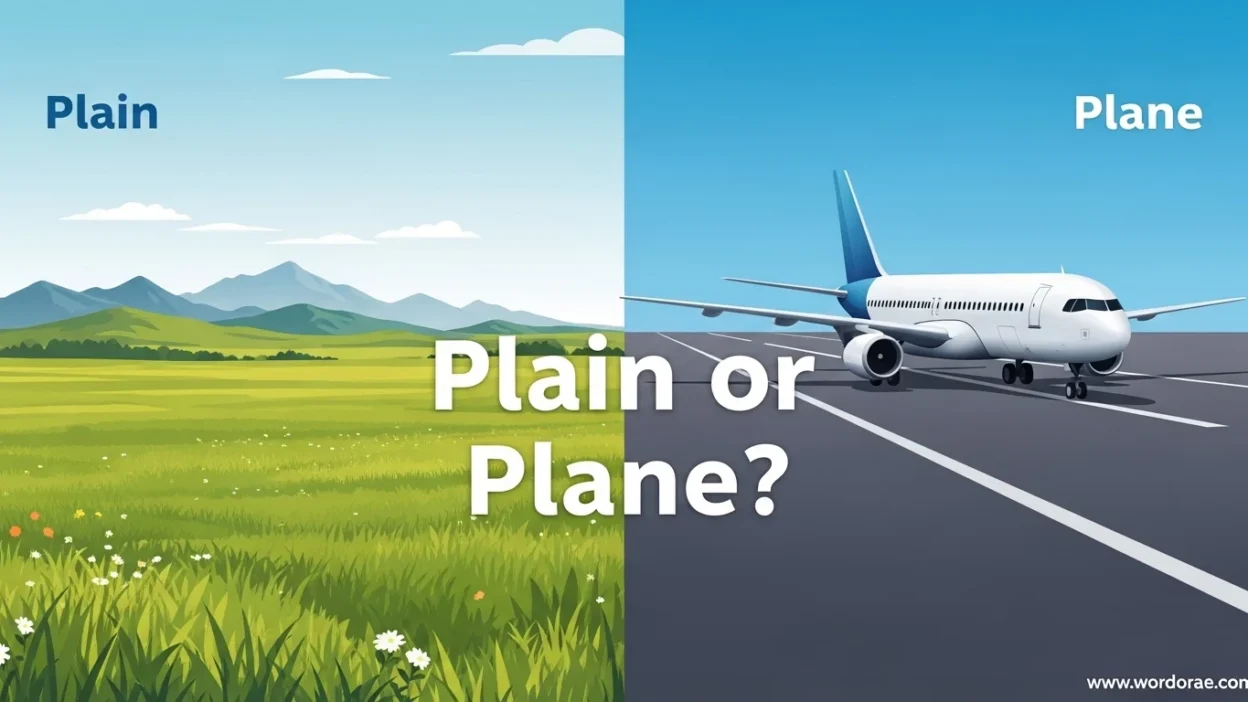
Plain is an adjective or noun used to describe something simple, unadorned, or flat.
Examples:
- Plain food – food without seasoning.
- A vast plain – a large flat area of land.
- Plain fabric – simple, unpatterned cloth.
Plane has multiple meanings:
- Flat surface – “The carpenter smoothed the wooden plane.”
- Level of existence – “On the same spiritual plane, people feel connected.”
- Aircraft – “The plane landed safely at the airport.”
When in doubt, remember: plain = simple/flat land, plane = surface/level/aircraft.
The Origin of Plain and Plane
The word plain comes from Latin planus, meaning “flat or level.” Over time, it also acquired the meaning “simple” or “unadorned.” Early English usage in the 14th century included plain lands and plain speech.
Plane, on the other hand, comes from the Old French plane, from Latin planum, meaning “flat surface.”
It evolved to include levels of existence, such as spiritual plane, and the modern meaning of an airplane comes from the early 20th century, based on its flat wings (“plane” as a flat surface).
This explains why people get confused between plain or plane of existence, or when talking about flat land (earthly plain or plane) versus an abstract level (mortal plain or plane).
British vs American English Spelling
The spelling of plain and plane is consistent in both British and American English. The difference lies mostly in context usage.
| Term | British English | American English | Notes |
|---|---|---|---|
| Plain | Plain | Plain | Used for simplicity or flat land |
| Plane | Plane | Plane | Used for flat surfaces, levels, or aircraft |
| Earthly plain or plane | Plain | Plain | Common in geography discussions |
| Spiritual plain or plane | Plane | Plane | Refers to levels of existence |
| Same plain or plane | Same plain/plane | Same plain/plane | Depends on context |
| Plain or plane mirror | Plane | Plane | Flat reflecting surface |
Tip: In American English, “plane” is often associated with aircraft, while in British English, “plane” might lean more towards surfaces or levels in scientific contexts.
Which Spelling Should You Use?
Here’s a quick guide depending on your audience:
- Everyday writing:
Use plain for simple things and flat lands, plane for surfaces or levels. - Academic or philosophical writing:
When discussing spiritual plain or plane, always use plane to indicate a level of existence. - Technical writing (engineering, carpentry, math):
Plane is correct for surfaces and geometrical references. - Global readers:
Clarify the meaning first: e.g., “plain (flat land)” or “plane (aircraft).”
Consistency is key. Mixing plain or plane mid-sentence can confuse your reader.
Common Mistakes
- Writing plain instead of plane for a flat surface or aircraft.
- Confusing plain or plane of existence with geography (earthly plain or plane).
- Overusing “plain” to mean boring or simple, when “plane” is required.
- Using plane for flavorless or unadorned objects.
- Misspelling words in phrases like on the same plain or plane.
Pro Tip: If the word relates to levels, surfaces, or aircraft, it’s plane. Otherwise, it’s likely plain.
Plain or Plane in Everyday Examples
- Email: “The report was written in plain language for everyone to understand.”
- News article: “Scientists studied the Earthly plain or plane to understand sediment layers.”
- Social media: “Flying on a plane is always exciting! #Travel #PlaneLife”
- Formal writing: “On the same spiritual plane, humans share emotional experiences.”
- Film/X-ray: “The technician adjusted the plain or plane film X-ray for clarity.”
Comparison Table
| Feature | Plain | Plane | Example |
|---|---|---|---|
| Meaning | Simple, unadorned, flat land | Flat surface, level, aircraft | Plain fabric vs plane surface |
| Usage | Adjective or noun | Noun | Plain speech, spiritual plane |
| Origin | Latin planus | Latin planum | Flat or level |
| Common phrases | Earthly plain, mortal plain | Spiritual plane, plane of existence | Same plain or plane, on another plain or plane |
| Mistakes | Using plain for aircraft or surface | Using plane for simple things | “Plain of existence” → incorrect |
Key Differences Between Plain and Plane
- Meaning:
Plain = simple/unadorned, flat land. Plane = surface, aircraft, level of existence. - Spelling:
Identical pronunciation, different meanings. - Context:
Plain → descriptive; Plane → technical, philosophical, or travel context. - Usage in Geography:
Plain = flat land; Plane = geometrical surface. - Abstract Concepts:
Plane = level of existence or consciousness; plain doesn’t apply. - Tools & Technology:
Plane → woodworking tool (hand plane) or aircraft; plain never used here. - Common Errors:
Mixing phrases like plain or plane mirror or plain or plane film X-ray.
FAQs
1. Is it plain or plane of existence?
It’s plane—refers to levels of spiritual or abstract existence.
2. How do I know when to use plain or plane?
Use plain for simplicity or flat land; use plane for surfaces, levels, or aircraft.
3. Can plain and plane ever be interchangeable?
No. Their meanings are distinct, and using the wrong one changes the sentence meaning.
4. What is an earthly plain or plane?
Earthly plain refers to flat land. Plane is only used for abstract or geometric surfaces.
5. How about a mortal plain or plane?
Mortal plane refers to our level of existence; plain is incorrect here.
6. Is plain or plane mirror correct?
Plane mirror is correct—it refers to a flat reflective surface.
7. Can I say “on the same plain or plane”?
Use plane for levels of existence; plain refers to land.
8. What about plain or plane film X-ray?
Plane X-ray is correct, referring to a flat imaging surface.
Conclusion
Now that you know the difference between plain or plane, you can write with confidence. I’ve made the same mistakes myself, confusing flat land with a surface or even aircraft, so I know how tricky it can be.
Remember: plain = simple or flat land, plane = surface, aircraft, or level of existence. Pay attention to context, especially in phrases like spiritual plane or plain of existence. Using them correctly makes your writing clear, professional, and precise.
“By consistently checking your usage and remembering these rules, you’ll confidently choose between plain or plane every time without second-guessing.”

I’m Jane Austen, a writer at Wordorae.com, where I focus on explaining grammar mistakes and confusing English words in a clear, simple way.
I help readers improve their writing by making tricky language rules easy to understand and use.