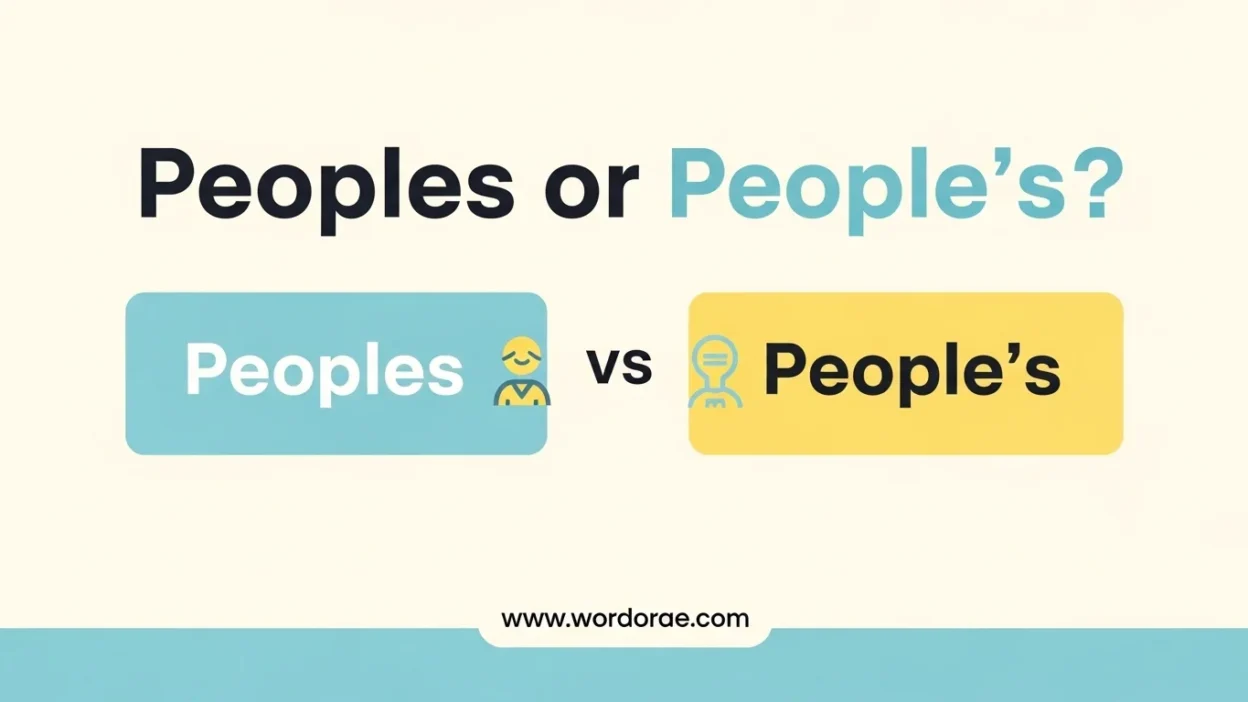
Quick answer: “Peoples” is the plural of people (used for different groups or nations), while “people’s” is the possessive form of people (showing ownership).
If you’ve ever paused while writing and thought, “Wait… is it peoples or people’s?” You’re not alone.
I’ve seen this confuse students, bloggers, and even professional writers.
You and I both know English loves to trip us up with tiny apostrophes and sneaky plurals.
The good news? This confusion is easy to fix once you see the pattern.
In this article, I’ll walk you through the difference in plain English. No grammar jargon. No overthinking.
By the end, you’ll know exactly when to use peoples and when people’s, and you’ll stop second guessing yourself in emails, essays, and content writing.
Peoples or People’s – Quick Answer
Let’s lock this in clearly:
- Peoples = plural noun
Used when talking about different groups, cultures, or nations. - People’s = possessive noun
Used when something belongs to people.
Simple way to remember it:
- No apostrophe → plural groups
- Apostrophe + s → ownership
The Origin of Peoples and People’s
The word people comes from Latin populus, meaning a group or nation. Over time, English started using people in two ways:
- As a collective noun (a group of persons)
- As a plural noun referring to ethnic or national groups
That’s where peoples came from. Historians, sociologists, and anthropologists needed a way to talk about many different groups, not just many individuals.
People’s, on the other hand, formed naturally using English possessive rules. When something belongs to people, we add an apostrophe + s.
Different purposes. Different meanings. Same root word.
Peoples vs People’s: British and American English
Here’s the good news:
British and American English use these words the same way.
There’s no spelling difference here—only a meaning difference.
Comparison Table
| Word | Type | Meaning | Example |
|---|---|---|---|
| peoples | plural noun | Different groups or cultures | Indigenous peoples |
| people’s | possessive | Something belonging to people | People’s choice |
So if you’re writing for the US, UK, or global readers, the rules stay consistent.
Which One Should You Use?
Ask yourself one quick question:
👉 Am I talking about ownership or groups?
- Talking about ownership → use people’s
- Talking about different groups → use peoples
Examples:
- The people’s voice was finally heard. (ownership)
- The museum honors indigenous peoples. (groups)
If you answer that one question, the choice becomes automatic.
Common Mistakes with Peoples or People’s
Let’s fix the most common errors I see:
❌ The peoples rights were ignored.
✅ The people’s rights were ignored.
❌ Many people’s live in this area.
✅ Many people live in this area.
❌ The cultures of different people’s are unique.
✅ The cultures of different peoples are unique.
Pro tip:
If you don’t mean ownership, don’t use the apostrophe.
Peoples or People’s Examples
Here’s how these words show up in real life.
In Emails
- We value the people’s feedback.
- This project supports local peoples.
In News Writing
- The government promised to protect the people’s interests.
- The region is home to many indigenous peoples.
On Social Media
- Stand up for the people’s rights.
- Celebrating the traditions of different peoples.
In Formal Writing
- International law recognizes the rights of all peoples.
- Democracy depends on the people’s participation.
Peoples or People’s – Usage Comparison Table
| Sentence Purpose | Correct Word |
|---|---|
| Ownership | people’s |
| Rights and opinions | people’s |
| Cultures and nations | peoples |
| Traditions of groups | peoples |
| Belonging to citizens | people’s |
This table alone can save you from future mistakes.
Peoples or People’s – Trends & Usage
Search data shows that “people’s” is far more commonly searched. Why? Because most writers talk about ownership—rights, opinions, voices, choices.
“Peoples” appears less often and mostly in:
- Academic writing
- History articles
- Cultural discussions
- Human rights content
So if you’re writing general content, you’ll probably use people’s more often. But when you need peoples, it really matters.
FAQs About Peoples or People’s
1. Is “peoples” grammatically correct?
Yes. It’s correct when referring to different cultural or ethnic groups.
2. Is “people’s” plural or singular?
It’s a possessive form of people, which is already plural.
3. Can I use “peoples” instead of “people”?
No. Use peoples only when you mean multiple groups, not just many individuals.
4. Does “peoples” need an apostrophe?
No. Apostrophes are for possession, not plural forms.
5. What about “peoples’”?
That’s the possessive of peoples, and it’s very rare.
6. Which one is more common in daily English?
People’s.
7. Do exams test this difference?
Yes, especially in grammar, writing, and competitive exams.
Conclusion
Now you know the difference and it’s simpler than it first looked.
Peoples talks about groups. People’s talks about ownership. That’s it.
When I write, I always pause and ask myself one thing: Am I talking about what belongs to people, or about different groups of people?
If you do the same, you’ll never mix these up again.
This small grammar detail can make your writing look sharper, clearer, and more professional.
And once you master it, you’ll start spotting the mistake everywhere else too.

I’m Helena Marwick, a grammar-focused writer at Wordorae.com, where I help readers understand confusing English words and usage clearly.
I specialize in making grammar simple, accurate, and easy to apply in everyday writing.