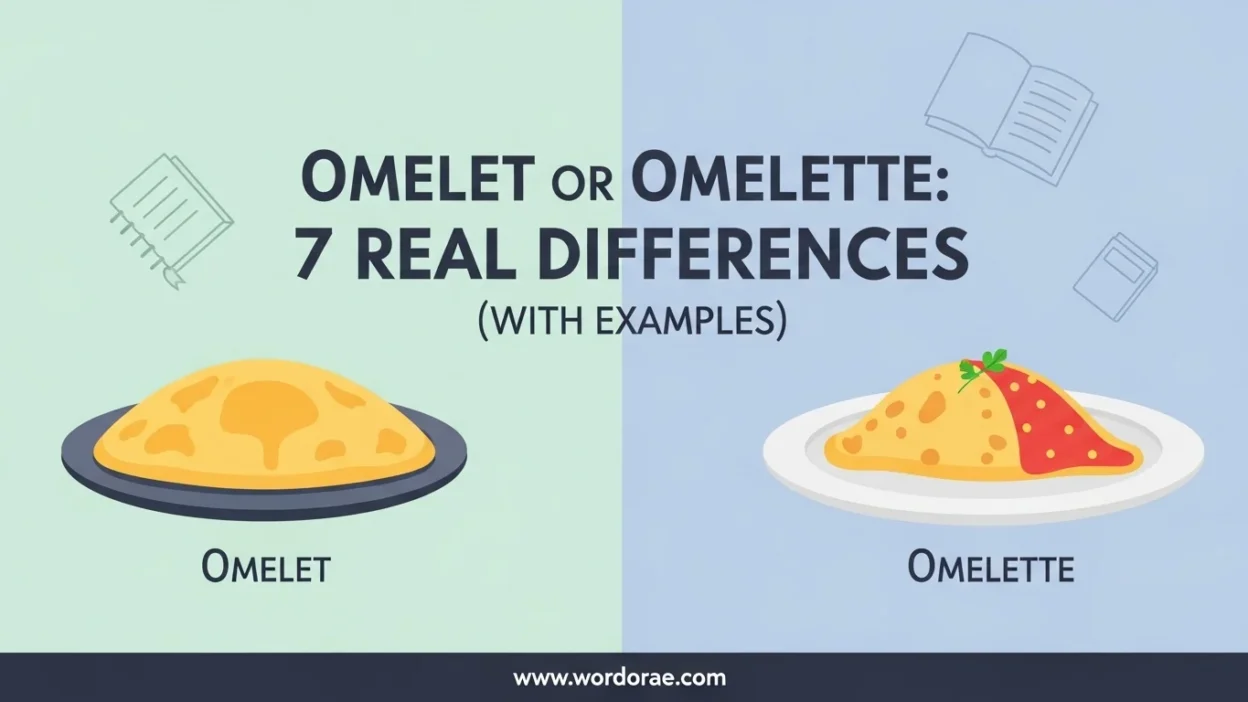
I’ll keep it simple: “omelet” and “omelette” are both correct spellings.
If you’re writing a recipe, a menu, or a blog post, this tiny choice can feel oddly stressful.
People also search for:
Omelet or Omelette
I’ve been there—typing the word, seeing a red underline, then wondering if you will look unprofessional for picking the “wrong” version.
The truth is, the confusion exists because English isn’t one single system.
Different regions standardize spelling differently, and food words borrowed from French make it even messier.
In this article, you’ll get:
- A quick answer paragraph (right after this intro)
- A clear outline so you know what’s coming
- 5–7 practical differences between omelet and omelette with examples
- Easy rules to choose the right spelling for your audience
Outline (what you’ll learn):
- Quick Answer
- The origin (French → English)
- 7 differences (spelling, region, tone, style guides, SEO, menus, consistency)
- Common mistakes
- Everyday examples (emails, news, social, formal)
- FAQ
- Conclusion
Quick Answer: Omelet or Omelette?
Use “omelet” in American English and “omelette” in British English.
They mean the same egg dish. The “correct” choice depends on where your readers are and which English style you’re using.
- US example: “I ordered a cheese omelet.”
- UK example: “I ordered a cheese omelette.”
The Origin of “Omelet/Omelette” (Why Two Spellings Exist)
The word comes from French, where omelette is the common spelling. When English adopted the term, spelling shifted over time. American English often prefers simplified spellings, while British English often keeps forms closer to older or French-influenced spellings. That’s why both versions exist today—and why both are considered correct in English.
7 Differences Between “Omelet” and “Omelette” (With Examples)
Below are 7 balanced, real-world differences that help you decide which spelling to use—without overthinking it.
1) Spelling Difference (The Obvious One)
- Omelet = one “t”
- Omelette = two “t”s
Examples
- “Make a fluffy herb omelet in 10 minutes.” (US)
- “Make a fluffy herb omelette in 10 minutes.” (UK)
What this changes: visual style and regional expectation.
2) Regional Preference (Where Each One Looks “Normal”)
- Omelet is standard in the United States.
- Omelette is standard in the UK and often the Commonwealth (Australia, New Zealand, and many international publications using British English).
Examples
- US café menu: “Western omelet with peppers and onions.”
- UK café menu: “Western omelette with peppers and onions.”
Tip: Match the spelling to your audience’s location.
3) Dictionary & Style Guide Alignment (Formal Writing Difference)
If you’re writing something professional—cookbook, brand guidelines, academic writing—style guides matter.
Examples
- US-based brand style: “Use American spelling: omelet.”
- UK-based editorial style: “Use British spelling: omelette.”
What this changes: perceived accuracy in formal writing and publishing.
4) Tone & “French Feel” (Perception Difference)
This one is subtle, but real: “omelette” can feel more French or classic, while “omelet” can feel more modern or streamlined—especially on menus.
Examples
- Fine-dining vibe: “Truffle omelette with fines herbes.”
- Diner vibe: “Three-egg omelet with cheddar.”
Important: The dish is the same—only the tone changes for some readers.
5) Menu and Branding Consistency (Customer Trust Difference)
On menus and packaging, spelling consistency builds trust. Mixing spellings can look sloppy.
Examples
- Inconsistent (avoid): “Cheese omelet” on one line, “Mushroom omelette” on another.
- Consistent (better): Choose one and use it everywhere.
Best practice: If your restaurant is US-based, standardize omelet. UK-based, standardize omelette.
6) SEO & Search Intent (Traffic Difference)
People search both spellings. Your content can capture both—without looking messy.
Examples
- A good SEO approach:
“Omelet (also spelled omelette) is a folded egg dish…”
Then stick to one spelling for the rest of the article. - Headings approach:
- H1: “Omelet or Omelette: Which Spelling Should You Use?”
- Use your primary audience spelling in body text.
What this changes: reach (US + UK readers) while keeping the article readable.
7) Auto-Correct & Language Settings (Practical Writing Difference)
Your device may “correct” one spelling depending on keyboard language settings.
Examples
- US keyboard: may flag omelette as uncommon and suggest omelet
- UK keyboard: may flag omelet and suggest omelette
Tip: Set your doc language (US/UK) before final editing.
Common Mistakes (And Quick Fixes)
- Mixing spellings in one piece
- Wrong: “This omelet is… my favorite omelette.”
- Fix: Pick one spelling per document.
- Thinking one is incorrect
- Fix: Both are correct; it’s a regional standard.
- Misspellings
- Wrong: omlet, omelete, omlette, omellete
- Correct: omelet / omelette
Everyday Examples
Emails / workplace
- US: “Please add a veggie omelet option for breakfast.”
- UK: “Please add a veggie omelette option for breakfast.”
News / blog
- “The café’s spinach omelet became a local favorite.” (US publication)
- “The café’s spinach omelette became a local favourite.” (UK publication)
Social media
- “Breakfast win: cheese omelet 🥚”
- “Sunday brunch: fluffy omelette 🥚”
Formal writing (menus / cookbooks)
- US cookbook: “Fold the omelet over the filling.”
- UK cookbook: “Fold the omelette over the filling.”
Quick Comparison Table
| Point | Omelet | Omelette |
| Standard region | US | UK/Commonwealth |
| Letters | 1 “t” | 2 “t”s |
| Formal preference | US style guides | UK style guides |
| Perceived tone | streamlined | slightly more classic/French |
| Best use case | American menus, US blogs | UK menus, British publications |
FAQs (7)
- Is “omelet” correct English?
Yes—standard in American English. - Is “omelette” correct English?
Yes—standard in British English. - Do they mean different dishes?
No, they mean the same egg dish. - Which spelling should I use for a US audience?
Use omelet. - Which spelling should I use for a UK audience?
Use omelette. - Can I use both spellings for SEO?
Yes—mention both once, then stick to one for consistency. - Which looks better on a restaurant menu?
Match your location and brand voice, then stay consistent.
Conclusion
Here’s the easiest way to decide: write for your reader, not your spellcheck. If your audience is American, omelet will look natural. If your audience is British or Commonwealth, omelette is the better fit. And if your audience is global, choose one spelling, mention the other once, and keep your writing consistent from start to finish.
If you want a simple rule you and I can both follow:
US content → omelet. UK/Commonwealth content → omelette. Global content → pick one and stay consistent.
Optional reference: Merriam-Webster (US) or Cambridge Dictionary (UK) can confirm the preferred spelling in each region.

I’m David Miller, a grammar expert and author at Wordorae.com, specializing in clear, simple explanations of confusing English grammar and word usage.
I help readers write with confidence by turning complex grammar rules into easy, practical guidance.