Quick answer: “Neither nor” is correct. “Neither or” is usually incorrect and considered a grammar mistake.
Many people search for neither nor or neither or because both phrases look similar, and in casual speech, they can sound interchangeable.
When writing especially in emails, exams, blogs, or professional content this confusion becomes a real problem. Writers want to sound correct, natural, and confident, but grammar rules don’t always feel obvious.
The issue comes from misunderstanding how correlative conjunctions work in English.
“Neither” follows a fixed structure, and breaking that structure leads to errors that grammar checkers, teachers, and editors notice instantly.
This article clears the confusion in a simple way. You’ll learn the correct structure, why “neither or” is wrong in most cases, common mistakes people make, real-life examples,
And how to use neither nor correctly in both spoken and written English.
Neither Nor or Neither Or – Quick Answer
“Neither nor” is grammatically correct.
“Neither or” is incorrect in standard English.
Correct example:
- She likes neither tea nor coffee.
Incorrect example:
- ❌ She likes neither tea or coffee.
Rule: “Neither” must always be paired with “nor.”
The Origin of Neither Nor or Neither Or
The word neither comes from Old English nāwther, meaning “not one nor the other.” From its earliest use, it was designed to work as part of a pair structure.
English developed fixed combinations called correlative conjunctions, such as:
- both.. and
- either or
- neither nor
Because “neither” already means “not one or the other,” it logically connects with “nor,” not “or.” Using “or” breaks the grammatical balance that English has followed for centuries.
British English vs American English Usage
Unlike spelling differences, this rule is the same in both British and American English.
Correct in both:
- Neither the manager nor the staff were informed.
Incorrect in both:
- ❌ Neither the manager or the staff were informed.
Comparison Table
| Phrase | Correct? | Notes |
| neither nor | ✅ Yes | Standard English |
| neither or | ❌ No | Common spoken error |
| either or | ✅ Yes | Different structure |
| both and | ✅ Yes | Positive pairing |
Which One Should You Use?

Always use neither nor when:
- You are rejecting two options
- You are writing formally or professionally
- You want grammatically correct English
Use either or when:
- You are choosing one of two options
Examples:
- Neither John nor Ali was late.
- You can choose either tea or coffee.
Never mix the structures.
Common Mistakes with Neither Nor or Neither Or
❌ Using “or” instead of “nor”
❌ Mixing “either” with “nor”
❌ Breaking sentence parallelism
❌ Copying spoken English into formal writing
Correction example:
- ❌ Neither the book or the movie was good.
- ✅ Neither the book nor the movie was good.
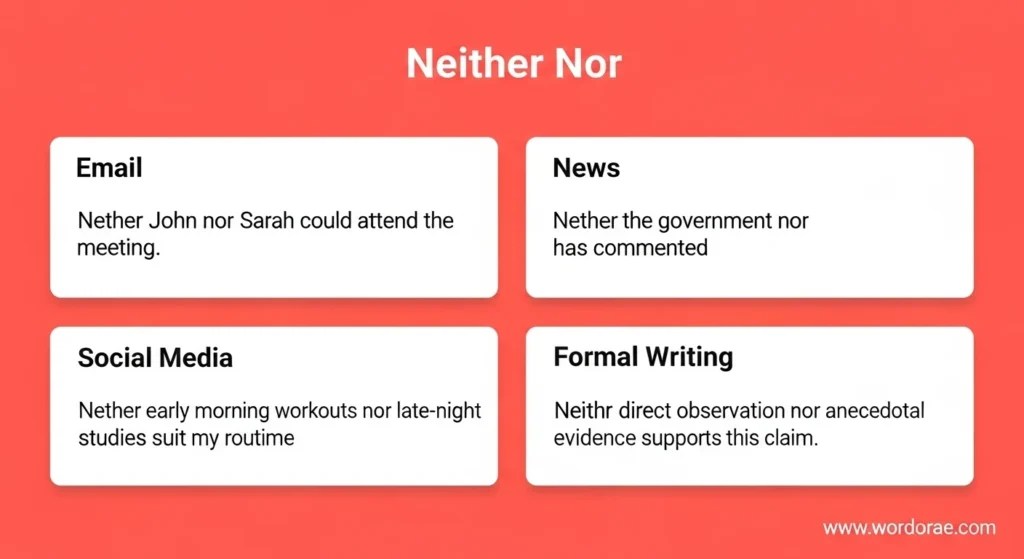
Neither Nor in Everyday Examples
Emails
- I am available neither today nor tomorrow.
News
- Neither the government nor the opposition commented.
Social Media
- I like neither summer nor winter 😅.
Formal Writing
- Neither the data nor the methodology supports the claim.
Neither Nor or Neither Or : Trends & Usage
Search data shows “neither nor” is widely accepted and dominant across all English-speaking regions.
Queries containing “neither or” usually come from learners checking if it is correct.
Google’s language systems recognize “neither or” as a grammar error in standard usage.
Content that explains the difference clearly aligns well with helpful content and educational intent, making this keyword ideal for grammar-focused SEO articles.
FAQs:
1. Is “neither or” ever correct?
No. In standard English, it is considered incorrect.
2. Why do people say “neither or”?
It appears in casual speech, but it is grammatically wrong in writing.
3. Is the rule different in British English?
No. Both UK and US English use “neither nor.”
4. Can “neither” be used alone?
Yes, but when pairing two items, it must use “nor.”
5. What comes after “neither nor” singular or plural?
The verb usually agrees with the closest noun.
6. Is “neither nor” formal English?
Yes. It is correct in both formal and informal writing.
Conclusion
The confusion between neither nor or neither or is common, but the rule itself is simple. “Neither nor” is always correct, while “neither or” is a grammatical mistake in standard English.
This rule applies equally in American and British English, making it easy to follow once you understand the structure.
If you remember one thing, remember this:
- Neither → nor
- Either → or
Using the correct pairing improves clarity, professionalism, and trust in your writing.
Whether you’re writing an email, an exam answer, or SEO content, sticking to neither nor ensures your English sounds natural and correct.

I’m Helena Marwick, a grammar-focused writer at Wordorae.com, where I help readers understand confusing English words and usage clearly.
I specialize in making grammar simple, accurate, and easy to apply in everyday writing.