Quick answer:
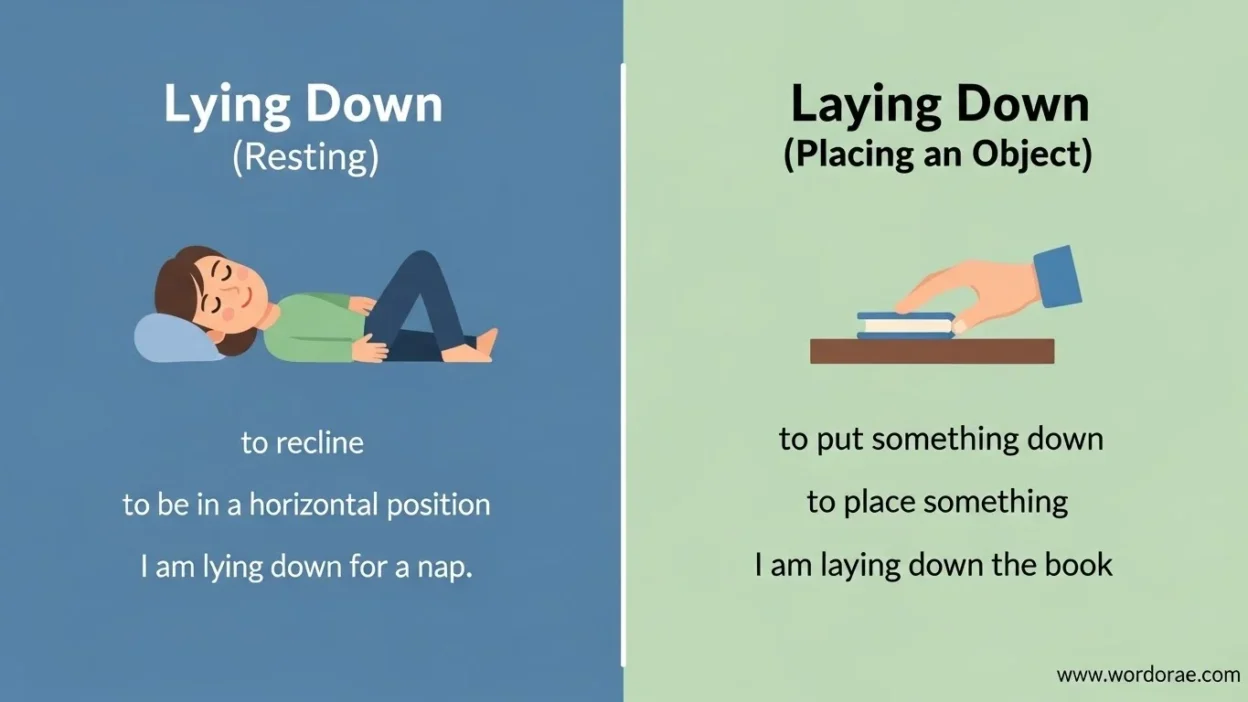
You lie down to rest. You lay something down when you place an object.
I’ve stopped mid-sentence more than once wondering, “Is it laying down or lying down?” It sounds fine either way when spoken, which is why this question shows up so often in searches.
If you’ve ever typed is it laying down or lying down, you’re not making a silly mistake you’re running into one of English’s most confusing verb pairs.
The good news is that the rule is simple once you see it clearly.
This guide breaks it down using real examples and plain language, so you can choose the correct phrase without second-guessing yourself again.
Laying Down or Lying Down: Quick Answer
Use lying down when someone is resting or reclining.
Use laying down only when something is being placed.
✔ I’m lying down after a long day.
✔ She’s laying down her phone.
❌ I’m laying down on the couch. (Nothing is being placed.)
Remember:
No object → lying
Object present → laying
The Origin of Laying Down or Lying Down
This confusion comes from how English developed.
- Lie originally meant “to rest” and never took an object.
- Lay meant “to place something” and always needed one.
The problem?
Lay is also the past tense of lie. Over time, spoken English blurred the difference, but standard written English still follows the original rule.
British English vs American English Spelling
There is no spelling difference between British and American English here. Both use the same forms and rules.
| Phrase | UK English | US English | Meaning |
| lying down | ✔ | ✔ | resting |
| laying down | ✔ | ✔ | placing an object |
This is a grammar issue, not a regional one.
Which Spelling Should You Use?
Ask yourself one question: Is there an object?
- Talking about rest or position → lying down
- Talking about placing something → laying down
For professional, academic, or global writing, following this rule avoids confusion and keeps your language clear.
Common Mistakes with Laying Down or Lying Down
❌ “I was laying down when you called.”
✔ “I was lying down when you called.”
❌ “He is lying the book on the table.”
✔ “He is laying the book on the table.”
Most errors happen when the object is overlooked.
Laying Down or Lying Down in Everyday Examples
Emails:
“I’m lying down with a migraine.”
News:
“The witness was found lying down near the entrance.”
Social media:
“Just lying down and scrolling.”
Formal writing:
“The patient remained lying down during the procedure.”
Laying Down or Lying Down: Usage Trends
Search trends show that laying down or lying down is most often looked up during writing or editing.
People want a fast answer and a clear rule, not long grammar lessons. That’s why simple explanations like this perform best.
Comparison Table
| Phrase | Needs an Object? | Correct Use |
| lying down | No | resting |
| laying down | Yes | placing something |
FAQs
1. Is it laying down or lying down on a bed?
Lying down.
2. Why does “laying down” sound correct?
Because “lay” is the past tense of “lie.”
3. Can I say “laying down rules”?
Yes. Rules are the object.
4. Is this mistake common in English?
Very common, even among native speakers.
5. What’s the easiest way to remember the rule?
If there’s no object, use lying.
Conclusion
The difference between laying down or lying down comes down to one simple check: is there an object involved?
If someone is resting, the correct phrase is lying down.
If something is being placed, laying down is the right choice.
Once you understand that rule, this grammar problem stops being confusing.
You’ll recognize the mistake instantly and fix it without hesitation.
Clear writing builds confidence, and mastering small details like this makes a big difference in how polished your English looks.

I’m Jane Austen, a writer at Wordorae.com, where I focus on explaining grammar mistakes and confusing English words in a clear, simple way.
I help readers improve their writing by making tricky language rules easy to understand and use.