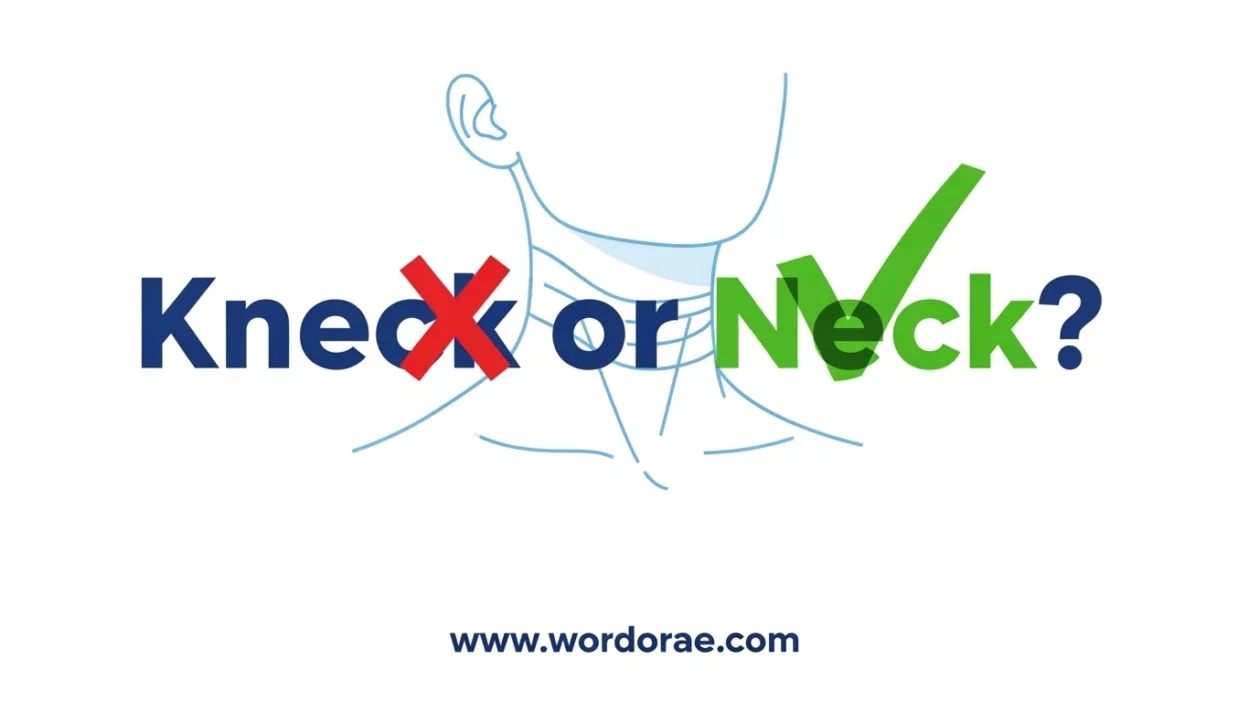
Quick answer: “Neck” is correct, and “kneck” is a spelling mistake.
Have you ever typed “kneck” and paused for a second? I know that feeling.
You look at the word and think, “Wait… is that right?” You’re not alone.
Many people search kneck or neck because English spelling can be confusing.
We see words like knife, knee, and know with a silent “k,” so it’s easy to assume “neck” follows the same rule but it doesn’t.
In this guide, I’ll explain why “neck” is correct, why “kneck” appears sometimes, and how you can remember the right spelling forever.
By the end, you won’t second-guess yourself again.
Kneck or Neck – Quick Answer
The correct spelling is neck.
❌ Wrong: kneck
✅ Correct: neck
Example:
Correct: She wore a necklace around her neck.
Wrong: She wore a necklace around her kneck.
“Kneck” is not a real English word. It is a common spelling mistake.
Why Do People Write “Kneck”?
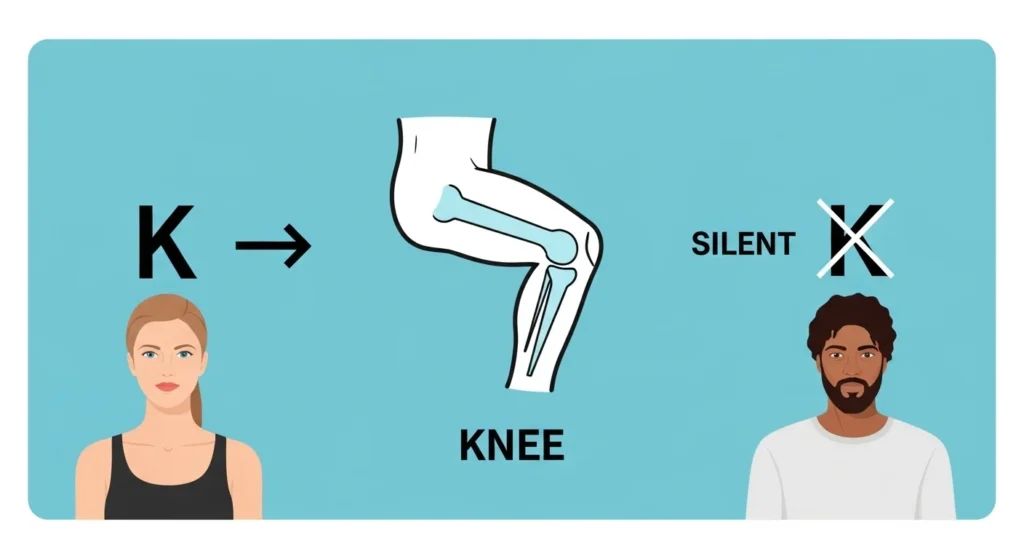
This is where the confusion starts.
English has many words that begin with a silent “k”:
- Knife
- Knee
- Know
- Knock
Because of these examples, some people assume that “neck” should follow the same pattern. But that assumption is wrong.
The word “neck” does not have a silent “k.” It has always been spelled without a “k” at the beginning in modern English.
The mistake happens because English spelling is not always consistent.
So when people write “kneck,” they are applying the wrong spelling rule.
The Silent “K” Rule Explained
Some English words kept their silent “k” from Old English. In the past, the “k” was actually pronounced. Over time, pronunciation changed, but the spelling stayed the same.
For example:
- “Knee” came from Old English “cneow.”
- “Knife” came from Old English “cnif.”
But “neck” has a different history. It comes from Old English “hnecca.” Over time, the spelling simplified, and the “h” disappeared. The word became “neck.”
It never needed a silent “k.”
So even though knee and neck sound similar at the start, their spelling history is different.
The Origin of the Word “Neck”
The word “neck” has been used for hundreds of years. It refers to the part of the body that connects the head to the shoulders.
Over time, the spelling became simple and stable: N-E-C-K.
There has never been an accepted version spelled “kneck” in modern English. Dictionaries do not recognize it.
That’s why using “kneck” will always be considered incorrect.
British English vs American English Spelling
Some spelling differences exist between British and American English, such as:
- Color / Colour
- Analyze / Analyse
But in this case, both British and American English agree.
| Variation | British English | American English | Correctness |
|---|---|---|---|
| Neck | ✅ Accepted | ✅ Accepted | Correct |
| Kneck | ❌ Wrong | ❌ Wrong | Incorrect |
There is no regional difference here. “Neck” is correct everywhere.
Which Spelling Should You Use?
In the US → Use neck
In the UK → Use neck
In Canada, Australia, and worldwide → Use neck
There is no situation where “kneck” is correct.
If you write “kneck” in emails, essays, or posts, it will be marked as a spelling error.
Common Mistakes with “Kneck or Neck”
Here are the most common reasons people write “kneck”:
- Confusing it with “knee.”
- Thinking all “n” sounds need a silent “k.”
- Typing too fast.
- Autocorrect not catching the error.
Correction tip: If you are talking about the body part, always spell it N-E-C-K.
Easy Trick to Remember the Correct Spelling

Here’s a simple memory trick.
Think about your neck. There is no knife on it. There is no silent “k.” It’s just neck.
Also remember:
Knee → has a silent K
Neck → does NOT have a silent K
If the word starts with “ne,” just write N-E, not K-N-E.
That small reminder can save you from making the mistake again.
“Neck” in Everyday Examples
Emails:
Please wear a scarf to keep your neck warm.
News:
The athlete suffered a minor neck injury.
Social Media:
My neck hurts after working all day.
Formal writing:
The patient reported pain in the neck region.
In every case, the spelling remains the same.
Comparison Table: Correct vs Incorrect Usage
| Sentence | Correct or Incorrect |
|---|---|
| She has a stiff neck. | ✅ Correct |
| She has a stiff kneck. | ❌ Incorrect |
| The necklace rested on her neck. | ✅ Correct |
| The necklace rested on her kneck. | ❌ Incorrect |
This table clearly shows that “kneck” never works in a sentence.
Is “Kneck” Ever a Real Word?
No. “Kneck” is not listed in English dictionaries.
Sometimes people use it by mistake in:
- School essays
- Social media posts
- Text messages
But it has no official meaning.
Spell check tools will usually underline it as an error.
FAQs
Q1: Is it kneck or neck?
A1: The correct spelling is neck.
Q2: Is kneck a real English word?
A2: No, kneck is not a real word in English.
Q3: Why do people write kneck?
A3: People confuse it with words like knee or knife that have a silent “k.”
Q4: Does British English use kneck?
A4: No. Both British and American English use neck.
Q5: How do you spell the body part neck?
A5: It is spelled N-E-C-K.
Q6: Is kneck ever acceptable in writing?
A6: No, it is always considered a spelling mistake.
Q7: Why does knee have a silent k but neck does not?
A7: The words have different origins in Old English, which explains the spelling difference.
Q8: Can kneck mean something else?
A8: No, kneck has no recognized meaning in English.
Q9: Will spell check correct kneck?
A9: Most spell check tools will mark kneck as incorrect.
Q10: How can I remember the correct spelling?
A10: Remember that neck starts with N-E. There is no silent K at the beginning.
Conclusion
So, is it kneck or neck? The answer is simple: neck is correct, and kneck is wrong.
I know English spelling can feel tricky, especially when silent letters confuse us.
The word “neck” has been used for hundreds of years. It comes from Old English hnecca and refers to the part of the body that connects the head to the shoulders.
Words like knee and knife make it easy to assume “kneck” might be right. But it isn’t.
If you remember one thing, let it be this: your neck starts with N, not K. There is no silent letter at the beginning.
When you write emails, essays, captions, or professional documents, always use “neck.”
Small spelling mistakes can affect how your writing is viewed.
But once you understand the rule and the word’s history, you won’t make this mistake again.
Now you can write with confidence, knowing that “neck” is the only correct choice.

I’m David Miller, a grammar expert and author at Wordorae.com, specializing in clear, simple explanations of confusing English grammar and word usage.
I help readers write with confidence by turning complex grammar rules into easy, practical guidance.