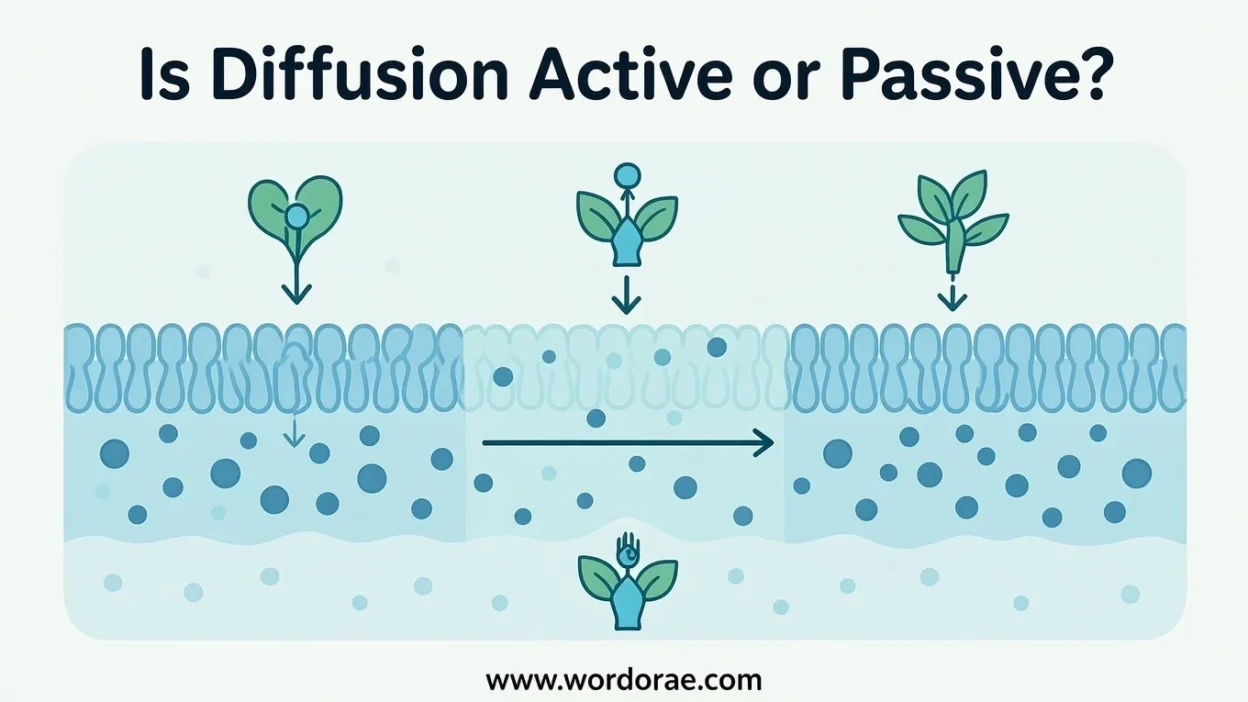
Quick answer: Diffusion is a passive process. It does not require energy (ATP) and happens naturally.
If you’ve ever studied biology and paused at the question “Is diffusion active or passive?”, you’re not alone.
I know how confusing this can feel especially when textbooks start mixing terms like active transport, passive transport, and concentration gradients. It’s easy to second-guess yourself.
You might be wondering why diffusion doesn’t need energy, how it’s different from active transport, or why teachers stress this question so much.
That’s exactly why I wrote this article for you. I’ll explain diffusion in simple words, show you how it works step by step, and clear up the confusion once and for all.
By the end of this guide, you’ll confidently know why diffusion is passive, how it works in cells,
And how to answer this question correctly in exams or homework without memorizing anything complicated.
Is Diffusion Active or Passive – Quick Answer
Diffusion is a passive transport process.
This means:
- No energy (ATP) is required
- Particles move naturally from high concentration to low concentration
- Movement happens until balance (equilibrium) is reached
In short, diffusion happens on its own.
The Origin of the Concept of Diffusion
The idea of diffusion comes from observing how particles naturally spread out. Scientists noticed that gases, liquids, and dissolved substances move from crowded areas to less crowded ones without any external force.
This concept became important in biology when scientists studied how oxygen, carbon dioxide, and nutrients move in and out of cells.
Diffusion helped explain how cells survive without constantly using energy.
Over time, diffusion became a core topic in cell biology, chemistry, and physics, especially when studying membranes and transport systems.
Passive Transport vs Active Transport
Understanding diffusion becomes easier when you compare it with active transport.
| Feature | Diffusion | Active Transport |
| Energy required | ❌ No | ✅ Yes |
| Direction of movement | High → Low concentration | Low → High concentration |
| Uses ATP | ❌ No | ✅ Yes |
| Example | Oxygen entering cells | Sodium-potassium pump |
Diffusion is passive because particles move naturally, not because the cell pushes them.
Why Diffusion Is a Passive Process
Diffusion is passive because it relies on natural particle motion. Molecules are always moving, and when there’s a concentration difference, they spread out evenly over time.
No cellular energy is needed because:
- The movement follows the concentration gradient
- The cell does not control or force the movement
- The process stops automatically at equilibrium
This is why diffusion is classified as passive transport, along with facilitated diffusion and osmosis.
How Diffusion Works in Cells
Here’s how diffusion typically works inside the body:
- There is a higher concentration of a substance outside or inside the cell
- Molecules move across the cell membrane
- Movement continues until concentrations are equal
Common examples include:
- Oxygen diffusing into blood cells
- Carbon dioxide diffusing out of cells
- Small molecules passing through membranes
This constant movement keeps cells alive and functioning properly.
Common Examples of Diffusion
| Example | Explanation |
| Oxygen entering cells | Moves from high oxygen to low oxygen |
| Perfume spreading in air | Molecules spread naturally |
| Food coloring in water | Color spreads without stirring |
| Carbon dioxide leaving cells | Waste moves out naturally |
These examples show that diffusion does not need energy, it just happens.
Common Mistakes About Diffusion
❌ Thinking diffusion requires ATP
✅ Diffusion never uses energy
❌ Confusing diffusion with active transport
✅ Active transport moves against the gradient
❌ Assuming all membrane movement is diffusion
✅ Some processes require pumps and proteins
❌ Mixing diffusion with osmosis
✅ Osmosis is diffusion of water only
Understanding these differences helps you avoid exam mistakes.
Diffusion vs Facilitated Diffusion
Both processes are passive, but there’s a small difference:
| Feature | Diffusion | Facilitated Diffusion |
| Uses transport proteins | ❌ No | ✅ Yes |
| Energy required | ❌ No | ❌ No |
| Type of molecules | Small, nonpolar | Large or charged |
Even when proteins are involved, facilitated diffusion is still passive.
Is Diffusion Important in Real Life?
Yes, diffusion is essential for life.
It plays a role in:
- Respiration: oxygen and carbon dioxide exchange
- Digestion: nutrient absorption
- Cell survival: waste removal
- Medical science: drug absorption
Without diffusion, cells would need much more energy to survive.
FAQs
Is diffusion active or passive?
Diffusion is passive.
Does diffusion require ATP?
No, diffusion does not use ATP.
Is facilitated diffusion active or passive?
It is passive.
Is osmosis a type of diffusion?
Yes, osmosis is diffusion of water.
Can diffusion happen in solids?
Yes, but very slowly.
Why is diffusion important for cells?
It allows materials to move without energy.
Conclusion
Diffusion is a passive transport process that happens naturally and requires no energy. Particles move from areas of high concentration to low concentration until balance is reached.
This simple process allows oxygen to enter cells, waste to leave, and nutrients to spread where they are needed.
If you remember just one thing, remember this: if no energy is used and movement follows the concentration gradient, it’s diffusion.
Once you understand that, this topic becomes easy and even logical.
With a little practice, you’ll never confuse diffusion with active transport again.

I’m Helena Marwick, a grammar-focused writer at Wordorae.com, where I help readers understand confusing English words and usage clearly.
I specialize in making grammar simple, accurate, and easy to apply in everyday writing.