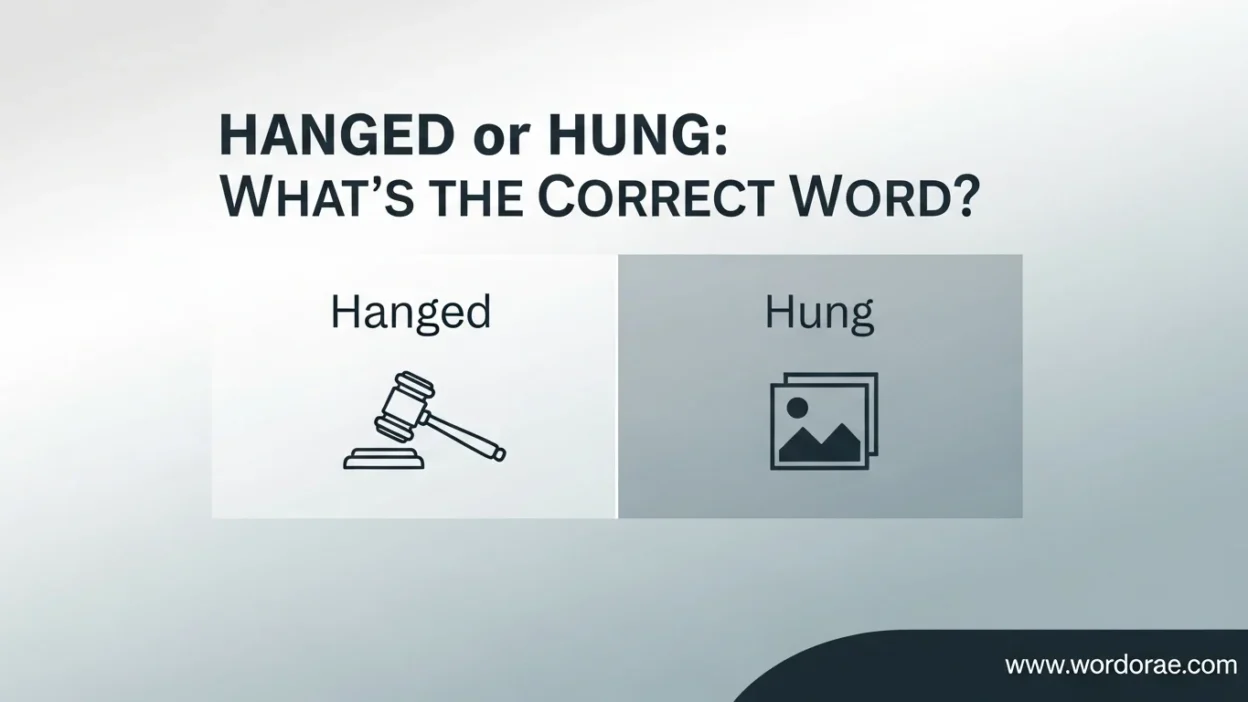
Quick answer: “Hanged” is used specifically for executions or capital punishment, while “hung” is used in almost all other cases, like objects being suspended.
I know why you’re here. You’ve probably typed “hanged or hung” into Google because you want to be sure which one to use.
Maybe you’re writing a story, an essay, or even a social media post and don’t want to sound wrong.
I’ve been there, and I know how confusing this can feel after all, both words sound the same and are past tense forms of hang.
Don’t worry. I’m going to make it simple. By the end of this article, you’ll know exactly when to use “hanged” and when to use “hung”,
And you’ll see plenty of real examples so that you can use these words naturally and confidently in your writing.
Hanged or Hung – Quick Answer
| Word | Use Case | Example |
| Hanged | Execution / legal death | The criminal was hanged for his crimes. |
| Hung | All other cases | She hung the picture on the wall. |
Remember: “hanged” is almost exclusively for people who were executed, while “hung” is everything else.
The Origin of Hanged or Hung
Both words come from the Old English verb “hangian”. Over time, the past tense diverged:
- Hung became the standard past tense for general usage.
- Hanged was retained specifically for execution contexts.
This distinction has been maintained in English grammar for centuries, especially in legal writing and historical texts.
British English vs American English Usage
| Word | British English | American English | Notes |
| Hanged | Hanged | Hanged | Legal executions |
| Hung | Hung | Hung | Everything else |
The rule is the same on both sides of the Atlantic, so you don’t need to worry about regional differences.
Which Word Should You Use?
Here’s a simple guideline:
- Talking about execution or death by hanging → use hanged.
- Talking about objects, pictures, clothes, or figurative hanging → use hung.
- If you’re unsure, ask yourself: Is this referring to a person being executed? If yes → hanged. Otherwise → hung.
Common Mistakes with Hanged or Hung
❌ Using hung for executions
✅ He was hanged for treason.
❌ Using hanged for objects
✅ She hung the coat on the hook.
❌ Mixing them in the same sentence
✅ Keep consistent: He hung the frame and the criminal was hanged.
Hanged or Hung Examples
Literature
- The villain was hanged at dawn.
- She hung the tapestry above the fireplace.
Emails
- I hung the calendar in the office.
- The play described a man who was hanged unjustly.
Social Media
- Hung my new painting today!
- The old story mentions people being hanged in the 1800s.
Formal Writing
- Historical records show that several rebels were hanged for treason.
- The flag was hung at half-mast.
Hanged or Hung – Trends & Usage Data
- Searches for “hanged or hung” spike around Halloween and historical event anniversaries.
- Writers and ESL learners often search this phrase for grammar clarity.
- US and UK data show consistent interest, confirming it’s a common confusion point in English.
Comparison Table: Hanged vs Hung
| Feature | Hanged | Hung |
| Refers to | Execution / death | Objects / clothes / pictures / figurative use |
| Capitalization | Only if proper noun | Only if proper noun |
| Usage Frequency | Rare | Common |
| Correct Example | The prisoner was hanged. | He hung the painting. |
Additional Usage Table
| Context | Hanged | Hung |
| Legal texts | ✅ | ❌ |
| Historical writing | ✅ | ⚠️ |
| Casual conversation | ❌ | ✅ |
| Emails & documents | ❌ | ✅ |
FAQs
- Can I ever use “hanged” for objects?
No, “hanged” is reserved for executions. - Can “hung” be used for people?
Only for figurative or non-execution contexts (e.g., “He hung his head in shame”). - Is “hanged” outdated?
No, it’s still correct for legal or historical writing. - Are there any exceptions?
Very few; standard English keeps the rule strict. - Do British and American English differ?
No, both use the same rule for hanged/hung. - Why do people get confused?
Because both words sound identical and are past tense forms of “hang.” - Can I start a sentence with “hanged”?
Yes, if referring to executions.
Example: “Hanged for their crimes, the rebels became legends.” - Can I say “hung someone” in casual speech?
Only if not referring to execution; for example, hung a jacket or hung a banner. - Is this considered formal or informal?
Using “hanged” is formal/legal; “hung” is neutral and widely used. - Are there synonyms?
- Hanged → executed, put to death
- Hung → suspended, attached, draped
Conclusion
“Hanged or hung” is one of the most classic English confusions, but the rule is simple:
- Hanged → executions
- Hung → everything else
Once you remember this, you’ll never hesitate when writing or speaking. Use the tables and examples as a reference,
And soon it will feel natural. With a little attention, you can write confidently and sound professional, If it’s a story, an essay, or casual writing.

I’m Helena Marwick, a grammar-focused writer at Wordorae.com, where I help readers understand confusing English words and usage clearly.
I specialize in making grammar simple, accurate, and easy to apply in everyday writing.