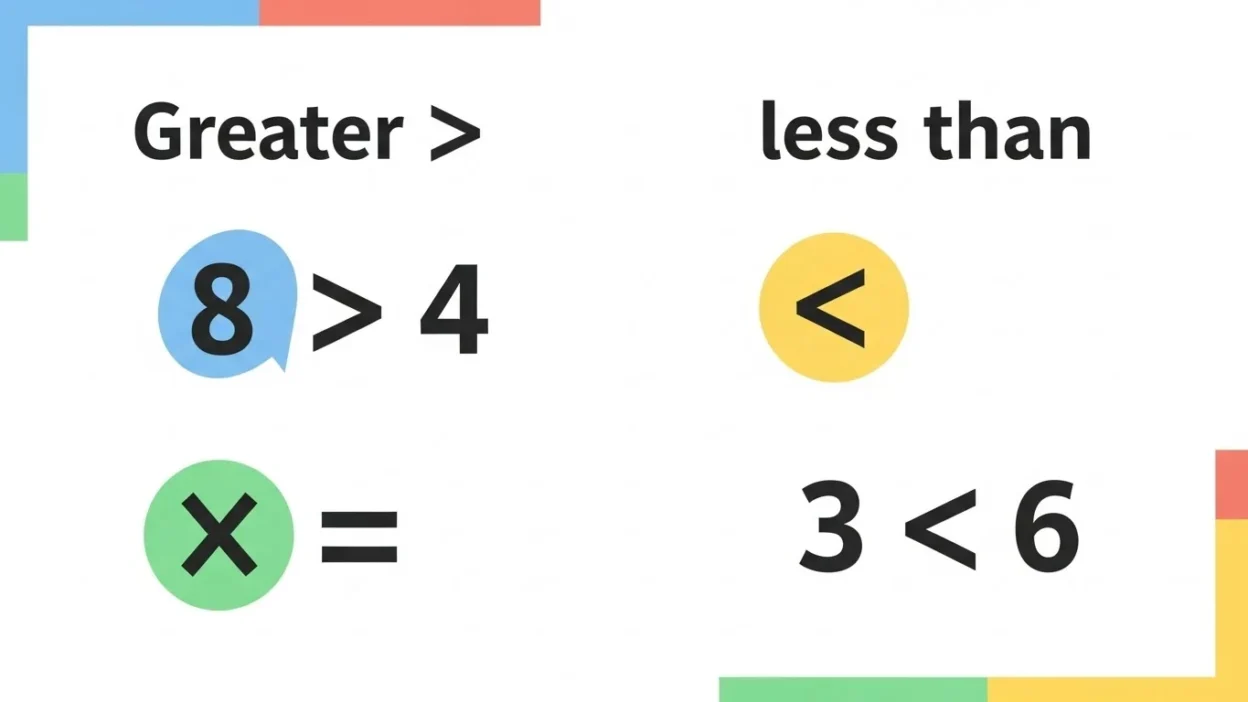
Quick answer: The greater than symbol ( > ) means bigger than, and the less than symbol ( < ) means smaller than.
I still remember the first time I saw these symbols in school. They looked almost identical, and no matter how many times the teacher explained them, my brain mixed them up.
One pointed left, the other right and somehow that tiny difference felt way bigger than it should have been. If you’ve searched for greater than or less than symbols, chances are you’ve felt the same confusion.
People look this up for many reasons. Some are helping their kids with homework. Some are studying for exams. Others see these symbols while coding or working with numbers and want to be sure they’re using the right one. The problem isn’t math, it’s remembering which symbol means what.
This guide is here to make it simple. No complicated rules. No overthinking. Just clear explanations, real examples, and an easy way to remember these symbols so they finally make sense.
Greater Than or Less Than Symbols : Quick Answer
Here’s the simplest explanation:
- Greater than ( > ) means bigger than
- Less than ( < ) means smaller than
Examples:
- 7 > 4 means 7 is bigger than 4
- 2 < 9 means 2 is smaller than 9
Easy memory trick:
The symbol opens toward the larger number.
Think of it like a mouth that always wants the bigger bite.
Where Greater Than and Less Than Symbols Come From
These symbols were created to make math faster and clearer. Instead of writing full sentences like “ten is larger than five,” mathematicians needed a short and simple way to compare numbers.
The shapes were designed on purpose. One side is wide, and the other is narrow.
The wide side always faces the bigger number, while the narrow side points to the smaller one.
Once you notice this, the symbols stop feeling confusing and start feeling logical.
British English vs American English Usage
This part is refreshingly easy.
There is no difference between British and American English when it comes to greater than or less than symbols. They are used the same way everywhere.
| Symbol | Meaning | UK | US |
| > | Greater than | Same | Same |
| < | Less than | Same | Same |
Whether you’re studying in London, New York, or anywhere else, these symbols never change.
Which Symbol Should You Use?
Use greater than ( > ) when the number on the left is bigger.
Use less than ( < ) when the number on the left is smaller.
That’s it.
This works for:
- School math
- Test questions
- Coding conditions
- Money comparisons
- Age limits
If you’re ever unsure, pause and ask one question:
Which number is bigger?
The symbol will follow naturally.
Common Mistakes People Make
| Mistake | Why It Happens | Correct Way |
| Symbol facing wrong direction | Guessing instead of checking | Compare numbers first |
| Mixing > and < | They look similar | Use the “mouth” trick |
| Forgetting equal symbols | Different meaning | Use ≥ or ≤ when needed |
| Rushing | Leads to careless errors | Slow down for one second |
Most mistakes come from rushing, not from lack of understanding.
Greater Than or Less Than Symbols in Everyday Life
You see these symbols more often than you realize.
Emails:
- “Approve expenses greater than $1,000 only.”
News:
- “Temperatures less than zero caused travel delays.”
Social Media:
- “Sleep > stress.”
Formal Writing:
- “Participants under 18 were excluded from the study.”
Programming:
- if (age > 18)
Once you notice them, you’ll see these symbols everywhere.
How Often People Search for These Symbols
Search interest in greater than or less than symbols stays steady all year. It increases during:
- School exam seasons
- Homework-heavy months
- Coding and programming courses
This tells us something important: people aren’t looking for advanced math. They want simple, clear explanations that help them understand quickly.
Comparison Table of Related Symbols
| Symbol | Meaning | Example |
| > | Greater than | 8 > 3 |
| < | Less than | 1 < 5 |
| ≥ | Greater than or equal to | 6 ≥ 6 |
| ≤ | Less than or equal to | 4 ≤ 7 |
| = | Equal to | 9 = 9 |
FAQs
What does the greater than symbol mean?
It means one number is bigger than another.
What does the less than symbol mean?
It means one number is smaller than another.
How can I remember which is which?
The open side faces the bigger number.
Are these symbols used in coding?
Yes, they’re very common in programming.
Do these symbols change by country?
No, they’re universal.
What’s the difference between > and ≥?
≥ includes equality; > does not.
Are these symbols used outside math class?
Yes, in finance, science, and daily life.
Conclusion
Greater than and less than symbols don’t have to be confusing. Once you understand that the open side always points to the larger number, everything clicks into place.
These symbols are simple, universal, and incredibly useful in school, work, and everyday decisions.
Most people struggle with them at first and that’s completely normal. With a few examples and one good memory trick, the confusion fades quickly.
Take your time, compare the numbers, and let the symbol do its job.
Before long, using greater than or less than symbols will feel natural, not stressful.

I’m Helena Marwick, a grammar-focused writer at Wordorae.com, where I help readers understand confusing English words and usage clearly.
I specialize in making grammar simple, accurate, and easy to apply in everyday writing.