Quick answer:
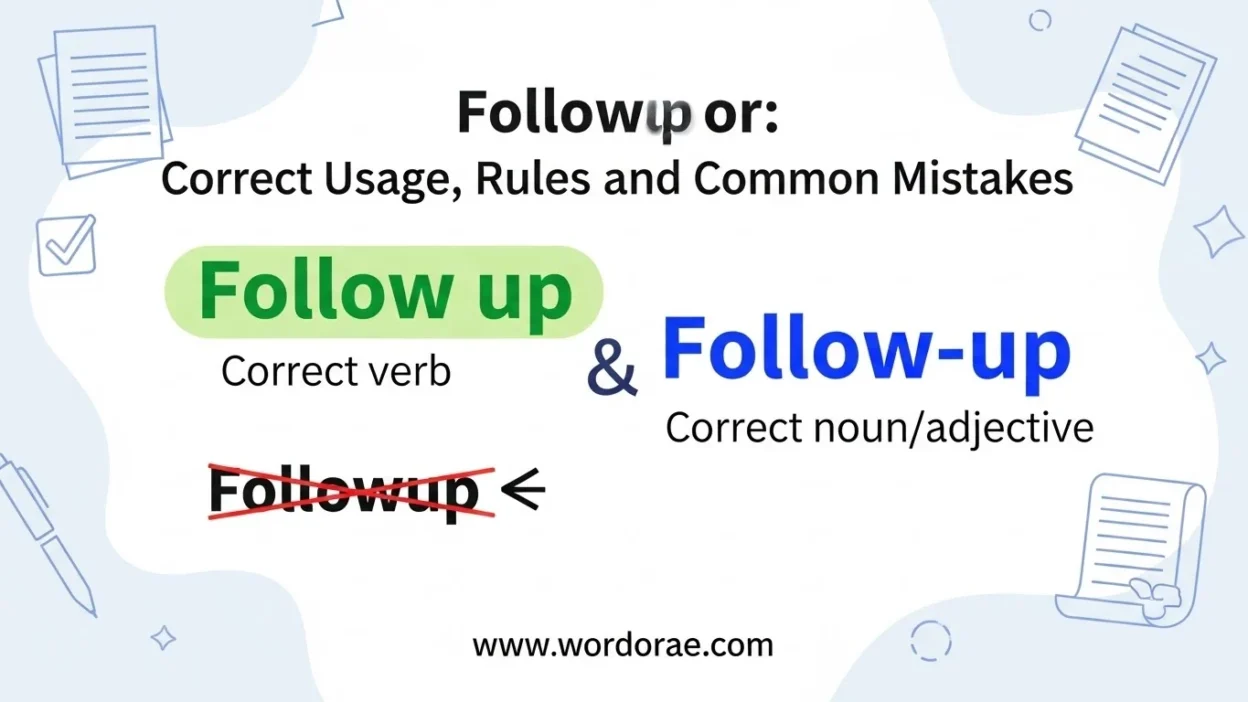
“Follow up” is the correct verb.
“Follow-up” (with a hyphen) is the correct noun or adjective.
“Followup” as one word is generally incorrect in standard English.
Many people search followup or follow up because both forms appear constantly especially in emails, messages, and business writing.
You’ll often see lines like “Just following up” or “This is a followup email”, which adds to the confusion.
The issue isn’t pronunciation. It’s grammar. English treats actions and things differently, and small spacing or hyphen changes affect correctness.
Since “follow up” is widely used in professional and online communication, writers want a clear rule they can trust.
This article explains the difference in simple terms, with real examples and practical advice, so you can use the correct form confidently every time.
Followup or Follow Up – Quick Answer
✔ Follow up → verb (an action)
✔ Follow-up → noun or adjective (a thing or description)
✘ Followup → incorrect in formal writing
Examples:
- I will follow up tomorrow. (verb)
- This is a follow-up email. (noun)
- We scheduled a follow-up call. (adjective)
If you’re describing an action, use two words.
If you’re naming something, use the hyphenated form.
The Origin of “Follow Up”
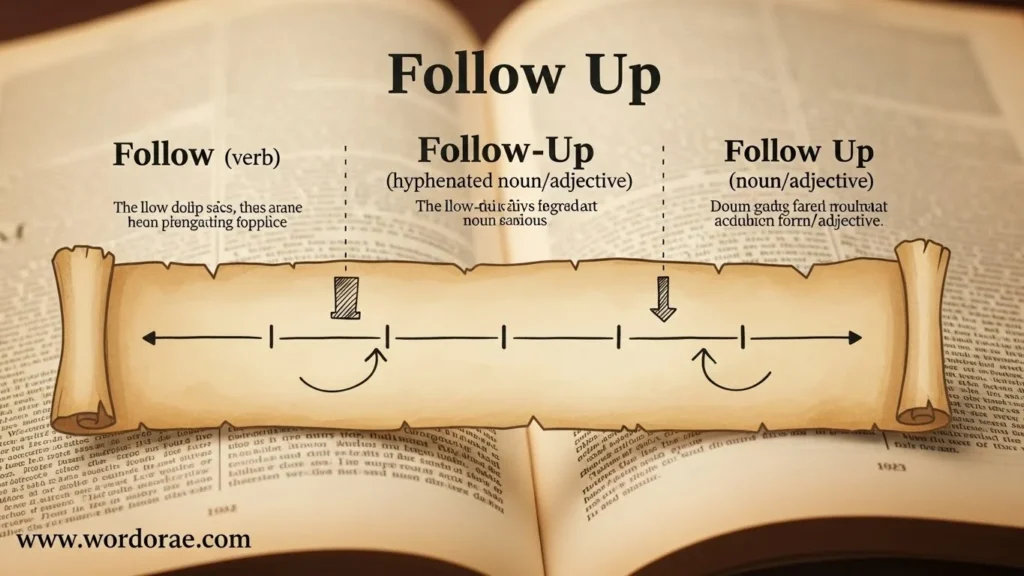
The phrase follow up comes from the verb follow, meaning to come after, combined with up, which adds the sense of completion or continuation.
As English evolved, this phrasal verb became common in both spoken and written language.
Over time, writers also needed a way to name the action itself, which led to the hyphenated form follow-up.
However, the closed compound “followup” never became standard. Major style guides and dictionaries still treat it as informal or incorrect in professional writing.
This history explains why the spacing and hyphen matter.
British English vs American English Spelling
There is no difference between British and American English when it comes to this word.
| Form | British English | American English |
| follow up (verb) | ✅ Correct | ✅ Correct |
| follow-up (noun/adjective) | ✅ Correct | ✅ Correct |
| followup | ❌ Incorrect | ❌ Incorrect |
Both varieties follow the same grammar rule.
Which Spelling Should You Use?
Choose the form based on how the word functions in your sentence, not your location.
- US audience: follow the verb vs noun rule
- UK & Commonwealth: same rule applies
- Global or professional writing: avoid “followup”
If it answers what are you doing? → follow up
If it answers what is it? → follow-up
Common Mistakes with Followup or Follow Up
❌ I will followup with you tomorrow.
✔ I will follow up with you tomorrow.
❌ Please send a follow up email.
✔ Please send a follow-up email.
❌ We need to follow-up on this issue.
✔ We need to follow up on this issue.
These mistakes are extremely common in emails and online content, but they reduce clarity and professionalism.
Followup or Follow Up in Everyday Examples

Emails:
- I’m writing to follow up on our conversation.
- This is a follow-up regarding your request.
Business writing:
- A follow-up meeting has been scheduled.
Social media:
- Just doing a quick follow up.
Formal writing:
- Further analysis will follow up the initial report.
Used correctly, the phrase fits naturally into all writing styles.
Followup or Follow Up – Usage Trends
Searches for “followup or follow up” are especially common among professionals, students, and non-native English writers.
The incorrect one-word form appears frequently in casual communication, which is why people look for confirmation.
Search engines tend to favor content that clearly explains common mistakes and correct usage.
Articles that separate verb and noun forms without overcomplicating the rule perform better because they directly satisfy user intent.
Comparison Table: Followup vs Follow Up
| Form | Correct? | Usage |
| follow up | ✅ Yes | Verb (action) |
| follow-up | ✅ Yes | Noun / adjective |
| followup | ❌ No | Misspelling |
FAQs: Followup or Follow Up
Is “followup” ever correct?
No. It’s not standard in formal English.
When should I use “follow up”?
When describing an action.
When should I use “follow-up”?
When naming or describing something.
Is the rule different in British English?
No. Both follow the same rule.
Can I hyphenate “follow up” as a verb?
No. The verb is never hyphenated.
Does incorrect usage matter in emails?
Yes. It affects clarity and professionalism.
Conclusion
So, followup or follow up? The difference comes down to function. Use follow up when you’re describing an action.
Use follow-up when referring to an email, meeting, or task. Avoid followup entirely in professional, academic, and SEO writing.
Once you understand this simple distinction, the confusion disappears.
Correct usage makes your writing clearer, more polished, and easier to trust—especially in business and online communication.

I’m David Miller, a grammar expert and author at Wordorae.com, specializing in clear, simple explanations of confusing English grammar and word usage.
I help readers write with confidence by turning complex grammar rules into easy, practical guidance.