Quick answer:
Exception is the correct word in standard English; acception exists but is rare and almost never used today.
I know why you’re here. You’ve seen exception and acception, and now you’re wondering if both are correct or if one is a mistake.
Maybe you saw acception in a book, an old document, or online. Or maybe spellcheck didn’t flag it, and now you’re unsure.
I’ve been there too, second-guessing a word and wondering if I missed something obvious.
Most people search “exception or acception” because the words look related. They sound similar.
They even share the same root. But in real-life English, they do very different jobs. One is common and essential. The other is rare and outdated.
In this article, I’ll walk you through the difference in a clear, simple way.
By the end, you’ll know exactly which word to use, when to use it, and why the confusion exists in the first place.
Exception or Acception – Quick Answer
Exception means something that does not follow a rule.
Acception is an old word that once meant “acceptance” or “meaning,” but it is almost never used today.
Example:
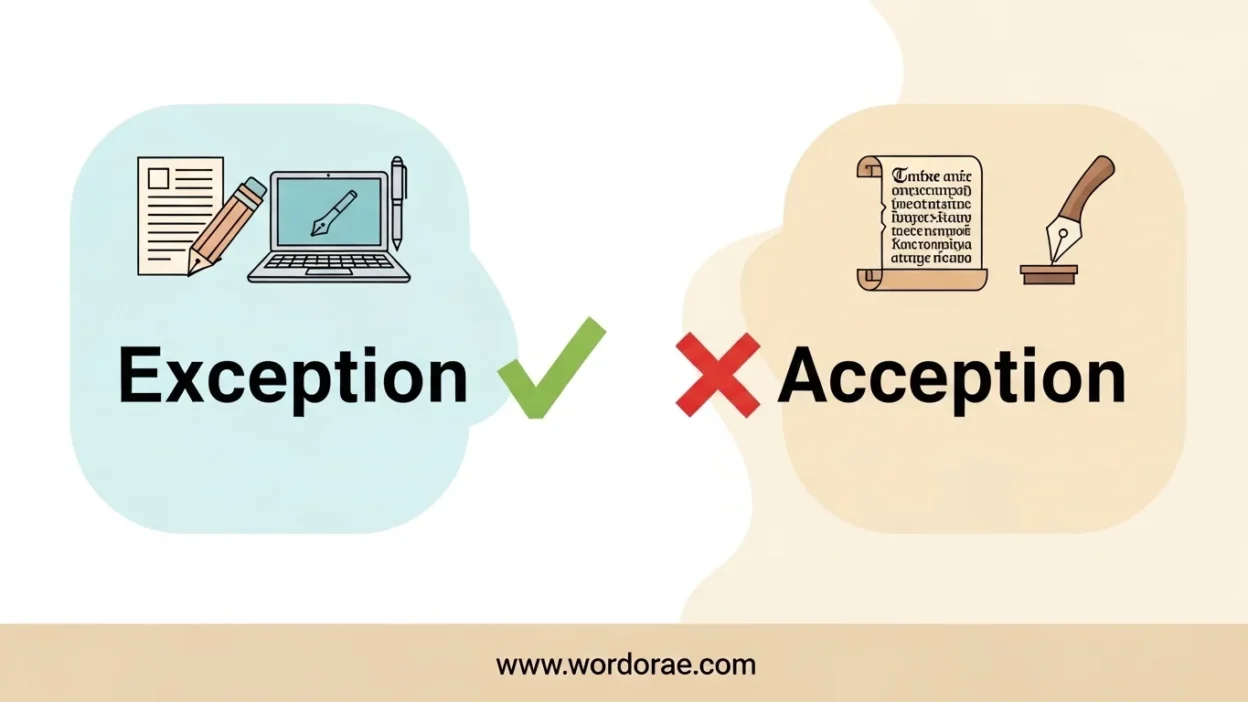
- This rule applies to everyone, with no exception.
- ❌ This rule applies to everyone, with no acception. (wrong)
The Meaning of Exception
Exception is a common noun in modern English.
It means:
- Something excluded from a rule
- A special case
- Something different from the rest
Simple examples:
- Everyone must attend the meeting, with one exception.
- The shop is open daily, no exceptions.
- She follows the rules without exception.
You will see exception in schools, offices, laws, emails, and news articles. It is a normal, everyday word.
The Meaning of Acception
Acception is a real word, but it is rare and outdated.
Historically, it meant:
- Acceptance
- Approval
- A particular meaning of a word
Today, most English speakers never use it. Many dictionaries still list it, but only as an archaic or technical term.
Important point:
In modern writing, acception sounds wrong or confusing. Readers may think it is a spelling mistake.
The Origin of Exception and Acception
Both words come from Latin.
- Exception comes from excipere, meaning “to take out.”
- Acception comes from acceptio, meaning “acceptance” or “meaning.”
Over time, English speakers kept exception because it filled a clear need. Acception slowly faded because other words like acceptance and meaning replaced it.
That history explains why the words look related but behave very differently today.
Exception vs Acception: Side-by-Side Comparison
| Feature | Exception | Acception |
|---|---|---|
| Common in modern English | Yes | No |
| Meaning | Exclusion from a rule | Acceptance / meaning |
| Used in daily writing | Very often | Almost never |
| Safe for exams and work | Yes | No |
| Sounds natural today | Yes | No |
British English vs American English
This is one area where British and American English agree.
- Exception is standard in both.
- Acception is rare in both.
You will not see acception used in normal UK or US writing. If you do, it is usually in old texts, legal history, or language studies.
So no matter where your audience is, exception is the right choice.
Which Word Should You Use?
The answer is simple.
Use exception if:
- You are writing emails
- You are writing articles or blogs
- You are a student
- You are taking exams
- You want clear, correct English
Avoid acception unless:
- You are studying old literature
- You are discussing word history
- You are quoting historical text
In everyday English, acception only creates confusion.
Common Mistakes
Many mistakes come from spelling or assumption.
Mistake 1: Thinking acception is another form of exception
They are not interchangeable.
Mistake 2: Using acception to sound formal
It does the opposite. It sounds incorrect.
Mistake 3: Trusting spellcheck alone
Some tools don’t flag rare words.
Correction tip:
If you mean “rule breaker” or “special case,” always choose exception.
Exception in Everyday Examples
Emails:
- Please follow the policy without exception.
News:
- The law applies to all citizens, with no exceptions.
Social media:
- Mondays are hard. No exceptions.
Formal writing:
- This agreement is binding, subject to specific exceptions.
Notice how natural exception feels in all these contexts.
Usage Clarity Comparison
| Sentence Goal | Correct Word | Wrong Word |
|---|---|---|
| Rule exclusion | Exception | Acception |
| Special case | Exception | Acception |
| Formal clarity | Exception | Acception |
| Modern writing | Exception | Acception |
FAQs
Is acception a spelling mistake?
Not exactly, but it is outdated and rarely correct today.
Can I ever use acception?
Only in historical or linguistic contexts.
Why does acception still exist?
Because English keeps many old words in dictionaries.
Will using acception hurt my writing?
Yes. Most readers see it as an error.
Is exception always the right choice?
Yes, for modern English.
Do native speakers use acception?
Almost never.
Can acception mean acceptance?
Historically, yes. Practically, no.
Conclusion
I want you to walk away from this feeling confident, not unsure.
When it comes to exception or acception, modern English makes the choice easy.
Exception is the word you need. It’s clear, natural, and understood everywhere.
Acception may exist on paper, but in real communication, it only distracts and confuses.
If you’re writing for school, work, the web, or everyday life, stick with exception every time.
You don’t need rare or old words to sound smart. Clear English always wins. Once you know this difference, you won’t second-guess it again.

I’m Jane Austen, a writer at Wordorae.com, where I focus on explaining grammar mistakes and confusing English words in a clear, simple way.
I help readers improve their writing by making tricky language rules easy to understand and use.