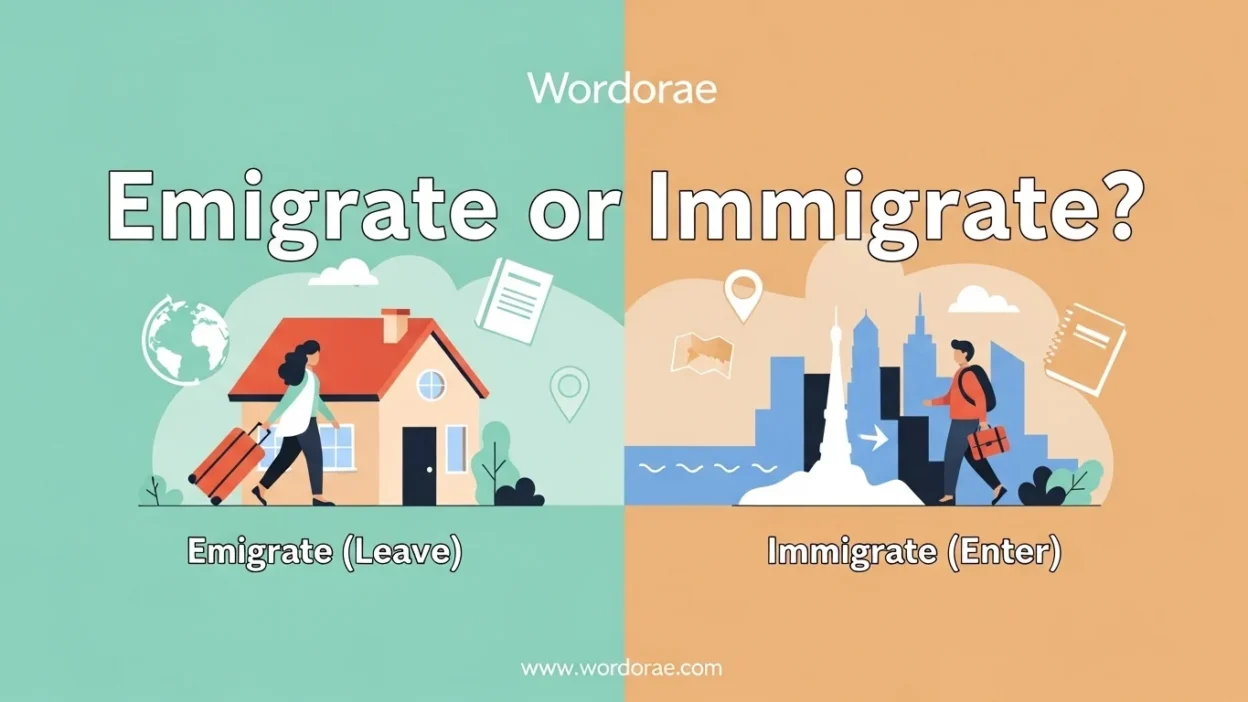
Quick Answer: You emigrate from a country and immigrate to a country.
Have you ever paused while writing and wondered, is it emigrate or immigrate? I’ve seen this confusion in essays, job applications, and even news articles.
You might be filling out a form or writing a sentence like, “My family ___ to Canada,” and suddenly you’re stuck.
The confusion is simple but powerful. Both words deal with moving between countries. Both sound similar. And both are used in discussions about citizenship, visas, and global mobility.
That’s why people search emigrate or immigrate meaning, difference between emigrate or immigrate, and when to use emigrate or immigrate every month.
Let’s clear this up in a way that sticks.
Emigrate or Immigrate – Quick Answer
Here’s the rule:
- Emigrate = Leave your country.
- Immigrate = Enter a new country to live there.
Examples:
- She emigrated from Brazil.
- She immigrated to Canada.
So if you’re asking, do you emigrate or immigrate to a country?
You immigrate to a country. You emigrate from a country.
That’s the core difference.
Key Differences Between Emigrate and Immigrate
Understanding the difference between emigrate or immigrate becomes easy when you see them side by side.
1️⃣ Direction of Movement
- Emigrate = Leaving
- Immigrate = Arriving
Example:
- He emigrated from India.
- He immigrated to Australia.
2️⃣ Preposition Used
- Emigrate from
- Immigrate to
Correct grammar matters in emigrate or immigrate grammar.
Example:
- She emigrated from Germany.
- She immigrated to the United States.
3️⃣ Point of View
- Emigrate focuses on the country you leave.
- Immigrate focus on the country you enter.
Example:
From Mexico’s perspective → He emigrated.
From Canada’s perspective → He immigrated.
4️⃣ Legal Context
- Emigration laws govern exit.
- Immigration laws govern entry.
Example:
- Immigration policies in Canada changed recently.
5️⃣ Usage in Forms
Official documents usually say:
- “Country of emigration”
- “Country of immigration”
6️⃣ Sentence Structure
Emigrate or immigrate in a sentence?
- My grandparents emigrated from Italy in 1950.
- My grandparents immigrated to the United States in 1950.
7️⃣ Memory Trick
Think:
- E = Exit → Emigrate
- I = In → Immigrate
If you remember exit vs in, you’ll never confuse them again.
The Origin of Emigrate and Immigrate
Both words come from Latin.
- Emigrate comes from emigrare (to move away).
- Immigrate comes from immigrare (to move into).
The prefix makes the difference:
- “E” means out.
- “Im” means in.
That’s why the spelling difference exists. The prefixes change direction.
The meanings have remained consistent for centuries.
Historically, emigration and immigration have shaped nations and cultures. For example, during the 19th and early 20th centuries, millions emigrated from Europe to America seeking better opportunities.
These movements highlight the practical use of both terms: individuals emigrate from one country and immigrate to another.
Understanding these origins helps clarify why the words are distinct and ensures you use them correctly in modern writing, whether for essays, reports, or even social media posts.
British English vs American English Spelling
Good news. There is no spelling difference between British and American English for these words.
| Word | US Spelling | UK Spelling |
| Emigrate | Emigrate | Emigrate |
| Immigrate | Immigrate | Immigrate |
Unlike “color/colour,” these words stay the same worldwide.
The only difference is usage, not spelling.
Which Spelling Should You Use?
The real question isn’t about spelling variation. It’s about context.
If you are writing from the perspective of the person leaving, use emigrate.
If you are writing from the perspective of the destination country, use immigrate.
For global audiences, consistency matters more than anything. Choose the word based on direction, and stay consistent in your article or document.
Common Mistakes
Here are frequent errors:
❌ Mistake 1: Using Immigrate With “From”
Incorrect:
- He immigrated from Spain.
Correct:
- He emigrated from Spain.
- He immigrated to France.
❌ Mistake 2: Using Emigrate With “To”
Incorrect:
- She emigrated to Canada.
Technically possible but perspective matters. If focusing on arrival, use immigrated.
❌ Mistake 3: Using Them Interchangeably
They are not synonyms. They describe opposite directions.
If you’re asking, is it emigrate or immigrate?
Check the direction of movement.
Emigrate or Immigrate in Everyday Examples
Let’s look at real-world usage.
📧 Email Example
- “My family emigrated from Poland in 1998.”
- Many students emigrate to study abroad and immigrate temporarily for education.
📰 News Example
- “Thousands immigrate to the UK every year for work opportunities.”
- Employees sometimes emigrate from one country for work and immigrate to another for better opportunities.
📱 Social Media Example
- “Thinking about immigrating to Canada next year.”
- Social media posts often misuse these words; remembering “exit vs in” prevents mistakes.
📚 Formal Writing
- “The family emigrated due to economic hardship.”
Notice how natural it feels when direction is clear.
Comparison Table: Emigrate vs Immigrate
| Feature | Emigrate | Immigrate |
| Direction | Leaving | Entering |
| Preposition | From | To |
| Focus | Origin country | Destination country |
| Legal Term | Emigration | Immigration |
| Memory Trick | Exit | In |
This table summarizes the difference between emigrate or immigrate instantly.
FAQs
Is it emigrate or immigrate?
It depends on direction. You emigrate from and immigrate to.
Do you emigrate or immigrate to a country?
You immigrate to a country.
What is the meaning of emigrate?
To leave your home country permanently.
What is the meaning of immigrate?
To enter and settle in a new country.
Can both words be used in the same sentence?
Yes.
- She emigrated from India and immigrated to Canada.
Are they interchangeable?
No. They describe opposite directions.
What is the difference between emigrate or immigrate?
Emigrate focuses on leaving. Immigrate focuses on arriving.
Is the spelling different in British English?
No. Both spellings are the same in UK and US English.
Conclusion
If you’ve ever stopped mid-sentence wondering, to emigrate or immigrate, you’re not alone. I’ve made this mistake before, and I know how small grammar doubts can shake confidence.
Here’s what you should remember: direction is everything. If someone is leaving, they emigrate. If someone is entering, they immigrate. Think exit vs in. That’s it.
When you focus on perspective, the confusion disappears. And once you understand the prefixes, the difference becomes logical instead of memorized.
Language is about clarity. And now, you have it.
Remember, the key to using emigrate or immigrate correctly is perspective. If you focus on leaving, use emigrate. If you focus on arriving, use immigrate. Picture a person leaving home and entering a new country.
Keep this mental image, and you’ll never confuse the two words again. Consistency in usage not only improves your writing but also builds confidence in professional or academic contexts.

I’m David Miller, a grammar expert and author at Wordorae.com, specializing in clear, simple explanations of confusing English grammar and word usage.
I help readers write with confidence by turning complex grammar rules into easy, practical guidance.