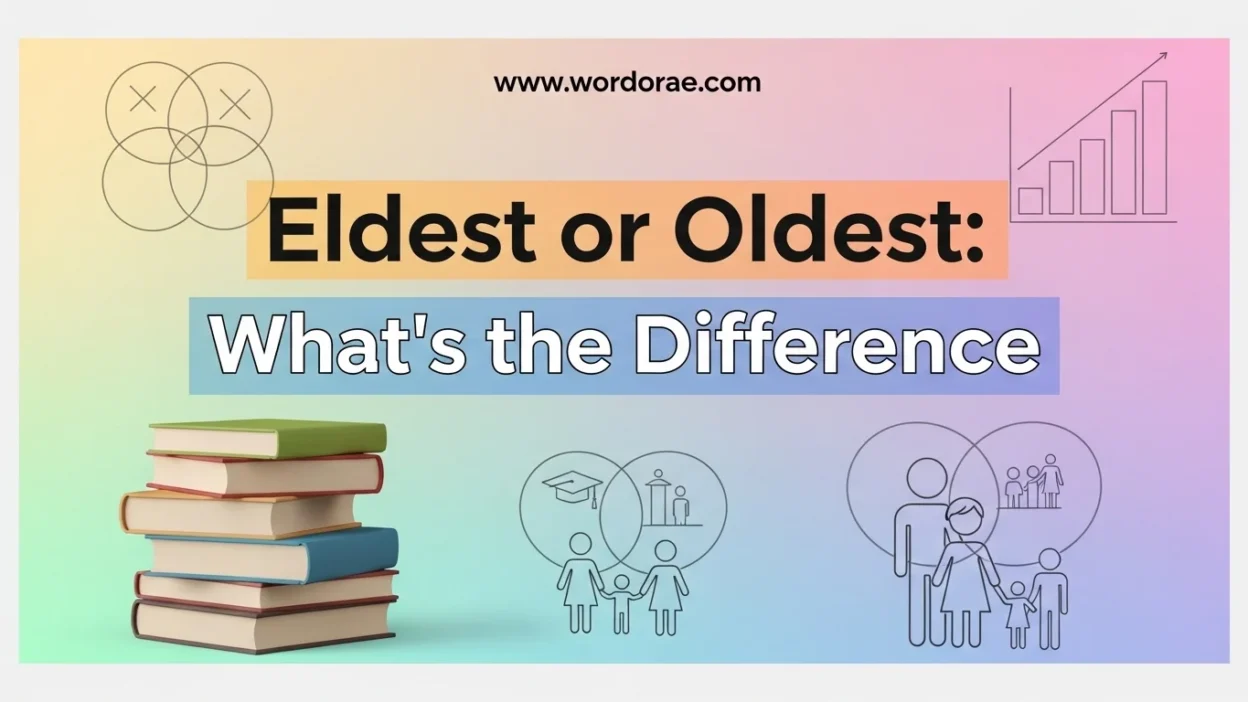
Quick answer: Use “eldest” for family birth order, and use “oldest” for general age comparisons involving people, animals, or things.
Have you ever paused while writing and wondered, Is it my eldest sister or my oldest sister? I have.
And if you care about writing clearly, If it’s for school, business, blogging, or SEO that small hesitation matters.
People search for “eldest or oldest” because both words look correct. Both relate to age. Both are superlatives of “old.”
But they don’t work the same way in every context. And if you want your writing to sound natural, accurate, and professional, you need to understand the difference.
Let’s break it down clearly, simply, and with authority.
Eldest or Oldest – Quick Answer
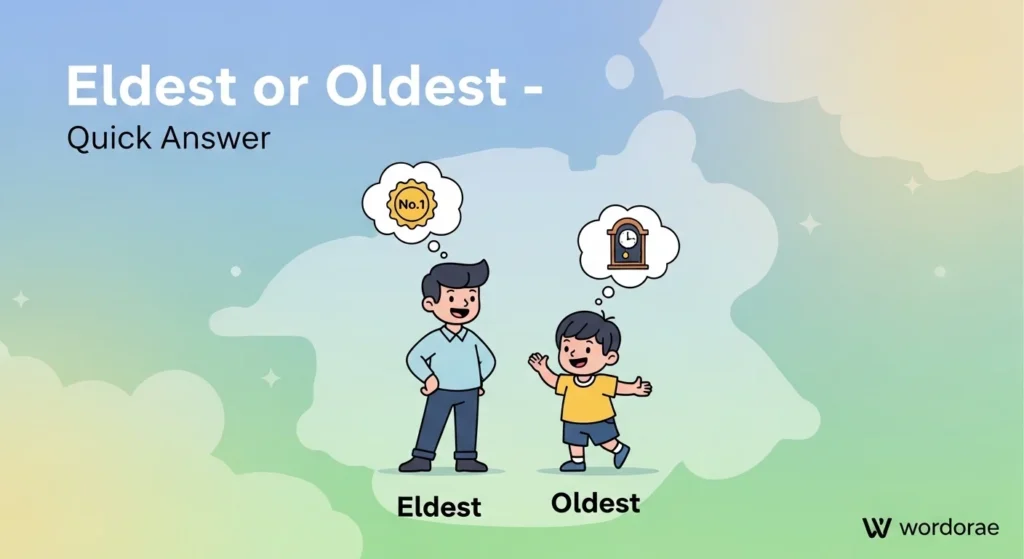
Both words are grammatically correct. The difference lies in context.
- Eldest → Used mainly for birth order within a family
- Oldest → Used for general age comparisons (people, animals, objects, places)
Examples
- She is my eldest daughter. ✔
- He is the oldest man in the village. ✔
- This is the oldest building in the city. ✔
- This is the eldest building. ✘
Simple rule:
Family hierarchy = eldest.
Everything else = oldest.
Definition Box: Eldest vs Oldest
Eldest
The first-born or earliest-born child in a family.
Oldest
Having lived the longest; highest in age among people, animals, or things.
Key distinction:
Eldest expresses family hierarchy.
Oldest expresses age ranking.
This distinction is semantic, not just stylistic.
The Origin of Eldest and Oldest
Both words come from Old English.
- Elder / Eldest developed from ieldra and ieldest.
- Older / Oldest evolved later as regular comparative and superlative forms of “old.”
In early English, “elder” and “eldest” were widely used. Over time, English simplified its comparative system. “Older” and “oldest” became dominant because they work in more grammatical positions.
Writers like William Shakespeare frequently used “elder” and “eldest” in historical and family contexts. But modern English has shifted toward “older” and “oldest” for flexibility.
Language naturally simplifies over centuries. This is one example of that evolution.
The Linguistic Rule Behind Eldest and Oldest
Now let’s go deeper.
1️⃣ Attributive vs Predicative Use
In grammar, adjectives can appear in two main positions:
- Attributive (before a noun)
- Predicative (after a linking verb like “is”)
“Eldest” is usually restricted to an attributive position.
✔ My eldest brother
✔ Their eldest child
“Oldest” works in both positions.
✔ My oldest sister
✔ She is the oldest
While you can say “He was the eldest,” it sounds formal or slightly archaic. In modern English, “He was the oldest” sounds more natural.
This syntactic flexibility explains why “oldest” dominates contemporary usage.
2️⃣ Semantic Restriction
There is also a meaning difference.
- Oldest is an absolute superlative it ranks by measurable age.
- Eldest is a hierarchical superlative it ranks by family position.
That is why:
- A company cannot have an “eldest branch.”
- A tree cannot be the “eldest tree.”
- A royal family may refer to an “eldest heir.”
“Eldest” implies relationship within a structured family unit.
This is not just preference. It is a semantic limitation.
British English vs American English Usage
There is no spelling difference. The difference is frequency and tone.
| Context | British English | American English |
| Family birth order | Eldest common (formal) | Oldest common |
| Casual speech | Oldest | Oldest |
| Historical writing | Eldest preferred | Both accepted |
| Objects & institutions | Oldest | Oldest |
In modern American English, “oldest sister” is more common than “eldest sister.”
In British English, “eldest son” still appears frequently in formal or legal contexts.
Major dictionaries like the Oxford English Dictionary recognize both forms as correct, with usage depending on context rather than region alone.
Modern Usage Trends (Data Insight)
Corpus-based language studies show clear patterns:
- “Oldest” appears far more frequently in modern English overall.
- In American English corpora, “oldest sister” now appears more often than “eldest sister.”
- “Eldest son” remains common in legal, historical, and aristocratic writing.
This reflects a broader trend: English favors flexible forms over restricted ones.
“Oldest” works everywhere.
“Eldest” works in specific relational contexts.
That flexibility explains the frequency difference.
Elder vs Older: A Related Distinction
This confusion often overlaps with elder vs older.
Here’s the rule:
- Use older for comparisons.
✔ She is older than me. - Use elder mainly before nouns in family contexts.
✔ My elder sister
Incorrect:
✘ She is elder than me.
That construction is considered outdated in modern English.
This pattern mirrors the eldest vs oldest distinction:
Elder/eldest → restricted usage
Older/oldest → flexible usage
Which One Should You Use?
Here’s the practical advice.
Use “eldest” when:
- Writing formally
- Describing family hierarchy
- Referring to inheritance or lineage
- Writing historical or legal content
Example:
- The estate passed to his eldest son.
Use “oldest” when:
- Speaking casually
- Writing for a broad audience
- Comparing age generally
- Referring to objects or institutions
Example:
- This is the oldest university in the country.
If you’re writing SEO content for a global audience, “oldest” is usually safer unless you’re specifically emphasizing birth order.
Consistency matters more than tradition.
Common Mistakes with Eldest or Oldest
❌ Using “Eldest” for Objects
Incorrect: The eldest building in town
Correct: The oldest building in town
❌ Using “Elder” in Comparisons
Incorrect: She is elder than me
Correct: She is older than me
❌ Assuming “Eldest” Is More Correct
It is not more correct. It is simply more specific.
❌ Mixing Both Randomly
Don’t shift between forms without reason. Choose based on context.
Eldest or Oldest in Everyday Examples
In Emails
- I am the oldest member of the team.
- She is the CEO’s eldest daughter.
In News Writing
- The country’s oldest museum reopened.
- The throne passed to the king’s eldest son.
On Social Media
- My oldest just turned 18!
- As the eldest sibling, I had all the responsibility.
In Academic Writing
- The dynasty continued through the eldest heir.
- This civilization is one of the oldest in history.
Notice the pattern?
Family structure = eldest.
Everything else = oldest.
Side-by-Side Comparison Table
| Feature | Eldest | Oldest |
| Refers to family birth order | Yes | Yes (modern usage) |
| Used for objects | No | Yes |
| Used for animals | No | Yes |
| Attributive position | Common | Common |
| Predicative position | Limited | Fully natural |
| Formal tone | More traditional | Neutral |
Quick Decision Guide
| Situation | Best Choice |
| First-born child | Eldest |
| Oldest employee | Oldest |
| Historical inheritance | Eldest |
| Oldest tree | Oldest |
| Casual speech about siblings | Oldest |
FAQs About Eldest or Oldest
Is “oldest sister” wrong?
No. It is completely correct, especially in American English.
Is “eldest” outdated?
No. It is still used, but mainly in formal or traditional contexts.
Can animals be “eldest”?
No. Use “oldest.”
Can I say “He is the eldest”?
Yes, but it sounds formal. “He is the oldest” sounds more natural.
Is one more formal?
Yes. “Eldest” sounds slightly more traditional.
Why is “oldest” more common today?
Because it works in more grammatical positions.
Do legal documents prefer “eldest”?
Often yes, especially when referring to inheritance.
Should I worry about this in everyday writing?
Not much. Use the rule and stay consistent.
Conclusion
Now you understand the difference between eldest or oldest at a deeper level.
If you’re describing the birth order within a family and want a formal tone, choose the eldest. If you’re talking about age in general, If it’s a person, building, animal, or institution choose oldest.
I always remind writers: clarity wins. You don’t need to sound archaic to sound intelligent. You need to sound precise.
When you understand not just the rule, but the linguistic reason behind it syntax, semantic restriction, usage frequency you write with authority.
And now, when you choose between eldest and oldest, you won’t hesitate. You’ll choose deliberately.
That’s the difference between guessing and mastering English.

I’m Jane Austen, a writer at Wordorae.com, where I focus on explaining grammar mistakes and confusing English words in a clear, simple way.
I help readers improve their writing by making tricky language rules easy to understand and use.