Quick answer:
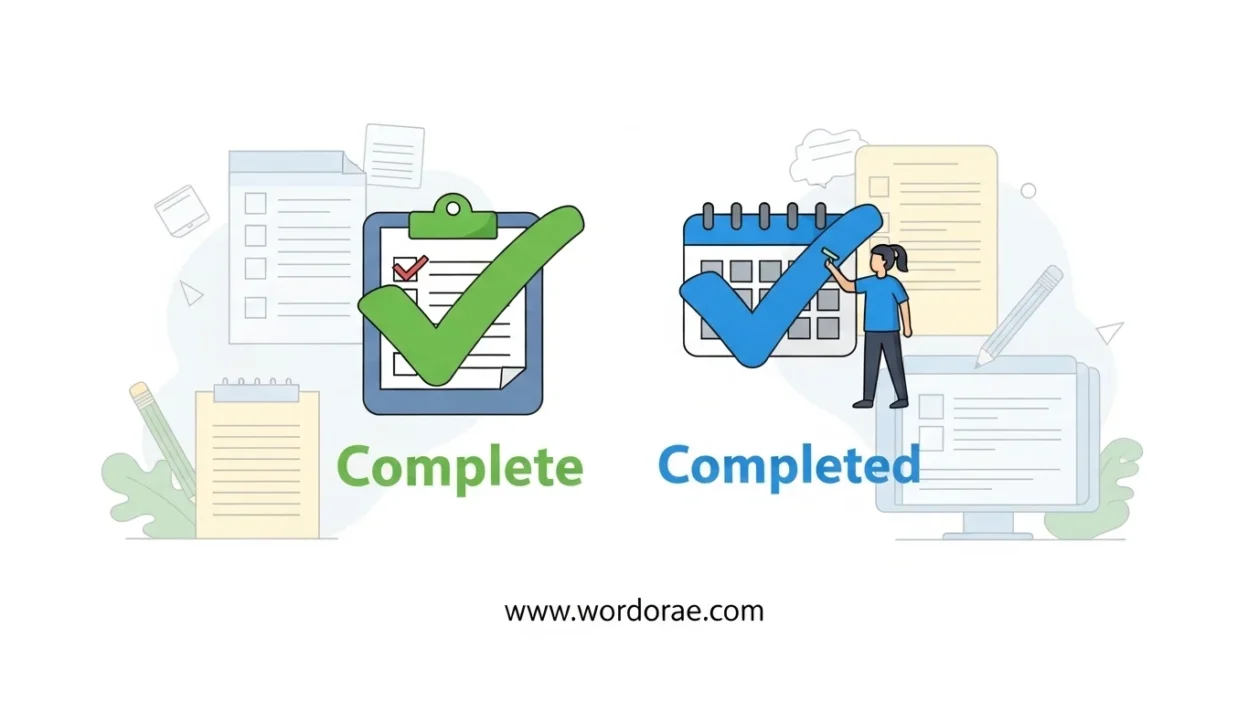
Complete describes something that is whole or finished, while completed is the past tense verb showing that an action has been finished.
I know why you’re here. You’ve probably seen sentences like “I will complete the project” or “The project is completed” and wondered which one is correct.
You’re not alone. Many people get confused between complete or completed because they sound similar and both relate to finishing something.
I’ve faced the same confusion when writing emails, essays, or reports. Using the wrong form can make your sentence sound awkward or even change the meaning.
This guide will make it simple. I’ll show you the difference, give you real-life examples, explain common mistakes, and include tables so you can see everything at a glance.
By the end, you’ll know exactly which word to use in every situation.
Complete or Completed – Quick Answer
- Complete is an adjective meaning “whole” or “finished.”
- Completed is the past tense of the verb “complete,” showing an action that has finished.
Examples:
- The assignment is complete. ✅
- I completed the assignment yesterday. ✅
The Meaning of Complete
Complete describes something that is whole, not missing parts, or ready.
As an adjective:
- The puzzle is complete.
- She gave a complete answer.
Other uses:
- Complete set
- Complete information
- Complete success
Key point: Complete talks about the state of something.
The Meaning of Completed
Completed is the past tense and past participle form of the verb complete.
As a verb:
- I completed my homework last night.
- The construction team completed the bridge.
Other uses:
- Completed tasks
- Completed projects
- Completed forms
Key point: Completed shows an action has finished.
Why People Confuse Complete and Completed
The confusion often happens because both relate to “finished” ideas.
- Complete = state
- Completed = action
Tip: If you’re describing the thing itself, use complete. If you’re describing the act of finishing it, use completed.
Complete vs Completed Comparison
| Word | Part of Speech | Meaning | Example |
| Complete | Adjective | Whole, finished state | The report is complete. |
| Completed | Verb (past) | Action finished | I completed the report yesterday. |
Which One Should You Use?
Use Complete when:
- Describing a finished state
- Talking about wholeness or totality
Use Completed when:
- Talking about the action of finishing
- Reporting that something was done in the past
Quick trick:
- Complete = adjective describing a noun
- Completed = verb describing an action
Common Mistakes with Complete / Completed
Mistake 1: Using complete as a verb incorrectly
❌ I complete the project yesterday.
✅ I completed the project yesterday.
Mistake 2: Using completed as an adjective when complete is correct
❌ The puzzle is completed. (technically fine but “complete” is simpler and more natural)
✅ The puzzle is complete.
Mistake 3: Overusing completed in informal writing
- Shorter, simpler phrasing with complete is often preferred.
Complete or Completed in Everyday Examples
In emails:
- Please ensure the form is complete before submitting.
- I completed the tasks assigned to me.
In school:
- Your homework is complete.
- I completed the assignment last night.
In work reports:
- The project is complete.
- We completed the first phase successfully.
In instructions/forms:
- Make sure all fields are complete.
- Completed forms should be sent to HR.
Usage Comparison
| Situation | Correct Choice | Notes |
| Describing a state | Complete | Adjective describing noun |
| Describing an action | Completed | Past tense verb |
| Formal report | Complete | Cleaner and precise |
| Casual conversation | Completed | Often used to show task finished |
| Forms / applications | Complete | Refers to all necessary info filled |
Why Understanding This Matters
Using the wrong form can make writing awkward or unclear. Correct use of complete or completed:
- Improves readability
- Shows professionalism in emails, essays, and reports
- Helps you write with confidence
FAQs
- Can I say “The project is completed”?
Yes, but “complete” is simpler and often preferred. - Is “complete” a verb?
No, it’s an adjective. The verb form is complete, past tense completed. - Can I say “I complete the homework yesterday”?
No. Use completed for past actions. - Is “completed” ever used as an adjective?
Yes, but usually in formal or technical contexts. - Which is more common in reports?
“Complete” is often used for status updates; “completed” for actions done. - Can “complete” be used with forms?
Yes, e.g., Make sure the form is complete. - Does “completed” imply effort?
Yes, it emphasizes that someone performed the action. - Can I use “complete” in casual conversation?
Yes, when describing a finished state: My lunch is complete. - Is “complete” always positive?
Mostly, yes. It implies wholeness or readiness. - Can “completed” refer to ongoing tasks?
No, it always refers to tasks that are finished.
Conclusion
I know complete or completed can be confusing at first, but the difference is simple:
complete describes the state of something, while completed emphasizes the action of finishing it.
Once you remember this, your writing will feel much clearer and more professional.
I want you to pause and think about your sentences. Are you describing a thing that is whole and ready? Use complete.
Are you talking about finishing a task or action? Use completed. This small distinction makes a big difference in clarity and tone.
Even in emails, reports, or casual writing, choosing the right word shows confidence and precision.
By practicing these examples and keeping the rule in mind, you’ll never second-guess yourself again.
Writing with complete and completed correctly will make your sentences stronger, easier to understand, and more polished every time.

I’m Jane Austen, a writer at Wordorae.com, where I focus on explaining grammar mistakes and confusing English words in a clear, simple way.
I help readers improve their writing by making tricky language rules easy to understand and use.