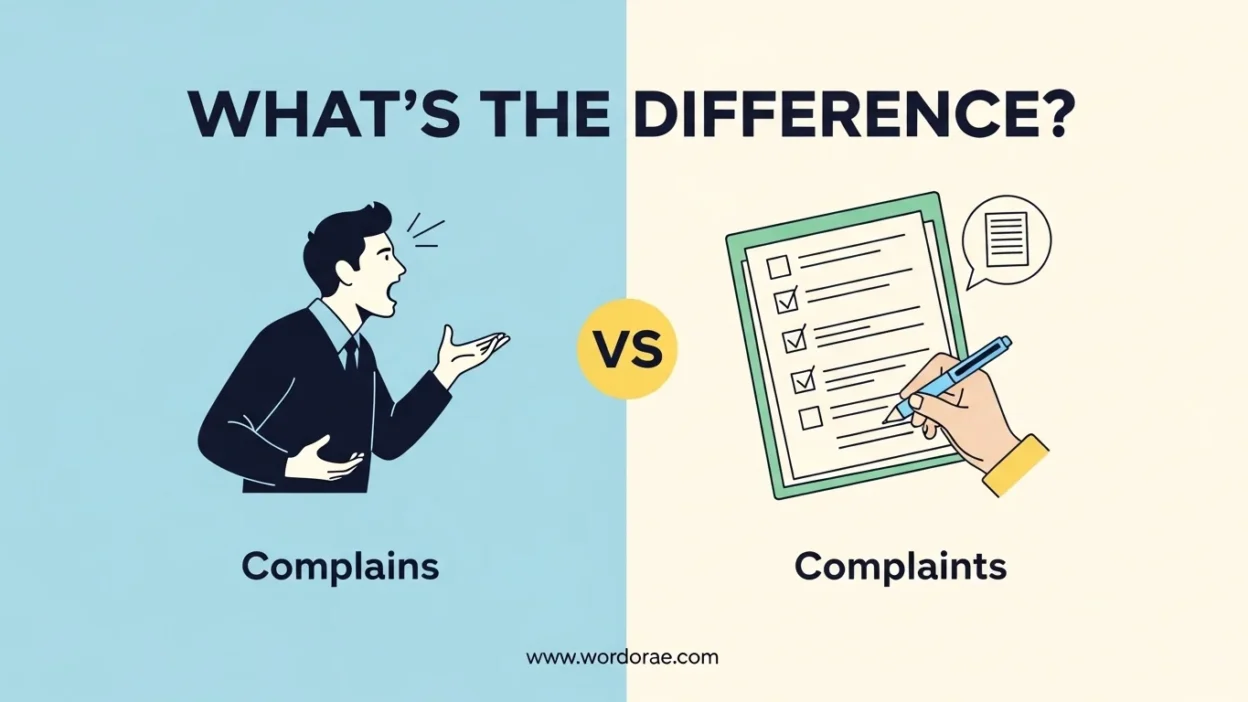
Have you ever paused while writing and wondered “is it complains or complaints?” You’re not alone. Many people search phrases like complains or complaints meaning, do we say complains or complaints, or complains or complaints difference because the words look almost the same but behave differently in sentences.
I’ve seen this confusion many times in emails, school writing, and even professional documents. For example, someone might write “I have no complains” instead of “I have no complaints.” That small mistake can make your writing look less polished.
Understanding the difference between complains or complaints is actually simple once you know the grammar rule. One word describes an action, and the other describes a problem someone reports.
In this guide, I’ll explain the complains or complaints meaning, show you 10 clear differences with examples, and help you use each word correctly in real sentences.
Table of Contents
- Complains or Complaints – Quick Answer
- Meaning of Complains
- Meaning of Complaints
- Complains vs Complaints Explained
- 10 Differences Between Complains and Complaints
- Common Mistakes With Complains or Complaints
- Complains or Complaints in Everyday Examples
- Comparison Tables
- FAQs
- Conclusion
Complains or Complaints – Quick Answer
The difference between complains or complaints comes down to grammar.
- Complains → verb (an action someone does)
- Complaints → noun (a problem someone reports)
Example:
He complains about the noise every night.
She filed several complaints with the manager.
So if someone asks “is it complains or complaints?”, the answer depends on whether you are describing an action or a thing.
Meaning of Complains
Complains is a verb, meaning someone expresses dissatisfaction or annoyance.
Example:
He complains whenever the food is late.
The verb comes from complain, and complains is the third-person singular form used with subjects like he, she, or it.
Example sentences:
She complains about the weather every winter.
The customer complains when service is slow.
When people search complains or complaints meaning, they usually want to know how verbs and nouns differ.
Meaning of Complaints
Complaints is a plural noun. It refers to statements about problems or dissatisfaction.
Example:
The company received many complaints about delayed shipping.
Another example:
I have no complaints about the service.
This is why phrases like “no complains or complaints” confuse writers. The correct phrase is:
✔ I have no complaints.
Complains vs Complaints Explained
Understanding complains or complaints difference becomes easier when you remember this simple rule.
Complains = action
Complaints = problem report
Examples:
The customer complains about the noise.
The customer filed three complaints.
People often search do we say complains or complaints, but the correct word depends entirely on the sentence structure.
10 Differences Between Complains and Complaints
1 Meaning
Complains = action of expressing dissatisfaction.
Complaints = statements about problems.
Example:
He complains about the service.
The manager received several complaints.
2 Grammar Type
Complains → verb
Complaints → noun
Example:
She complains too much.
Her complaints are constant.
3 Sentence Role
Complains describes an action.
Complaints describes a thing.
Example:
He complains daily.
The office received many complaints.
4 Singular vs Plural
Complains refers to a single action.
Complaints refers to multiple issues.
Example:
He complains every morning.
There were several complaints.
5 Formal Use
Complaints is common in formal writing like reports.
Example:
The company documented customer complaints.
6 Verb Conjugation
Complains changes depending on the subject.
Example:
I complain
He complains
7 Everyday Expressions
People often say:
“I have no complaints.”
Not:
“I have no complains.”
8 Customer Service Context
Businesses track complaints, not complains.
Example:
Customer complaints increased last month.
9 Sentence Construction
Incorrect:
She complaints about everything.
Correct:
She complains about everything.
10 Writing Clarity
Using the wrong word can make a sentence confusing.
Example:
Incorrect:
I have many complains.
Correct:
I have many complaints.
Common Mistakes With Complains or Complaints
Here are common mistakes people make when writing complains or complaints in a sentence.
Incorrect:
I have no complains.
Correct:
I have no complaints.
Incorrect:
She complaints about everything.
Correct:
She complains about everything.
The easiest trick is remembering:
Complains = action
Complaints = problem
Everyday Examples
Here are simple real-life examples.
The customer complains about slow delivery.
Workplace
The HR department reviews employee complaints.
Customer service
The client complains about billing errors.
Casual conversation
Honestly, I have no complaints about the trip.
Comparison Table: Complains vs Complaints
| Feature | Complains | Complaints |
| Grammar type | Verb | Noun |
| Meaning | Express dissatisfaction | Reported problem |
| Usage | Action in sentence | Object in sentence |
| Example | He complains often | They filed complaints |
Comparison Table: Sentence Examples
| Sentence Type | Correct Example |
| Verb usage | She complains about noise |
| Noun usage | There are many complaints |
| Common phrase | I have no complaints |
| Business use | The company reviews complaints |
FAQs
Is it complains or complaints?
It depends on grammar. Complains is a verb, while complaints is a noun.
What is the meaning of complains or complaints?
Complains means expressing dissatisfaction. Complaints are statements about problems.
Do we say complains or complaints?
Both are correct depending on sentence structure.
Example:
He complains often.
There are many complaints.
Is “I have no complains” correct?
No. The correct sentence is:
I have no complaints.
How do you use complains in a sentence?
Example:
She complains about traffic every morning.
How do you use complaints in a sentence?
Example:
The company received several complaints.
What is the difference between complains or complaints?
The difference is grammatical:
Complains = verb
Complaints = noun
Conclusion
Understanding complains or complaints becomes simple when you remember one key rule. Complains is a verb that describes an action, while complaints is a noun referring to problems or dissatisfaction reported by someone.
I always recommend checking your sentence structure when choosing between the two. If you are describing what someone does, the correct word is complains. If you are talking about reported issues or problems, then complaints is the right choice.
Once you practice this rule, you’ll confidently use complains or complaints in emails, conversations, and professional writing without confusion.

I’m Sophia Larkins, a grammar-focused writer at Wordorae.com, where I break down common grammar mistakes and confusing words.
I specialize in clear, practical explanations that help readers write with confidence and accuracy.