Quick answer:
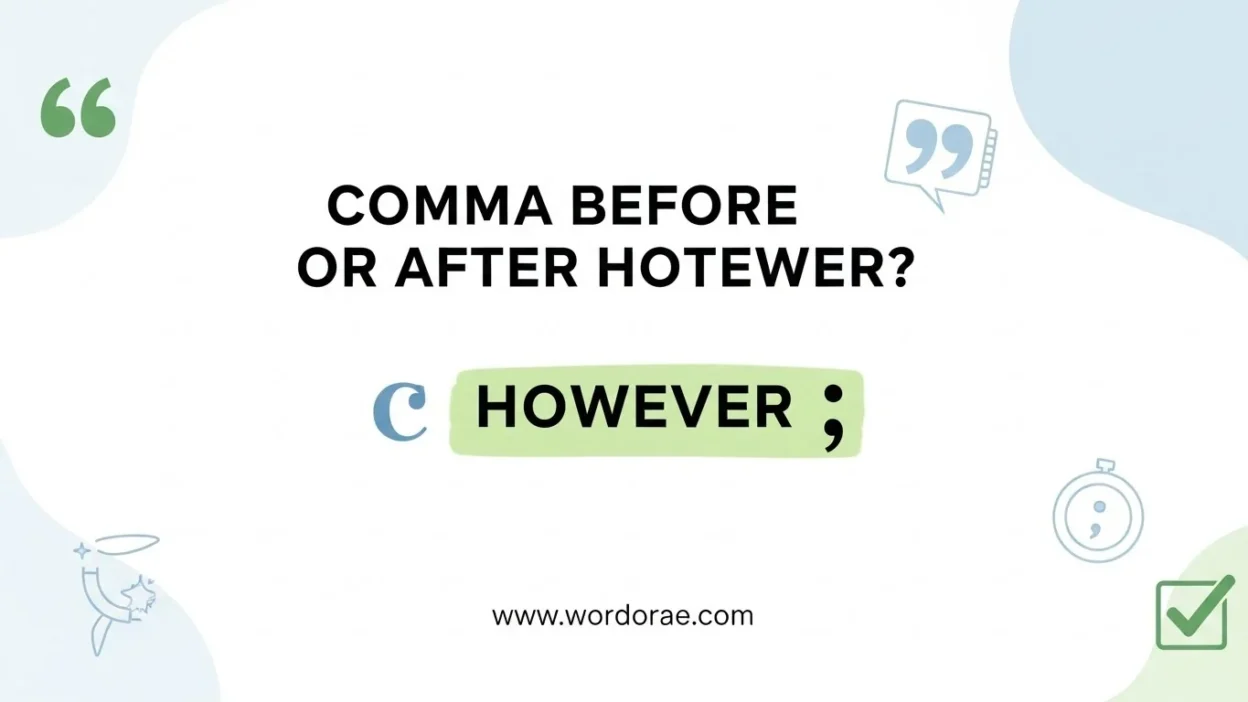
Most of the time, you use a comma after “however.” When “however” links two full sentences, you place a semicolon before it and a comma after it.
Many writers search comma before or after however because this word causes hesitation even for confident English users.
You see “however” everywhere emails, essays, news articles yet it’s one of the most mispunctuated transition words.
The confusion comes from the fact that it changes its role depending on how it’s used. Sometimes it introduces a contrast.
Other times, it connects two complete thoughts. In certain cases, it doesn’t need any punctuation at all. Because of this flexibility, people often apply the wrong rule.
This article clears up the confusion in plain English. You’ll get a quick answer, clear rules, real examples, and practical guidance you can trust whether you’re writing casually or professionally.
Comma Before or After However – Quick Answer
✔ Comma after “however” → most common
✔ Semicolon before + comma after “however” → when joining two sentences
✘ Comma before “however” only → usually incorrect
Examples:
- However, I disagree with that point.
- I wanted to help; however, I was busy.
The Origin of “However”
The word however comes from Middle English and originally meant “in whatever way” or “to whatever degree.” Over time, its meaning expanded to show contrast between ideas.
Because however evolved as an adverb, not a conjunction, it never followed the same punctuation rules as words like and or but.
This historical role explains why it requires commas or semicolons instead of simple commas alone.
Understanding this background helps explain why punctuation not spelling is the real challenge with “however.”
British English vs American English Spelling
There is no spelling or punctuation difference between British and American English for “however.”
| Usage | British English | American English |
| However, at sentence start | ✅ Correct | ✅ Correct |
| Semicolon + however | ✅ Correct | ✅ Correct |
| Comma before however only | ❌ Incorrect | ❌ Incorrect |
Both follow the same grammar rules.
Which Spelling Should You Use?
There’s only one spelling: however.
- US audience: follow standard punctuation rules
- UK & Commonwealth: same rules apply
- Global readers: use the same structure for clarity
Your focus should be punctuation, not spelling. Correct punctuation improves readability and credibility for all audiences.
Common Mistakes with Comma Before or After However
❌ I wanted to help, however I was busy.
✔ I wanted to help; however, I was busy.
❌ However I disagree with your view.
✔ However, I disagree with your view.
❌ However, hard she tried, she failed.
✔ However hard she tried, she failed.
These errors often appear in professional writing and can weaken clarity.
Comma Before or After However in Everyday Examples

Emails:
- However, I’ll need more time to review this.
News writing:
- The proposal passed; however, concerns remain.
Social media:
- However, that’s just my opinion.
Formal writing:
- However, further analysis is required.
Comma Before or After However – Usage Trends
Search interest for “comma before or after however” is strong in English-speaking countries, especially among students, writers, and professionals.
Most users are looking for a fast, reliable rule rather than complex grammar theory.
Content that clearly explains punctuation with examples tends to perform better because it directly satisfies user intent and avoids overcomplication.
Comparison Table: How to Punctuate “However”
| Usage | Punctuation | Example |
| Sentence opener | Comma after | However, I agree. |
| Linking sentences | Semicolon + comma | I tried; however, I failed. |
| Meaning “no matter how” | No comma | However hard he tried |
FAQs:
Do I always need a comma after however?
Only when it’s used as a transition.
Can I start a sentence with however?
Yes. Just add a comma after it.
Is a comma before however correct?
No. Use a semicolon instead.
Does British English follow different rules?
No. The rules are the same.
Can however be used without punctuation?
Yes, when it means “no matter how.”
Is it formal or informal?
It works in both styles.
Conclusion
So, comma before or after however? In most cases, the comma goes after “however.” When the word connects two complete sentences, use a semicolon before it and a comma after it.
When “however” means no matter how, skip the commas entirely.
The key is understanding how the word functions in the sentence. Once you do, the punctuation becomes simple and consistent.
Using “however” correctly improves clarity, flow, and professionalism in small details that make a big difference in strong writing.

I’m Jane Austen, a writer at Wordorae.com, where I focus on explaining grammar mistakes and confusing English words in a clear, simple way.
I help readers improve their writing by making tricky language rules easy to understand and use.