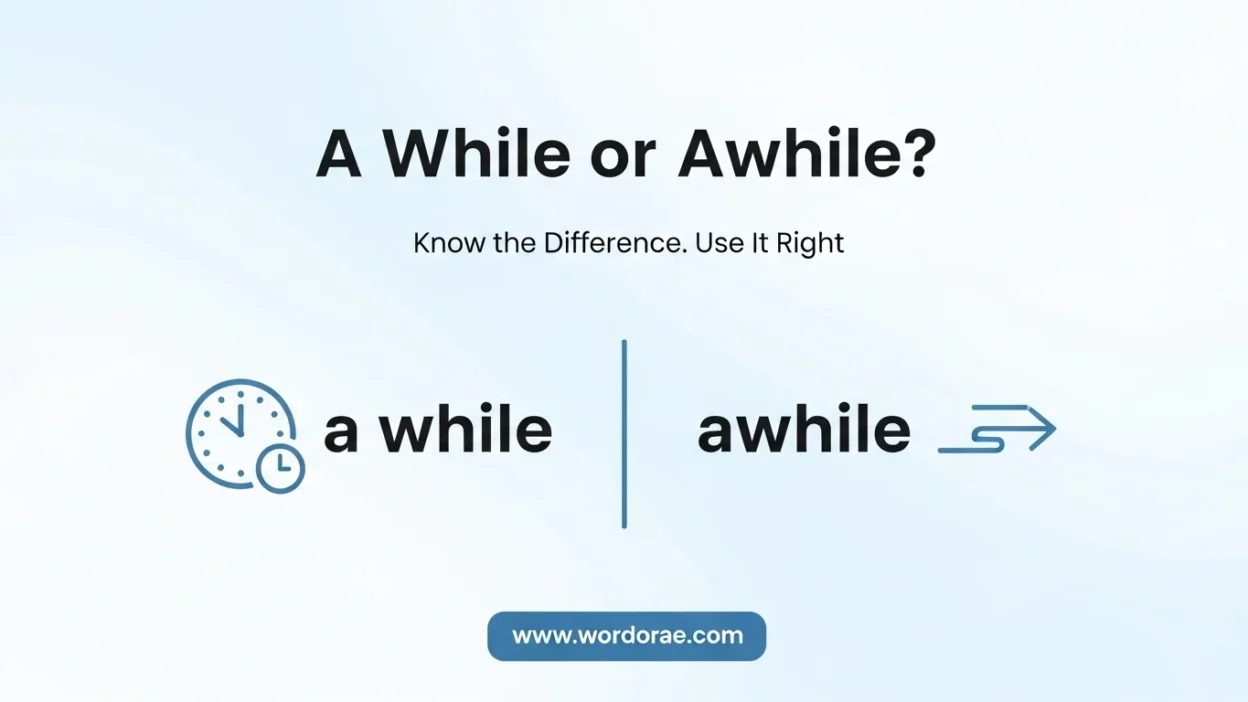
Quick answer: “Awhile” is an adverb that means “for a short time.” “A while” is a noun phrase that means “a period of time.” Both are correct, but they are not interchangeable.
I know this pair can be confusing. I’ve paused over it myself while writing emails or blog posts.
You see a while and awhile everywhere. They sound the same. They look almost the same. So it feels natural to use either one.
But English has rules that don’t always follow sound. In this case, the rule is about how the word works in the sentence, not how it sounds.
In this article, I’ll explain the difference in very simple language. I’ll show you clear examples.
And I’ll give you easy tricks so you always know which one to use. By the end, this confusion will be gone for good.
A While or Awhile – Quick Answer
- ✅ Awhile → an adverb meaning for a short time
- ✅ A while → article + noun meaning a period of time
Fast rule:
If the sentence needs the word for, use a while.
If it doesn’t, use awhile.
Why “A While” and “Awhile” Are Confusing
The main reason is pronunciation. Both sound exactly the same when spoken. English learners and native speakers hear no difference at all.
Another reason is habit. Many people type quickly and rely on instinct. Spellcheck doesn’t help because both forms are spelled correctly.
The confusion isn’t about spelling. It’s about grammar function.
The Origin of “A While” and “Awhile”
Originally, awhile came from the words a and while combined into one. Over time, English kept both forms instead of choosing one.
- Awhile stayed as a single-word adverb
- A while stayed as a noun phrase
This is common in English. Older forms often survive side by side, even when they seem unnecessary.
A While vs Awhile – Comparison Table
| Form | Part of Speech | Meaning | Example |
|---|---|---|---|
| Awhile | Adverb | For a short time | Sit awhile |
| A while | Noun phrase | A period of time | Sit for a while |
This table alone clears up most confusion.
How to Use “Awhile” Correctly
Use awhile when the verb does not need an object.
Examples:
- Let’s rest awhile.
- Stay awhile and talk.
- He paused awhile before answering.
In each sentence, awhile directly modifies the verb. No extra words are needed.
How to Use “A While” Correctly
Use a while when you are talking about time as a thing.
Examples:
- Let’s rest for a while.
- It’s been a while since we last met.
- I waited a while before replying.
Notice how for, since, or before often appear with a while. That’s a strong clue.
Common Mistakes and Corrections
❌ It’s been awhile since we talked.
✅ It’s been a while since we talked.
❌ I’ll call you in awhile.
✅ I’ll call you in a while.
Why? Because words like since and in need a noun phrase. That noun phrase is a while.
A While or Awhile in Daily Writing
Emails
- Please wait a while while I check the details.
- You can stay awhile if you’d like.
Text Messages
- Be there in a while.
- Hang around awhile.
Formal Writing
- The discussion continued for a while.
- The speaker paused awhile before continuing.
Both forms are correct when used in the right place.
Easy Tricks to Remember the Difference
The “For” Test
If you can add for naturally, use a while.
The Object Test
If the verb needs something after it, use a while.
If not, awhile usually fits.
These two tests work almost every time.
FAQs: A While or Awhile
1. Is “awhile” one word?
Yes. Always one word.
2. Is “a while” incorrect?
No. It is completely correct in many sentences.
3. Which one is used more often?
“A while” is more common in everyday writing.
4. Is “stay awhile” grammatically correct?
Yes. “Stay” does not need an object.
5. Is “in awhile” correct English?
No. It should be “in a while.”
6. Can I replace “awhile” with “for a while”?
Yes. That’s a reliable test.
7. Do native speakers confuse these?
Yes. Very often.
8. Does this mistake matter in professional writing?
Yes. It affects clarity and polish.
9. Is one form more formal than the other?
No. Both are neutral.
10. What’s the easiest rule to remember?
If you need for, use a while.
Conclusion
Both a while and awhile are correct English. The difference is how they function in a sentence.
Use awhile when you mean for a short time without an object. Use a while when you’re talking about a period of time as a thing.
Once you learn this rule, the confusion disappears. Your writing becomes smoother. And you avoid one of the most common grammar slip-ups in English.
This is a small detail, but mastering it makes your writing look confident and professional.

I’m David Miller, a grammar expert and author at Wordorae.com, specializing in clear, simple explanations of confusing English grammar and word usage.
I help readers write with confidence by turning complex grammar rules into easy, practical guidance.